Auxiliary-Loss-Free Load Balancing: MoE Routing Guide
The Problem: The Inherent Conflict in MoE Load Balancing
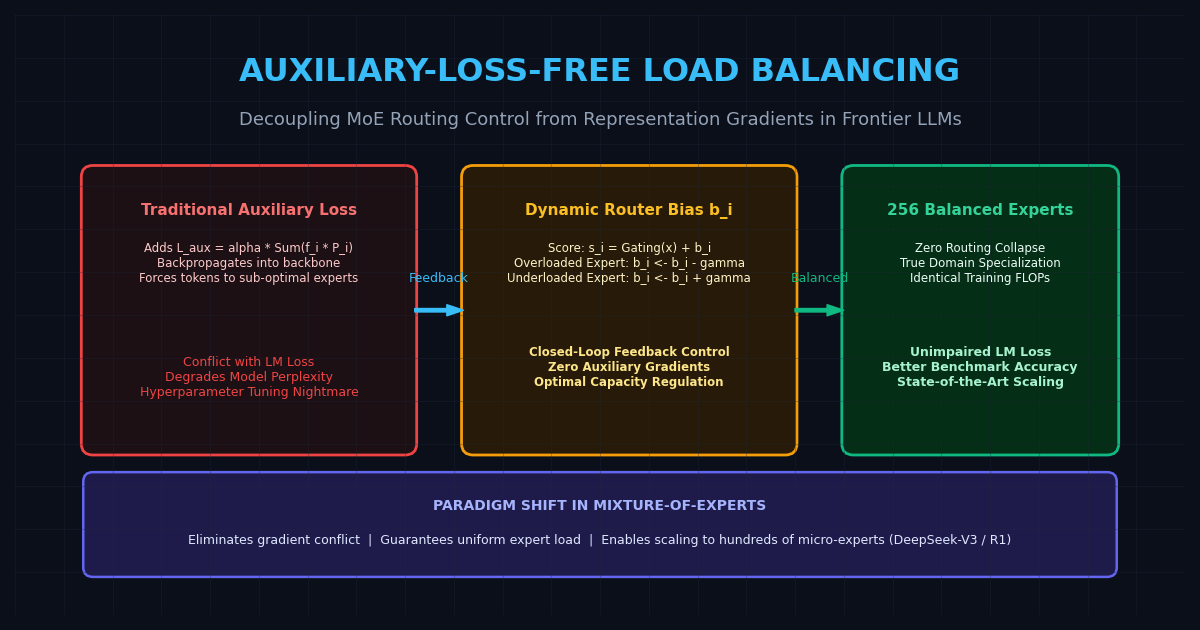
Sparse Mixture-of-Experts (MoE) architectures (such as Mixtral, DeepSeekMoE, and Grok) represent a major milestone in frontier scaling laws. By replacing monolithic Feed-Forward Networks (FFNs) with multiple specialized expert networks and dynamically activating only a small subset per token (e.g., top-2 of 8 experts, or top-8 of 256 experts), MoE models expand parameter capacity by an order of magnitude while maintaining constant computational FLOPs per forward pass.
However, training sparse MoE models has historically suffered from a persistent structural failure mode: Routing Collapse.
1. Winner-Take-All Dynamics in Sparse Gating
During early training iterations, random weight initialization causes slight variations in expert activations. A gating router computing token-to-expert affinity:
$$P_i(\mathbf{x}_t) = \text{Softmax}\left(\mathbf{u}_i^T \mathbf{x}_t\right)$$
will naturally send slightly more tokens to a handful of “popular” experts. Because these favored experts receive more frequent gradient updates, their representations improve faster, causing the router to route even more tokens to them in subsequent steps.
Without intervention, this positive feedback loop triggers complete routing collapse: 2 or 3 experts perform 95% of all computation, while the remaining experts starve and never learn meaningful representations. The model effectively degenerates into a small dense network with wasted memory.
2. The Flaw of Traditional Auxiliary Balancing Losses
To counteract collapse, pioneering systems (such as GShard and Switch Transformer) introduced an auxiliary load-balancing loss added directly to the training objective:
$$\mathcal{L}{\text{Total}} = \mathcal{L}{\text{LM}} + \alpha \cdot \mathcal{L}_{\text{aux}}$$
Where: $$\mathcal{L}{\text{aux}} = N \sum{i=1}^N f_i P_i$$
Here, $f_i$ is the actual fraction of tokens dispatched to expert $i$, $P_i$ is the average routing probability assigned to expert $i$, and $\alpha$ is a balancing hyperparameter.
While mathematically intuitive, this formulation introduces a severe gradient conflict:
- If $\alpha$ is too small: The auxiliary loss fails to overpower the primary language modeling gradients, and routing collapse still occurs.
- If $\alpha$ is too large: The router is forced to dispatch tokens to sub-optimal, irrelevant experts solely to equalize batch counts. The auxiliary gradient actively penalizes the model for choosing the most semantically qualified expert.
- Degraded Benchmark Performance: Forcing tokens into mismatched experts introduces noise into intermediate residual connections, directly degrading final language modeling perplexity, code generation accuracy, and multi-step reasoning.
The Solution: Auxiliary-Loss-Free Load Balancing
Pioneered by researchers at DeepSeek (Wang et al., 2024; DeepSeek-V3 Technical Report), Auxiliary-Loss-Free Load Balancing fundamentally resolves this dilemma by decoupling load regulation from gradient descent.
Rather than modifying the loss function and injecting artificial gradient vectors into the model backbone, the architecture introduces a dynamic, additive routing bias $b_i$ to each expert’s gating score. The bias values are adjusted via an external control loop based on real-time expert occupancy.
The Three Core Principles
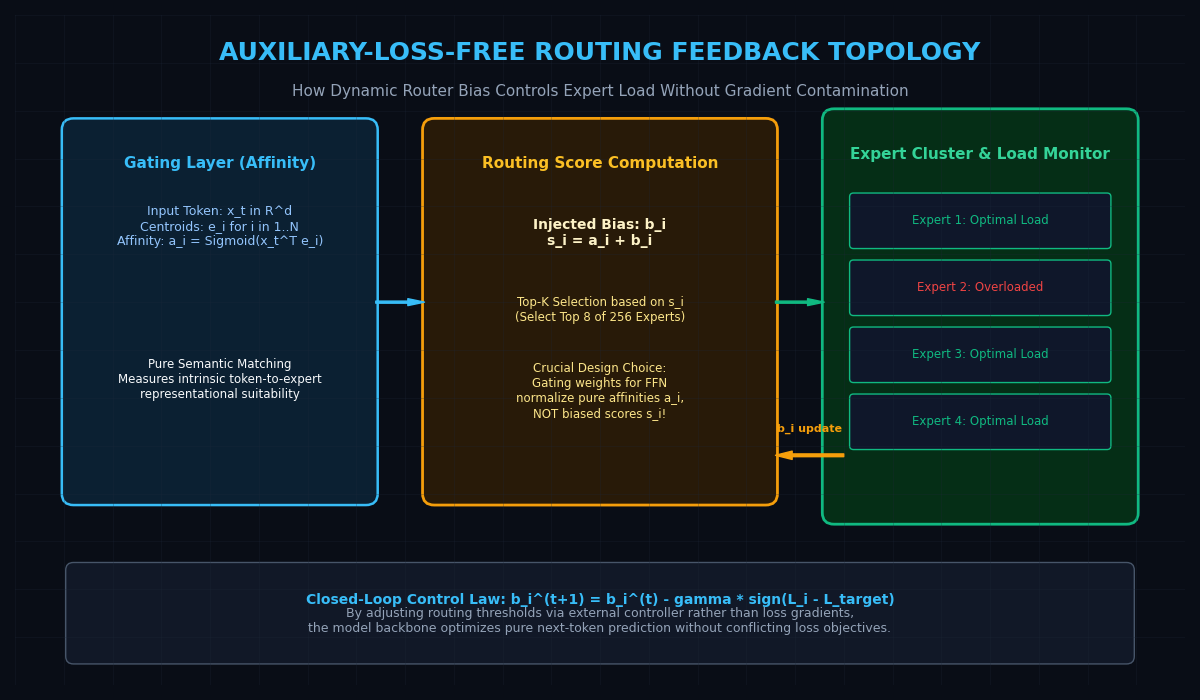
- Pure Semantic Affinity: The gating network computes unadulterated token-to-expert affinity using dot-product projection or sigmoid scoring, reflecting pure semantic relevance.
- Biased Top-$K$ Selection: The router selects the active Top-$K$ experts by ranking the biased scores ($s_i = a_i + b_i$), ensuring that underloaded experts are promoted and overloaded experts are demoted.
- Unbiased Output Weighting: When combining expert outputs, the model weights each expert using the original, unbiased affinities, guaranteeing that routing biases never distort feature magnitudes in the residual stream.
Key Architectural Mechanics
1. Dual-Score Gating Computation
For an input token representation $\mathbf{x}_t \in \mathbb{R}^d$, the router first computes intrinsic semantic affinity across all $N$ experts:
$$a_{i,t} = \text{Sigmoid}\left(\mathbf{u}_i^T \mathbf{x}_t\right)$$
Where $\mathbf{u}_i$ is the learnable centroid embedding for expert $i$. Next, the system computes the routing selection score by adding the dynamic expert bias $b_i$:
$$s_{i,t} = a_{i,t} + b_i$$
The top-$K$ experts with the highest selection scores $s_{i,t}$ are chosen to process token $\mathbf{x}_t$:
$$\mathcal{T}t = \text{TopK}\left({s{1,t}, s_{2,t}, \dots, s_{N,t}}, , K\right)$$
2. The Weight Normalization Rule
A critical design requirement of auxiliary-loss-free routing is preventing the artificial bias $b_i$ from contaminating forward activations.
The gating weights $w_{i,t}$ used to scale the outputs of selected experts $\text{FFN}_i(\mathbf{x}t)$ are computed strictly from the unbiased affinities $a{i,t}$:
$$w_{i,t} = \frac{a_{i,t}}{\sum_{j \in \mathcal{T}t} a{j,t}}, \quad \forall i \in \mathcal{T}_t$$
The final MoE layer output combines the selected experts with optional shared experts:
$$\mathbf{y}t = \sum{i \in \mathcal{T}t} w{i,t} \text{FFN}_i(\mathbf{x}t) + \sum{s \in \mathcal{S}} \text{FFN}_s(\mathbf{x}_t)$$
Because $b_i$ is excluded from the calculation of $w_{i,t}$, the dynamic bias acts strictly as an admission gatekeeper—it never corrupts the scale or gradients of the transformer representations.
3. Closed-Loop Feedback Control Law
At the end of each training iteration or micro-batch step, the serving master calculates the actual token load $L_i$ allocated to each expert across the batch:
$$L_i = \sum_{t=1}^T \mathbb{I}(i \in \mathcal{T}_t)$$
The target balanced load across $N$ experts for $T$ total tokens is:
$$\bar{L} = \frac{K \cdot T}{N}$$
The dynamic bias vector $\mathbf{b}$ is updated using a negative feedback integral control law governed by step size $\gamma$:
$$b_i^{(step+1)} = b_i^{(step)} - \gamma \cdot \text{sign}\left(L_i - \bar{L}\right)$$
- If expert $i$ received more tokens than average ($L_i > \bar{L}$), $b_i$ is decremented by $\gamma$, raising its admission threshold in the next step.
- If expert $i$ is underutilized ($L_i < \bar{L}$), $b_i$ is incremented by $\gamma$, lowering its admission threshold.
In practice, a small update rate (such as $\gamma = 0.001$) provides smooth, stable convergence, keeping all experts within 2%–3% of target capacity throughout hundreds of billions of training tokens.
MoE Balancing Strategy Comparison Matrix
| Strategy | Load Balancing Mechanism | Gradient Conflict | Hyperparameter Sensitivity | Final Model Perplexity | Scalability to 256+ Experts |
|---|---|---|---|---|---|
| Unconstrained Gating | None | None | None | Collapses to dense | Complete failure (Dead experts) |
| Auxiliary Loss (GShard/Switch) | Auxiliary penalty $\alpha \sum f_i P_i$ | Severe (Conflicts with LM) | High (Fragile $\alpha$ tuning) | Degraded by noise | Poor (Gradients fight each other) |
| Expert Dropping (Capacity Limit) | Drops excess tokens | None | High (Hard capacity factor) | Severe token information loss | Infeasible at high concurrency |
| Auxiliary-Loss-Free Dynamic Bias | Dynamic controller bias $b_i$ | Zero (No auxiliary gradients) | Zero (Self-regulating feedback) | Optimal (Pure LM optimization) | Exceptional (DeepSeek-V3 256 experts) |
Reference Implementation: PyTorch Auxiliary-Loss-Free MoE Layer
Below is a complete, educational PyTorch implementation demonstrating the dual-score gating mechanism, unbiased output normalization, and the post-step feedback controller.
import torch
import torch.nn as nn
import torch.nn.functional as F
from typing import List, Tuple

class AuxiliaryLossFreeMoERouter(nn.Module):
    """
    MoE Router utilizing Auxiliary-Loss-Free Load Balancing.
    Maintains dynamic additive bias b_i updated via a closed-loop controller.
    """
    def __init__(self, dim: int, num_experts: int = 64, top_k: int = 4, bias_lr: float = 0.001):
        super().__init__()
        self.dim = dim
        self.num_experts = num_experts
        self.top_k = top_k
        self.bias_lr = bias_lr

        # Learnable expert gating centroids
        self.gate = nn.Linear(dim, num_experts, bias=False)

        # Dynamic router bias vector b (non-trainable buffer, updated via controller)
        self.register_buffer("expert_biases", torch.zeros(num_experts))

    def forward(self, x: torch.Tensor) -> Tuple[torch.Tensor, torch.Tensor, torch.Tensor]:
        """
        Forward pass for routing:
        x: [batch_size * seq_len, dim]
        Returns:
            top_indices: [num_tokens, top_k]
            top_weights: [num_tokens, top_k]
            expert_counts: [num_experts] (for external controller tracking)
        """
        num_tokens, _ = x.shape

        # Step 1: Compute pure semantic affinities (unbiased)
        affinities = torch.sigmoid(self.gate(x)) # [num_tokens, num_experts]

        # Step 2: Compute biased routing scores for admission ranking
        routing_scores = affinities + self.expert_biases.unsqueeze(0)

        # Step 3: Select top-K experts based on biased scores
        _, top_indices = torch.topk(routing_scores, k=self.top_k, dim=-1) # [num_tokens, top_k]

        # Step 4: Extract unbiased affinities for the selected experts
        selected_affinities = torch.gather(affinities, dim=-1, index=top_indices)

        # Step 5: Normalize weights using pure affinities (preserving representation scale)
        top_weights = selected_affinities / (selected_affinities.sum(dim=-1, keepdim=True) + 1e-8)

        # Track token allocation per expert
        expert_counts = torch.bincount(top_indices.flatten(), minlength=self.num_experts)

        return top_indices, top_weights, expert_counts

    @torch.no_grad()
    def update_biases(self, expert_counts: torch.Tensor, total_tokens: int):
        """
        Closed-loop controller executed after forward-backward pass.
        Adjusts bias b_i according to deviation from expected load.
        """
        expected_load = (total_tokens * self.top_k) / self.num_experts
        load_error = expert_counts.float() - expected_load

        # Negative feedback: decrease bias if overloaded, increase if underloaded
        self.expert_biases.sub_(self.bias_lr * torch.sign(load_error))


# Demonstration: Simulated Training Step with 64 Experts
if __name__ == "__main__":
    router = AuxiliaryLossFreeMoERouter(dim=2048, num_experts=64, top_k=4, bias_lr=0.01)

    # Simulate a batch of 1,024 tokens
    dummy_tokens = torch.randn(1024, 2048)

    print("--- Initial Routing Step ---")
    indices, weights, counts = router(dummy_tokens)
    print(f"Expert 0 load: {counts[0].item()}, Expert 10 load: {counts[10].item()}")
    print(f"Load standard deviation across 64 experts: {counts.float().std():.2f}")

    # Run 50 control updates to demonstrate automatic balancing
    for step in range(50):
        _, _, step_counts = router(dummy_tokens)
        router.update_biases(step_counts, total_tokens=1024)

    _, _, final_counts = router(dummy_tokens)
    print("\n--- After 50 Closed-Loop Feedback Updates ---")
    print(f"Target load per expert: {(1024 * 4) / 64:.1f} tokens")
    print(f"Final load standard deviation: {final_counts.float().std():.2f}")
print(f"Biases min: {router.expert_biases.min():.4f}, max: {router.expert_biases.max():.4f}") Production Scaling and Serving Implications
The transition to auxiliary-loss-free routing has rewritten the scaling limits of modern open-weights architectures:
1. Scaling to 256+ Fine-Grained Experts
In coarse-grained MoE models (like Mixtral 8x7B), models deploy 8 large experts and route to 2. Auxiliary losses are barely tolerable because tuning a single scalar $\alpha$ across 8 entities is feasible.
In fine-grained architectures like DeepSeek-V3 (deploying 256 routed experts and activating 8 per token), an auxiliary loss creates chaos: the cross-entropy loss between 256 competing gradient vectors causes severe training instability. Auxiliary-loss-free routing solves this permanently, enabling models to divide tasks across hundreds of specialized micro-experts with zero training loss divergence.
2. Inference-Time Deployment Strategy
During production deployment, engineers have two operational options for the bias vector $\mathbf{b}$:
- Retain Final Training Biases: Keeping the converged biases preserves the hardware load-balancing profile across GPU tensor-parallel ranks, avoiding memory hotspots.
- Zero Out Biases for Pure Greedy Inference: Setting $\mathbf{b} = 0$ routes queries purely according to unconstrained semantic affinity $a_i$, maximizing answer precision on downstream tasks where server load balancing is unconstrained.
3. Local MoE Intelligence in aiFetchly
For software engineers and data analysts executing enterprise intelligence pipelines via AiFetchly, fine-grained MoE architectures provide unprecedented capability. When running desktop agents against local open-weight MoE checkpoints (such as DeepSeek-V3 or Gemma MoE), auxiliary-loss-free training guarantees that the underlying model preserves sharp coding, document parsing, and structured data extraction abilities—without the subtle hallucinations and domain dilution historically caused by auxiliary balancing losses.