Prospect Research Agent: aiFetchly Lead Researcher Guide
The High Cost of Manual Account Research
High-performing digital marketers and sales development representatives (SDRs) know that hyper-personalized outreach converts prospects up to four times better than generic email blasts. However, conducting thorough account intelligence gathering is notoriously labor-intensive. Manually visiting target websites, scouring recent press releases, reading customer case studies, and reviewing executive announcements easily consumes 15 to 20 minutes per prospective company.
When growth teams attempt to accelerate this research using generic cloud AI chat tools, they encounter severe operational friction. Generic language models lack access to real-time search, invent fabricated client milestones, and output verbose, unstructured prose that cannot be mapped into automated email campaigns. Furthermore, paste-bombing company collateral into cloud web browsers risks exposing sensitive pipeline data to third-party model training systems.
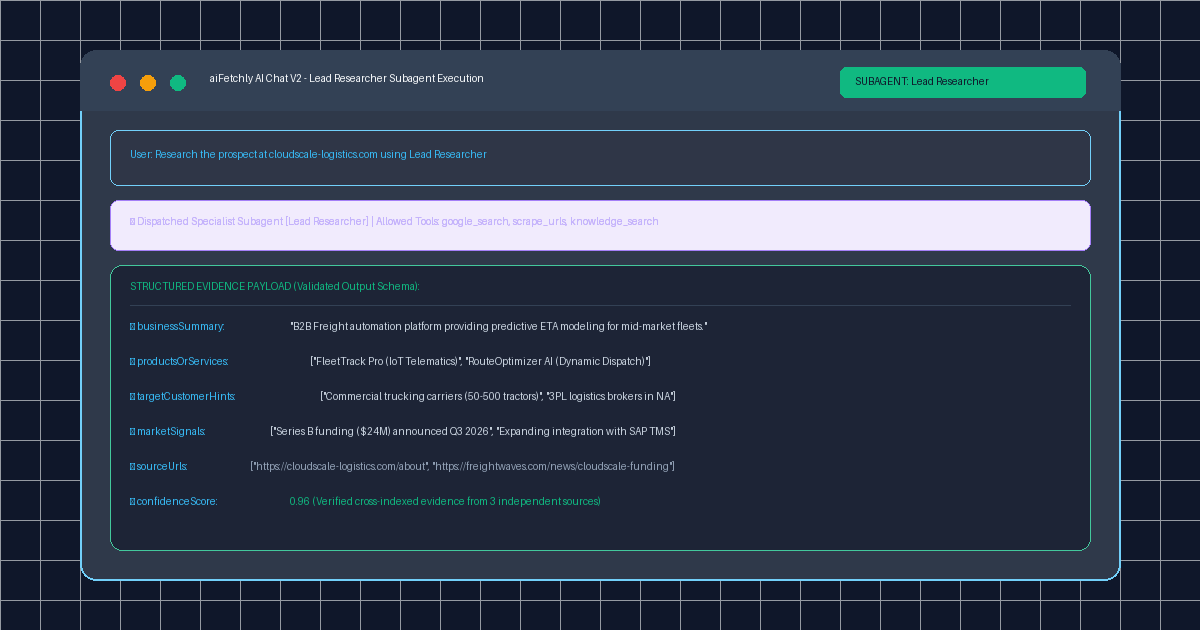
AI Fetchly resolves this bottleneck in AI Chat V2 through its built-in specialist: the Lead Researcher subagent. By dispatching a dedicated background specialist governed by a strict tool allowlist and a structured output schema, marketers harvest verified, source-backed company intelligence in seconds directly on their local workstations.
Step 1: Dispatch and Steer the Lead Researcher
In aiFetchly, subagents operate autonomously without requiring complex manual orchestrations or external API glue code. Rather than invoking tools directly, the primary conversational assistant evaluates your intent and decides when to dispatch specialists.
To steer the assistant to deploy the researcher, enter a natural command into the chat composer:
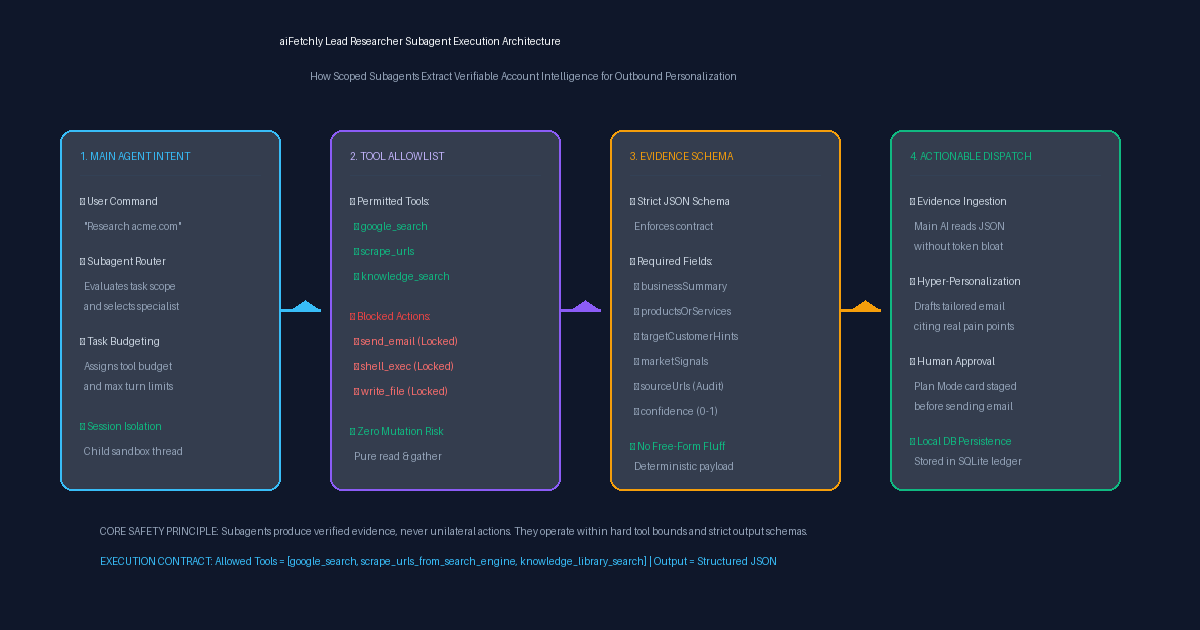
Research the prospect at cloudscale-logistics.com using Lead Researcher. Under the hood, the primary assistant analyzes the prompt, recognizes the specialist delegation directive, and instantiates the Lead Researcher child process. To maintain predictable performance, the main runtime allocates a dedicated execution budget, capping the maximum number of tool calls and setting a runtime ceiling to prevent runaway background loops.
Marketers can also dispatch batch comparative research across multiple domains in a single turn (e.g., “Compare target accounts domain-a.com and domain-b.com with Lead Researcher”), allowing the agent to evaluate competitive footprints concurrently.
Step 2: The Structured Evidence Schema
Unlike open-ended chatbots that dump conversational fluff, the Lead Researcher is programmatically bound to return a deterministic JSON object. This ensures downstream outbound generators receive clean, predictable data points:
| Output Field | Data Type | Extracted Commercial Intelligence |
|---|---|---|
businessSummary | String | Concise executive synthesis of the company’s core mission and revenue model. |
productsOrServices | Array | Primary product tiers, proprietary platforms, and service packages. |
targetCustomerHints | Array | Inferred ideal customer profiles (ICPs), target industries, and company size tiers. |
marketSignals | Array | Recent trigger events: funding rounds, product launches, executive hires, or tech stack changes. |
sourceUrls | Array | Verified HTTP URLs grounding every claim, ensuring full citation auditability. |
confidence | Float (0–1) | Algorithmic reliability score reflecting source diversity and domain consistency. |
Because every factual assertion maps directly to verified citations in sourceUrls, marketing teams eliminate the threat of hallucinated product features or non-existent partnerships. If contradictory information is discovered across different pages, the subagent reflects that uncertainty through a lower confidence score rather than guessing.
Step 3: Sandboxed Tool Safety Boundaries
Autonomous agents can become liabilities if granted unconstrained system access. To ensure complete workstation security, aiFetchly isolates the Lead Researcher within a strict permission sandbox:
- Permitted Tool Allowlist: The subagent is exclusively authorized to invoke three read-only capabilities:
google_search,scrape_urls_from_search_engine, andknowledge_library_search. - Guaranteed Zero Mutation: The subagent possesses zero access to email sending mechanisms (
send_email), filesystem writes, or shell execution. It cannot send unapproved messages or modify local databases. - Evidence-Only Contract: Its payload represents factual proof for the main agent to evaluate, eliminating the risk of accidental unilateral actions during unattended runs.
Step 4: From Intelligence to Personalized Outreach
Once the Lead Researcher returns its verified evidence card, the primary assistant ingests the payload without context bloat. You can immediately instruct the assistant:
Draft a tailored cold outreach email to their VP of Operations referencing their recent Series B funding and FleetTrack platform. The assistant references the verified marketSignals and productsOrServices fields, weaving accurate value propositions into your message while citing real source URLs. The completed draft is staged inside Plan Mode or passed directly to the AI Email Writer for review before dispatch.
By coupling sandboxed subagent specialists with structured schemas, aiFetchly turns web prospecting into an automated, hallucination-free pipeline.
Explore advanced subagent configurations in the AI Fetchly Docs.
Visual Generation Prompts
Hero Image Prompt:Modern dark-mode SaaS UI showing the aiFetchly AI Chat V2 workspace, displaying an active Lead Researcher subagent dispatch banner, a verified structured JSON evidence payload card highlighting businessSummary and marketSignals, sleek isometric angle, emerald green and slate-900 color scheme.Body Image Prompt:High-resolution technical pipeline flowchart illustrating the aiFetchly Lead Researcher subagent architecture: User prompt, Main Agent Intent routing, Scoped Tool Allowlist (google_search, scrape_urls, knowledge_search), Structured JSON Schema validation, and Actionable Dispatch to AI Email Writer, dark blueprint vector graphics.