AutoGen Architecture: Multi-Agent Conversational Systems
The Problem: The Brittle Boundaries of Text-Only and Tool-Bound Agents
In modern enterprise automation, automated web research, and complex data intelligence platforms like AiFetchly, developers require agents that do more than chat. They need systems capable of writing algorithms, analyzing mathematical formulas, interacting with databases, and downloading dynamic web content.
Historically, generative AI systems relied on Function Calling (tool use): the language model generates a structured JSON object containing tool arguments, an external runtime executes the tool, and the raw text output is injected back into the prompt.
While function calling works well for basic CRUD lookups, deploying tool-bound and text-only agents against non-trivial engineering tasks exposes three fundamental architectural bottlenecks:
1. The Dynamic Tool Synthesis Ceiling
Pre-defining every conceivable API tool beforehand is impossible:
- If a data extraction task requires calculating rolling median price variances across 50,000 scraped records, providing an explicit API for every statistical edge case bloats the model’s system prompt and saturates context.
- Text-only LLMs struggle with precise arithmetic, sorting algorithms, and statistical transformations, frequently hallucinating numbers when forced to perform mathematical reasoning purely within attention weights.
- What agents truly need is the ability to write their own tools on the fly—synthesizing custom Python or Bash scripts to process data locally.
2. The High Cost of Unchecked Execution Failures
When an agent writes code, syntax errors and runtime exceptions are inevitable:
- Missing dependencies, deprecation warnings, unexpected API schemas, and indentation mistakes cause scripts to crash.
- In traditional pipeline scripts, a single runtime error terminates the entire workflow, requiring human intervention to diagnose the traceback, modify the prompt, and restart the job from scratch.
- Without a native conversational feedback loop between the code execution environment and the code authoring model, self-correction is impossible.
3. The Security Risk of Unsandboxed Code Execution
Granting a language model permission to generate and execute arbitrary code on a production server creates a severe security attack surface:
- An unconstrained model might overwrite local environment files, exhaust host system memory, or execute destructive commands (e.g., unintended file deletions or infinite loops).
- Real-world production engineering requires isolated sandboxing (such as Docker containers or lightweight virtualization) paired with customizable human-in-the-loop permission gates.
The Solution: The AutoGen Conversable Agent Paradigm
To resolve these challenges, Microsoft Research developed AutoGen (now maintained as the open-source AG2 framework).
AutoGen re-architects multi-agent development around a single, powerful foundational abstraction: Conversable Programming. In AutoGen, every entity—whether an LLM, a human operator, or a sandboxed terminal—is represented as a ConversableAgent.
1. The Anatomy of a ConversableAgent
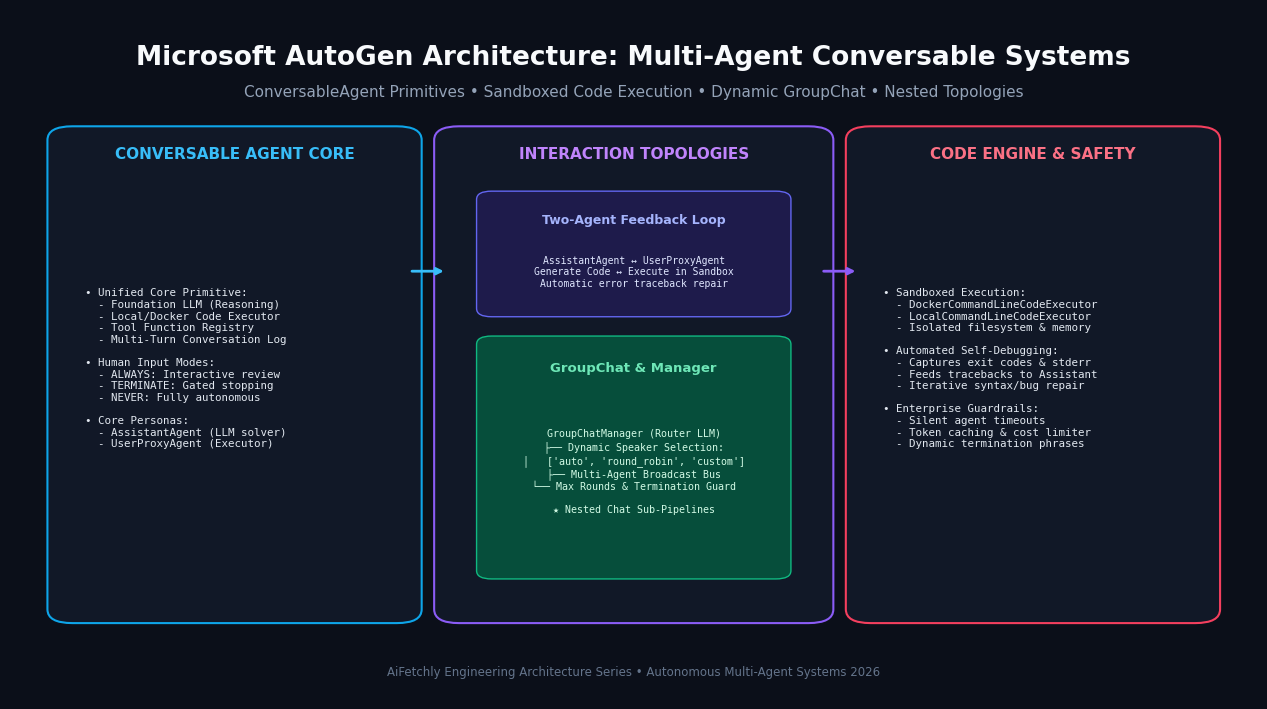
A ConversableAgent is an autonomous entity capable of sending, receiving, and processing messages with other agents. It unifies five core runtime components into a cohesive interface:
The Inference Engine (LLM Config): Configured via llm_config, specifying model endpoints (OpenAI, Anthropic, local vLLM), temperature, context windows, and caching layers.
The Code Execution Engine: An execution backend (Docker, local shell, or Jupyter kernel) that automatically extracts code blocks from incoming messages, executes them, and formats the output (stdout/stderr) into reply messages.
The Tool Registry: A repository of pre-registered Python functions that can be invoked via standard function-calling protocols.
Human-in-the-Loop Mode: A configurable interaction gate controlling when human feedback is solicited:
human_input_mode="ALWAYS": Prompts a human operator before every step.human_input_mode="TERMINATE": Runs autonomously until a termination condition is met, prompting the human only to approve the final outcome or intervene on persistent failures.human_input_mode="NEVER": Fully autonomous machine execution.
Conversational Memory Log: A structured internal history of messages exchanged with other participants, maintaining conversational context across multi-turn interactions.
2. Core Concrete Personas: AssistantAgent and UserProxyAgent
While developers can build custom agents, AutoGen provides two battle-tested personas out of the box:
AssistantAgent:
Acts as the AI cognitive worker. Typically configured with human_input_mode="NEVER" and code execution disabled. Its primary responsibility is to analyze problems, decompose tasks, write Python/Bash code blocks, propose tool invocations, and reflect on error tracebacks.
UserProxyAgent:
Acts as the operational bridge representing the human operator and the system runtime. Configured with a sandboxed code executor and capable of executing code generated by the AssistantAgent. It inspects incoming messages, extracts python code fences from incoming messages, executes the code inside Docker or a local shell, and replies with the execution results.
The Mechanics: Code Execution Sandboxing and GroupChat Topologies
The defining architectural superpower of AutoGen is how it coordinates agents across diverse interaction topologies.
1. The Autonomous Self-Correction Code Execution Loop
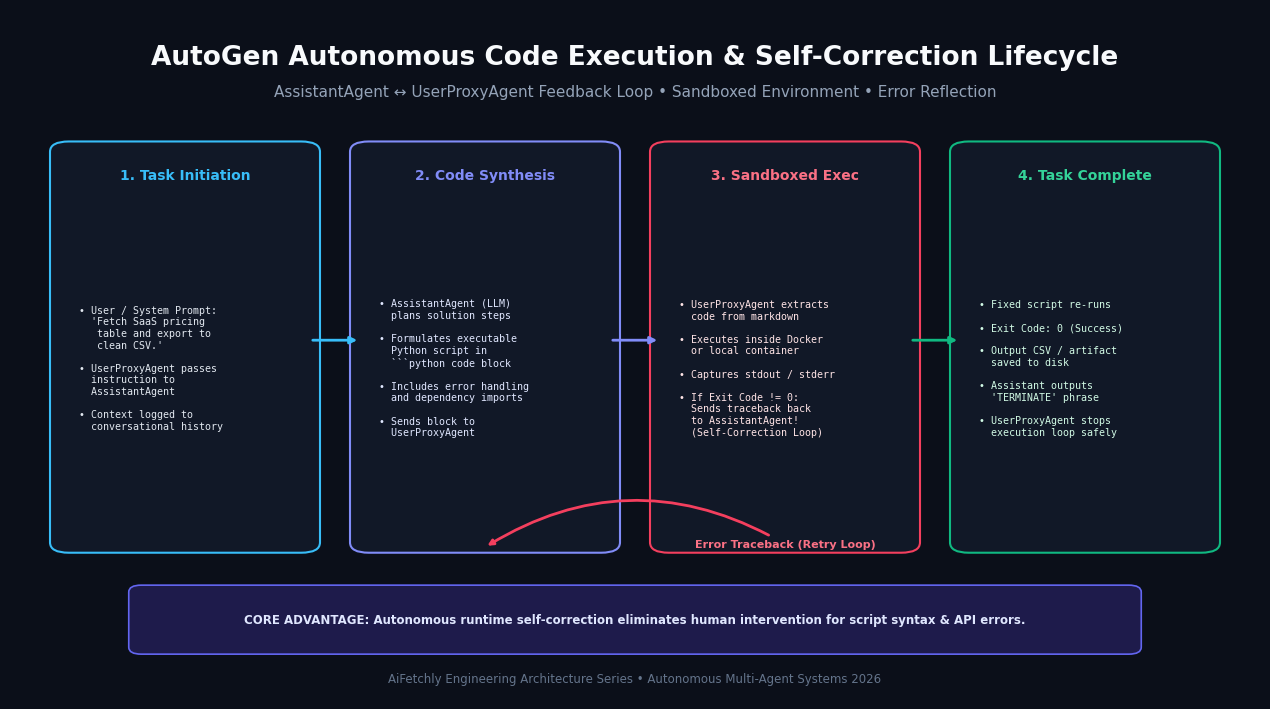
When an AssistantAgent and a UserProxyAgent engage in a two-agent dialogue, they establish an automated generate-execute-debug loop:
- Generation: The Assistant receives a user prompt and generates an executable Python script wrapped in markdown fences.
- Extraction & Sandboxing: The UserProxy parses the markdown block and dispatches the code to a secure executor (e.g.,
DockerCommandLineCodeExecutor). - Traceback Feedback: If the script encounters an error (e.g.,
KeyError: 'pricing_tier'), the UserProxy captures the stderr traceback and sends it as a new conversational message back to the Assistant. - Self-Correction: The Assistant reads the traceback, diagnoses the missing key, edits the script, and emits a corrected code block.
- Termination: Once the code runs successfully with exit code 0 and verifies the output, the Assistant emits a designated termination keyword (e.g.,
"TERMINATE"), signaling the UserProxy to halt the conversation.
2. GroupChat and Dynamic Speaker Selection
Beyond two-agent dialogues, AutoGen enables multi-agent collaboration via GroupChat governed by a GroupChatManager:
In a standard group chat, multiple specialized agents (Researcher, Coder, Validator, Admin) share a unified conversation thread. The GroupChatManager orchestrates turn-taking using configurable speaker selection policies:
auto(LLM-Driven Routing): An orchestrator LLM inspects the current conversation state and dynamically selects the most appropriate agent to speak next based on agent descriptions.round_robin: Deterministic cyclic turn-taking across all participating agents.random: Stochastic speaker selection, useful for Monte Carlo idea generation.custom(Graph Transition Constraints): Developers can provide an explicit state machine adjacency matrix specifying which agents are legally permitted to speak after a given agent.
3. Nested Chats for Modular Problem Solving
As multi-agent conversations scale, a single shared group chat risks token bloat and context contamination. AutoGen solves this via Nested Chats:
- An agent can register a nested sub-chat using
register_nested_chats(). - When the parent agent receives a message requiring complex multi-step analysis, it temporarily spawns an internal sub-chat with specialized worker agents.
- The sub-chat resolves the sub-problem in an isolated context window, summarizes the final answer, and returns only the concise deliverable back to the parent conversation.
- This keeps the parent chatroom clean, deterministic, and highly focused.
Implementation: Building an Autonomous Data Extraction & Analysis Agent
Let us implement a production-grade AutoGen system that scrapes web pricing data, processes statistical anomalies in a sandboxed Python runtime, and self-corrects code errors autonomously.
import os
from autogen import AssistantAgent, UserProxyAgent, GroupChat, GroupChatManager
from autogen.coding import DockerCommandLineCodeExecutor, LocalCommandLineCodeExecutor

# 1. Configure the LLM Inference Parameters
llm_config = {
    "config_list": [
        {
            "model": "gpt-4o",
            "api_key": os.environ.get("OPENAI_API_KEY"),
            "temperature": 0.0,
        }
    ],
    "cache_seed": 42,  # Enables deterministic caching to save API costs
    "timeout": 120,
}

# 2. Configure Sandboxed Code Execution
# In production, use DockerCommandLineCodeExecutor for strict process isolation
code_executor = LocalCommandLineCodeExecutor(
    timeout=60,
    work_dir="./sandbox_workspace"
)

# 3. Instantiate the Coder Assistant
coder_assistant = AssistantAgent(
    name="Data_Engineer",
    system_message=(
        "You are an expert data engineer and web extraction specialist. "
        "When asked to extract or process data, write complete, self-contained Python scripts. "
        "Wrap all executable code in ```python ``` blocks. "
        "Always print the final verified results to stdout. "
        "If an error occurs, inspect the traceback and provide a fixed version. "
        "Once the task is 100% verified, output 'TERMINATE'."
    ),
    llm_config=llm_config,
)

# 4. Instantiate the QA Auditor Assistant
qa_auditor = AssistantAgent(
    name="QA_Auditor",
    system_message=(
        "You are a rigorous data quality auditor. "
        "Inspect data outputs generated by the Data_Engineer. "
        "Ensure all numeric fields are valid and no anomalies exist. "
        "If quality standards pass, confirm approval. If not, state the defect clearly."
    ),
    llm_config=llm_config,
)

# 5. Instantiate the UserProxy Executor
user_proxy = UserProxyAgent(
    name="User_Proxy_Executor",
    system_message="A computer proxy that executes code generated by the Data_Engineer and reports output.",
    code_execution_config={"executor": code_executor},
    human_input_mode="NEVER",  # Fully autonomous execution
    is_termination_msg=lambda msg: "TERMINATE" in msg.get("content", ""),
    max_consecutive_auto_reply=10,
)

# 6. Assemble Multi-Agent GroupChat
group_chat = GroupChat(
    agents=[user_proxy, coder_assistant, qa_auditor],
    messages=[],
    max_round=12,
    speaker_selection_method="auto"  # LLM dynamically selects next speaker
)

manager = GroupChatManager(
    groupchat=group_chat,
    llm_config=llm_config
)

# 7. Execute the Autonomous Task
if __name__ == "__main__":
    task_prompt = (
        "Generate a mock dataset of 5 SaaS competitor pricing tiers with columns: "
        "['tier_name', 'monthly_usd', 'annual_monthly_usd', 'seat_limit']. "
        "Calculate the annual discount percentage for each tier. "
        "Save the cleaned table to './sandbox_workspace/saas_pricing.csv' and print the summary."
    )

    print("--- INITIATING AUTOGEN MULTI-AGENT EXECUTION ---")
    user_proxy.initiate_chat(
        manager,
        message=task_prompt
    )
print("--- EXECUTION COMPLETED SUCCESSFULLY ---") Architectural Comparison: Modern Multi-Agent Frameworks in 2026
To understand where AutoGen excels relative to alternative multi-agent frameworks, consider this architectural comparison:
| Architectural Dimension | Microsoft AutoGen (AG2) | CrewAI | MetaGPT | LangGraph |
|---|---|---|---|---|
| Foundational Abstraction | Conversable Agents | Role-Playing Personas | Corporate SOP Roles | Cyclical State Graphs |
| Code Execution | First-class Sandboxed Runtime | Auxiliary tool wrapper | File-based local build | Tool node invocation |
| Self-Debugging Loop | Automatic Traceback Reflection | Task retry prompts | QA Bugfix Ticket SOP | Conditional router edges |
| Interaction Topology | Dynamic GroupChat & Nested Chats | Hierarchical / Sequential | Pub-Sub Message Bus | Explicit Graph Edges |
| State Representation | Message History / Sub-Chats | Context dependency args | Structured PRD/UML docs | TypedDict Central State |
| Human-in-the-Loop | Native Modes (Always/Terminate) | Delegation approval | Human review step | Superstep Interrupts |
| Best-Fit Enterprise Use | Code writing, data science, self-repair | Business process crews | Full software repo gen | Stateful workflow infra |
While LangGraph offers low-level graph-theoretic determinism and CrewAI provides role-playing ergonomics, AutoGen remains the industry benchmark for dynamic, conversational problem-solving, automated code synthesis, and runtime self-debugging.
Production Engineering: Security, Sandboxing, and Best Practices
When deploying AutoGen systems in enterprise environments, engineering teams should adhere to four operational standards:
1. Mandatory Container Sandboxing (Docker Isolation)
Never run LocalCommandLineCodeExecutor in production environments:
- Always configure
DockerCommandLineCodeExecutorwith strict resource quotas (e.g., memory limits of 2GB, CPU quota caps, and network isolation). - Mount dedicated, ephemeral volume directories for file input and output, ensuring the executing script has zero read/write access to host operating system secrets or environment variables.
2. Caching and Cost Governance
Multi-agent group chats can consume significant API tokens if left unconstrained:
- Leverage AutoGen’s built-in
cache_seedto cache identical prompt-response pairs in Redis or local SQLite, slashing debugging costs during iterative development. - Enforce strict
max_roundboundaries onGroupChatand configuremax_consecutive_auto_replyonUserProxyAgentto guarantee that rogue conversations terminate gracefully.
3. Clear Termination Functions
Avoid ambiguous termination prompts that depend solely on loose string matching:
- Use custom callable functions for
is_termination_msg:def verify_termination(msg: dict) -> bool: content = msg.get("content", "") return "TERMINATE" in content and os.path.exists("./sandbox_workspace/output.csv") - This ensures the conversation only halts when both the conversational agreement is reached and the physical output artifact is verified on disk.
4. Nested Chats for Token Efficiency
When coordinating 5 or more agents:
- Decompose monolithic group chats into nested conversations using
register_nested_chats. - Restrict top-level chats to executive decision-makers, delegating implementation details to isolated sub-agents. This avoids the quadratic $\mathcal{O}(N^2)$ context-flooding trap while preserving modular, auditable agent design.
By combining the natural adaptability of conversational programming with the rigorous verification of sandboxed execution environments, AutoGen empowers developers to build autonomous systems that write, execute, and debug their own solutions with unprecedented reliability.