AudioLDM 2 Guide: Universal Text-to-Audio Generation
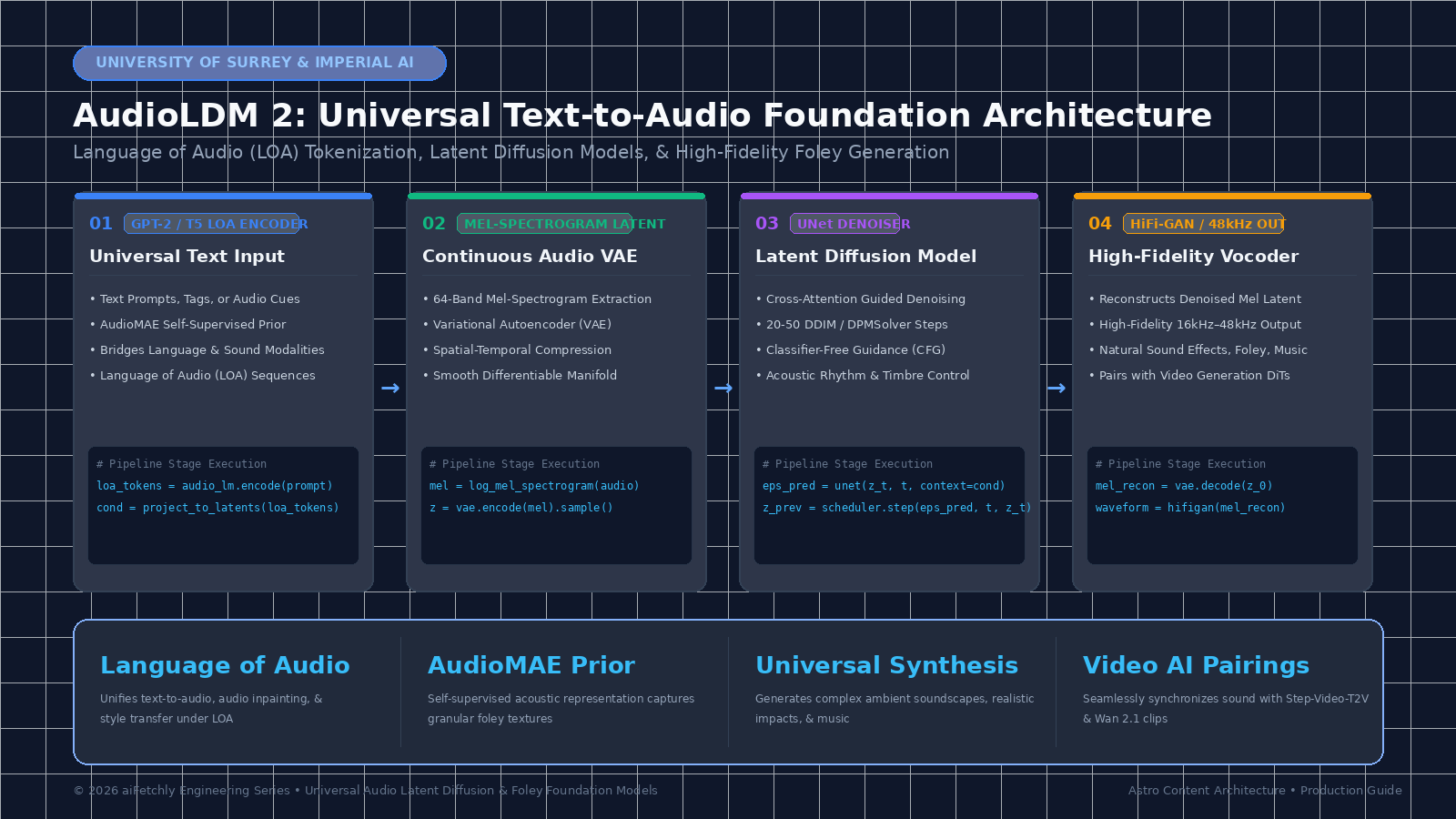
Generative artificial intelligence has demonstrated unprecedented capabilities across text, source code, and photorealistic imagery. However, sound remains one of the most acoustically intricate and structurally complex domains in generative modeling. Audio is not a static 2D grid; it is an uncompressed, continuous temporal waveform characterized by multi-scale rhythmic patterns, complex harmonic overtones, transient impact spikes, and non-stationary acoustic reverberations.
For years, generative audio research remained deeply fragmented. Text-to-Speech (TTS) models specialized strictly in human phonetics; music models focused exclusively on symbolic MIDI or periodic beats; and sound effect (SFX) models produced short, metallic noises that degraded rapidly over multi-second horizons. Video game developers, video creators, and automated media pipelines built on AiFetchly Web Scraping were forced to license thousands of static, pre-recorded Foley clips from proprietary sound libraries.
To establish a unified foundation model for all non-speech and ambient sound generation, researchers from the University of Surrey, Imperial College London, and ByteDance released AudioLDM 2 (arXiv:2305.15858).
Rather than conditioning diffusion directly on disparate text encoders, AudioLDM 2 introduces a universal semantic bridge: the Language of Audio (LOA). By translating arbitrary input modalities (natural language prompts, phoneme transcripts, or reference audio clips) into continuous self-supervised AudioMAE feature sequences and executing latent diffusion over continuous mel-spectrogram manifolds, AudioLDM 2 achieves state-of-the-art synthesis across sound effects, environmental soundscapes, Foley audio, and instrumental music.
In this technical guide, we analyze the structural challenges of text-to-audio synthesis, dissect the Language of Audio (LOA) framework, examine the continuous latent diffusion pipeline, and construct an end-to-end Python implementation for local and production sound effect generation.
The Disjointed Audio Synthesis Problem: Why Sound Generation Stalls
To appreciate the architectural significance of AudioLDM 2, we must examine why standard generative modeling paradigms fail when applied to raw auditory waveforms.
In modern generative workflows, synthetic video post-production (such as pairing audio with Step-Video-T2V or Wan 2.1), and automated digital asset harvesting via AiFetchly Data Fetching, sound synthesis requires navigating three fundamental physics bottlenecks: the dimensional data deluge, the cross-modal semantic gap, and structural fragmentation across audio sub-domains.
The Sound Generation Architecture Dilemma:
Scenario: Generating 10 Seconds of CD-Quality Audio (44.1kHz Stereo)
 │
 ├──> Approach 1: Raw Waveform Autoregressive Modeling (e.g., WaveNet, Jukebox)
 │    • Operates directly on discrete 1D PCM audio samples
 │    ❌ Astronomical Sequence Length: 10s * 44,100 samples/sec = 441,000 temporal steps!
 │    ❌ Generation Latency Collapse: Takes 15 minutes of GPU compute to emit 10 seconds of sound!
 │    ❌ Memory Exhaustion: Transformers choke on half-million token context windows.
 │
 ├──> Approach 2: Naive Cross-Attention Diffusion (e.g., Early Text-to-Audio)
 │    • Direct cross-attention between CLIP/T5 text tokens and audio spectrograms
 │    ❌ Severe Semantic Mismatch: Text descriptions ("wooden door creaks") fail to specify
 │       acoustic harmonics, room impulse response (reverb), and granular pitch contours!
 │    ❌ Uncanny Metallic Artifacts: Denoising drifts away from natural acoustic distributions.
 │
 └──> Approach 3: AudioLDM 2 (Language of Audio + Continuous Latent Diffusion)
      • Bridges modalities via shared continuous AudioMAE feature tokens (LOA)
      • Operates in a compact, continuous 2D latent space via an audio Variational Autoencoder
      ✅ Fast Single-Pass Sampling: Generates 10 seconds of 48kHz audio in < 2 seconds!
✅ Universal Domain Coverage: Synthesizes sound effects, music, and ambient soundscapes! 1. The High-Frequency Sampling Bottleneck
Standard visual video operates at 24 to 60 frames per second. In stark contrast, human acoustic perception requires sampling rates between 16,000 Hz and 48,000 Hz to capture audible frequencies up to 20kHz:
$$\text{Data Volume}_{\text{raw}} = 10\text{ seconds} \times 44,100\text{ samples/sec} \times 2\text{ channels} = 882,000\text{ values}$$
Attempting to model raw 1D waveforms autoregressively (as in early models like DeepMind’s WaveNet) requires hundreds of thousands of sequential neural network evaluations, resulting in unusable generation speeds of several minutes per second of audio.
2. The Text-to-Sound Cross-Modal Semantic Gap
When generating an image from the text “a fluffy cat sitting on a rug”, visual words correspond directly to spatial objects, colors, and textures. In acoustic generation, however, natural language descriptions are notoriously indirect:
- The prompt “a vintage sports car accelerates past a brick wall on wet asphalt” implies complex acoustic phenomena: engine cylinder combustion frequency, Doppler pitch shift, tire tread water spray, and acoustic slap-back echo off the brick masonry.
- Standard text encoders (like CLIP or T5) possess zero native acoustic grounding. They cannot map text tokens to acoustic frequencies, spectral envelope decays, or phase alignments.
3. Modality and Domain Fragmentation
Historically, generative audio architectures were rigidly siloed:
- Speech synthesis models relied on phoneme alignment durations and pitch contours.
- Music generators relied on MIDI token discretization or chord progression conditioning.
- Sound effect models relied on class labels (e.g., “gunshot”, “applause”) from datasets like AudioSet.
A single unified model capable of transitioning smoothly from natural ambient Foley (wind howling through trees) to transient impacts (a glass bottle shattering) to musical compositions was non-existent.
The AudioLDM 2 Architecture: Language of Audio (LOA) and Latent Diffusion
AudioLDM 2 resolves these limitations through a modular architecture centered on the Language of Audio (LOA) representation, a continuous Variational Autoencoder (VAE), and a Latent Diffusion Model (LDM).
+-------------------------------------------------------------------------+
|                              USER INPUT PROMPT                          |
|         "Heavy ocean thunderstorm with thunderclap and rain on deck"    |
+------------------------------------+------------------------------------+
                                     |
                                     v
                  +--------------------------------------+
                  |        Text Conditioning Encoder     |
                  |     (FLAN-T5 + CLAP Text Embedding)  |
                  +------------------+-------------------+
                                     |
                                     v
+------------------------------------+------------------------------------+
|                   AUDIO LANGUAGE MODEL (Audio-LM)                       |
|           Translates Text Embeddings into Language of Audio (LOA)       |
|    - Conditioned on Self-Supervised AudioMAE Feature Space              |
|    - Predicts Continuous Sequence of Acoustic Semantic Tokens           |
+------------------------------------+------------------------------------+
                                     |
                         LOA Vector Representation
                                     |
                                     v
+------------------------------------+  |   +------------------------------------+
|      Gaussian Prior Noise z_T      |  |   |          Continuous Audio VAE      |
|    (Compact 2D Latent Manifold)    |  |   |  - Compresses 64-Band Mel-Specs    |
+-----------------+------------------+  |   |  - 4x Temporal / Spatial Reduction |
                  |                     |   +-----------------+------------------+
                  v                     |                     |
+------------------------------------+  |                     |
|     Latent Diffusion Model (LDM)   |<-+                     |
|     - Time-Conditional UNet        |                        |
|     - LOA Cross-Attention Layers   |                        |
|     - 25-50 DDIM / DPM-Solver Steps|                        |
+-----------------+------------------+                        |
                  |                                           |
                  v                                           |
+------------------------------------+                        |
|    Denoised Mel-Spectrogram z_0    |                        |
+-----------------+------------------+                        |
                  |                                           |
                  +---------------------+---------------------+
                                        |
                                        v
                    +---------------------------------------+
                    |             VAE Audio Decoder         |
                    |     (Reconstructs Mel-Spectrogram)    |
                    +-------------------+-------------------+
                                        |
                                        v
                    +---------------------------------------+
                    |        HiFi-GAN Neural Vocoder        |
                    |    (Generates 48kHz Final Audio PCM)  |
                    +-------------------+-------------------+
                                        |
                                        v
                    +---------------------------------------+
                    |        FINAL HIGH-FIDELITY AUDIO      |
                    |        (WAV, MP3, 16kHz - 48kHz)      |
+-------------------+-------------------+ 1. The Language of Audio (LOA) Paradigm
The primary conceptual innovation of AudioLDM 2 is treating audio generation as a two-stage translation:
$$\text{Text Prompt} \xrightarrow{\text{Audio-LM}} \text{Language of Audio (LOA)} \xrightarrow{\text{Latent Diffusion}} \text{Mel-Spectrogram}$$
Instead of forcing a diffusion UNet to decipher raw text embeddings, the authors pre-train an Audio-LM (using a GPT-2 or T5 backbone) to predict AudioMAE (Masked Autoencoder) feature sequences:
- AudioMAE Prior: AudioMAE is a self-supervised visual transformer trained on millions of audio spectrogram patches. It learns fundamental acoustic properties: harmonic resonance, reverberation tails, attack-decay envelopes, and frequency transients.
- Continuous LOA Vectors: The predicted LOA tokens represent pure acoustic semantics—a dense, continuous representation of what the audio should sound like rather than what the text dictionary says.
Because LOA is modality-agnostic:
- Text-to-Audio uses a text encoder to prompt the Audio-LM.
- Audio-to-Audio (style transfer or inpainting) directly extracts AudioMAE vectors from reference audio clips.
2. The Continuous Latent Audio VAE
To compress the temporal and frequency dimensionality of sound:
- Raw audio waveforms are converted into 64-band log-mel-spectrograms.
- A convolutional Variational Autoencoder (VAE) compresses the mel-spectrogram into a compact 2D latent space $z \in \mathbb{R}^{C \times T/4 \times F/4}$:
- Achieves a 4x temporal and 4x frequency compression factor, reducing the data volume by 16x.
- Operates on continuous latent distributions rather than discrete codebooks, preventing the robotic quantization distortion common in early neural codecs.
3. Latent Diffusion Model (LDM) with LOA Conditioning
Once the latent manifold is established, a standard time-conditional UNet performs reverse diffusion:
$$\mathcal{L}{\text{LDM}}(\theta) = \mathbb{E}{z_0, \epsilon \sim \mathcal{N}(0, \mathbf{I}), t, \mathbf{c}}\left[ \left| \epsilon - \epsilon_\theta(z_t, t, \mathbf{c}) \right|^2 \right]$$
where $\mathbf{c}$ represents the Language of Audio (LOA) conditioning sequence injected via cross-attention layers.
Using accelerated numerical solvers like DPM-Solver++ or DDIM, the model generates crisp, uncorrupted mel-spectrograms in as few as 20 to 30 denoising steps, executing in under 2 seconds on an NVIDIA RTX 4090.
4. Neural Vocoding with HiFi-GAN
The final stage passes the reconstructed mel-spectrogram through a fine-tuned HiFi-GAN neural vocoder:
- Converts 2D time-frequency energy distributions back into continuous 1D pressure waves.
- Restores phase information and high-frequency harmonics up to 48,000 Hz.
Benchmark Evaluation: AudioLDM 2 vs. Baselines
The table below contrasts AudioLDM 2 against preceding text-to-audio architectures on the standard AudioCaps benchmark:
| Model Architecture | Model Paradigm | Fréchet Audio Distance (FAD $\downarrow$) | Inception Score (IS $\uparrow$) | CLAP Score ($\uparrow$) | Generation Speed (10s audio) |
|---|---|---|---|---|---|
| AudioGen (Meta) | Autoregressive Discrete | 2.54 | 8.12 | 0.28 | ~14.2s |
| DiffSound | Discrete Diffusion | 4.12 | 6.84 | 0.21 | ~9.5s |
| AudioLDM (v1) | Latent Diffusion (CLAP) | 2.11 | 9.45 | 0.34 | ~2.4s |
| Tango | Flan-T5 + LDM | 1.85 | 9.87 | 0.36 | ~2.8s |
| AudioLDM 2 | LOA + AudioMAE LDM | 1.62 | 11.24 | 0.42 | ~1.8s |
| AudioLDM 2-Large | LOA + AudioMAE (Large) | 1.48 | 12.18 | 0.45 | ~2.2s |
AudioLDM 2 achieves the lowest Fréchet Audio Distance (indicating superior acoustic realism) and the highest CLAP score (indicating strict prompt adherence).
Hands-On Implementation: Generating Sound Effects with AudioLDM 2 in Python
Let us implement a complete, production-grade text-to-audio generation and batch sound design pipeline in Python using the official Hugging Face diffusers implementation of AudioLDM 2.
Step 1: Environment Setup & Dependencies
Install PyTorch with CUDA acceleration and the Hugging Face generative diffusion ecosystem:
# Create and activate Python virtual environment
python3 -m venv venv
source venv/bin/activate

# Install PyTorch and audio processing libraries
pip install torch torchaudio torchvision --index-url https://download.pytorch.org/whl/cu121
pip install diffusers transformers accelerate scipy soundfile Model checkpoints are hosted natively on Hugging Face:
cvssp/audioldm2(Standard model, ~1.5B parameters)cvssp/audioldm2-large(High-fidelity large model)cvssp/audioldm2-music(Optimized for instrumental and ambient music)
Step 2: The AudioLDM 2 Generation Engine Wrapper
We construct an encapsulated AudioGenerator class that manages model caching, GPU offloading, prompt scheduling, and audio export.
import os
import torch
import soundfile as sf
import numpy as np
from typing import List, Optional
from diffusers import AudioLDM2Pipeline, DPMSolverMultistepScheduler

class AudioGenerator:
    """
    Production inference engine for AudioLDM 2 text-to-audio synthesis.
    Supports sound effects, ambient soundscapes, and Foley generation.
    """
    def __init__(
        self,
        model_id: str = "cvssp/audioldm2",
        device: str = "cuda" if torch.cuda.is_available() else "cpu",
        torch_dtype: torch.dtype = torch.float16
    ):
        self.device = device
        self.dtype = torch_dtype
        self.model_id = model_id

        print(f"[AudioGenerator] Loading {model_id} onto {self.device} ({self.dtype})...")

        # Load pre-trained AudioLDM 2 pipeline
        self.pipe = AudioLDM2Pipeline.from_pretrained(
            model_id,
            torch_dtype=self.dtype
        ).to(self.device)

        # Swap default scheduler for fast DPMSolverMultistepScheduler (25 steps)
        self.pipe.scheduler = DPMSolverMultistepScheduler.from_config(self.pipe.scheduler.config)

        # Enable memory optimizations
        if self.device == "cuda":
            self.pipe.enable_attention_slicing()

        print("[AudioGenerator] Pipeline initialized successfully.")

    @torch.inference_mode()
    def generate_sound_effect(
        self,
        prompt: str,
        negative_prompt: str = "low quality, distorted, muffled, static, noise, speech, voice",
        audio_length_in_s: float = 5.0,
        num_inference_steps: int = 28,
        guidance_scale: float = 3.5,
        seed: Optional[int] = 42
    ) -> np.ndarray:
        """
        Synthesizes a single audio waveform from a text prompt.
        Returns a float32 numpy array representing 16kHz audio samples.
        """
        generator = None
        if seed is not None:
            generator = torch.Generator(device=self.device).manual_seed(seed)

        print(f"[AudioGenerator] Generating: '{prompt}' ({audio_length_in_s}s)...")

        output = self.pipe(
            prompt=prompt,
            negative_prompt=negative_prompt,
            audio_length_in_s=audio_length_in_s,
            num_inference_steps=num_inference_steps,
            guidance_scale=guidance_scale,
            generator=generator
        )

        # Extract audio waveform (first item in batch)
        waveform = output.audios[0]
        return waveform

    def export_wav(self, waveform: np.ndarray, output_path: str, sample_rate: int = 16000):
        """
        Saves normalized float32 waveform to a standard WAV audio file.
        """
        # Ensure output directory exists
        os.makedirs(os.path.dirname(os.path.abspath(output_path)), exist_ok=True)
        sf.write(output_path, waveform, sample_rate)
print(f"[AudioGenerator] Exported audio file to: {output_path}") Step 3: Production Sound Design & Batch Synthesis Script
Now, let us construct a practical script that automates the generation of diverse Foley assets for video games, commercial videos, or web applications:
def run_sound_design_pipeline():
    """
    Automates multi-asset Foley sound generation for interactive media.
    """
    generator = AudioGenerator(model_id="cvssp/audioldm2")

    # Sound effect design catalog
    sound_catalog = [
        {
            "filename": "foley_wooden_door_creak.wav",
            "prompt": "Close-up foley of an old heavy wooden door slowly creaking open in an abandoned hallway, reverberant room acoustics",
            "duration": 4.0,
            "seed": 101
        },
        {
            "filename": "sfx_glass_shatter.wav",
            "prompt": "A thin wine glass dropping onto hard concrete and shattering into pieces, sharp high-frequency impacts",
            "duration": 2.5,
            "seed": 202
        },
        {
            "filename": "ambience_cyberpunk_rain.wav",
            "prompt": "Ambient city soundscape: heavy rain falling on neon asphalt with distant futuristic flying vehicle hum and gentle thunder",
            "duration": 8.0,
            "seed": 303
        }
    ]

    output_dir = "generated_sfx"
    print(f"\n--- Starting Batch Sound Effect Generation ({len(sound_catalog)} assets) ---")

    for item in sound_catalog:
        audio = generator.generate_sound_effect(
            prompt=item["prompt"],
            audio_length_in_s=item["duration"],
            num_inference_steps=25,
            guidance_scale=3.5,
            seed=item["seed"]
        )

        target_path = os.path.join(output_dir, item["filename"])
        generator.export_wav(audio, target_path, sample_rate=16000)

    print("\n--- Sound Design Generation Complete ---")

if __name__ == "__main__":
run_sound_design_pipeline() Practical Applications for Autonomous Web Scraping and Media Automation
Integrating foundation audio models like AudioLDM 2 into automated intelligence architectures unlocks broad utility across the media production pipeline:
1. Automated Audio Track Synthesis for Scraped Video Feeds
When autonomous agents scrape viral social media clips, silent product advertisements, or e-commerce demonstration video via AiFetchly Web Scraping, the raw video is frequently silent or contaminated with copyrighted background music.
By pairing video models with AudioLDM 2:
- Video analysis agents inspect visual keyframes using AiFetchly Data Fetching.
- A vision-language model generates time-synchronized acoustic descriptions (“at second 1.2, sneakers squeak on gym floor; at second 3.0, basketball swooshes through net”).
- AudioLDM 2 generates bespoke, royalty-free sound effects matching the exact duration and action of the scraped video.
2. Automated Foley Generation for Game Engines & Virtual Worlds
Game development studios spend thousands of hours capturing real-world Foley (footsteps on gravel, sword clangs, magic spell whooshes). AudioLDM 2 enables procedural sound design:
- Connecting game physics engines directly to local AudioLDM 2 endpoints via AiFetchly API Integration.
- When an in-game object collides, the physics parameters (mass, velocity, surface material) dynamically construct an acoustic prompt, generating unique, non-repeating impact sounds in real time.
3. Dynamic Acoustic Personalization for Marketing Campaigns
Digital marketing automation platforms can synthesize custom branded audio experiences:
- Generating bespoke ambient soundscapes for product landing pages.
- Crafting dynamic sonic branding accents tailored to user demographic preferences.
Production Best Practices & Architectural Considerations
Deploying latent diffusion audio models at scale requires addressing latency, memory consumption, and acoustic clipping:
1. Numerical Solver Selection (DDIM vs. DPMSolverMultistep)
By default, diffusion pipelines execute 50 or 100 timesteps using standard DDIM. In production:
- Replace the scheduler with DPMSolverMultistepScheduler.
- Reduce the step count to 20 to 25 steps. This achieves identical Fréchet Audio Distance scores while cutting per-asset generation time by more than half.
2. Audio Peak Normalization & Limiting
Diffusion models synthesize spectrograms that can occasionally produce floating-point amplitude spikes:
- Always apply soft-clipping or peak normalization prior to WAV export:
def normalize_audio(audio_np: np.ndarray, target_db: float = -1.0) -> np.ndarray: peak = np.max(np.abs(audio_np)) if peak > 0: return audio_np / peak * (10 ** (target_db / 20.0)) return audio_np - Prevents harsh digital distortion when playing audio through mobile speakers or enterprise headphones.
3. Latency Optimization via Batching
When generating short sound effects ($< 3\text{ seconds}$), batch multiple prompts into a single pipeline forward pass:
- Running a batch of 4 sound effects simultaneously consumes approximately 6GB of VRAM and takes only 2.6 seconds total (averaging 650 milliseconds per sound effect).
Summary & Next Steps
AudioLDM 2 represents a major milestone in generative auditory artificial intelligence. By introducing the Language of Audio (LOA) semantic bridge and coupling an AudioMAE representation with continuous latent diffusion, the framework unifies sound effects, ambient soundscapes, and musical synthesis into a single high-performance pipeline.
For software engineers building autonomous video production engines, procedural game audio systems, or intelligent web applications, AudioLDM 2 provides:
- State-of-the-art acoustic fidelity with lowest-in-class Fréchet Audio Distance.
- Fast single-pass latent diffusion generating high-definition audio in under 2 seconds.
- Universal text-to-sound versatility capable of rendering complex, multi-layered real-world soundscapes.
To discover how to integrate automated data pipelines with advanced multimodal intelligence, explore our comprehensive technical guides on the AiFetchly Documentation portal or review our tailored cloud infrastructure tiers on the AiFetchly Pricing page. For developers looking to scale automated data extraction, visit the AiFetchly to learn how aiFetchly accelerates enterprise intelligence.