AttnCache Guide: Reusing Attention Maps in LLM Prefill
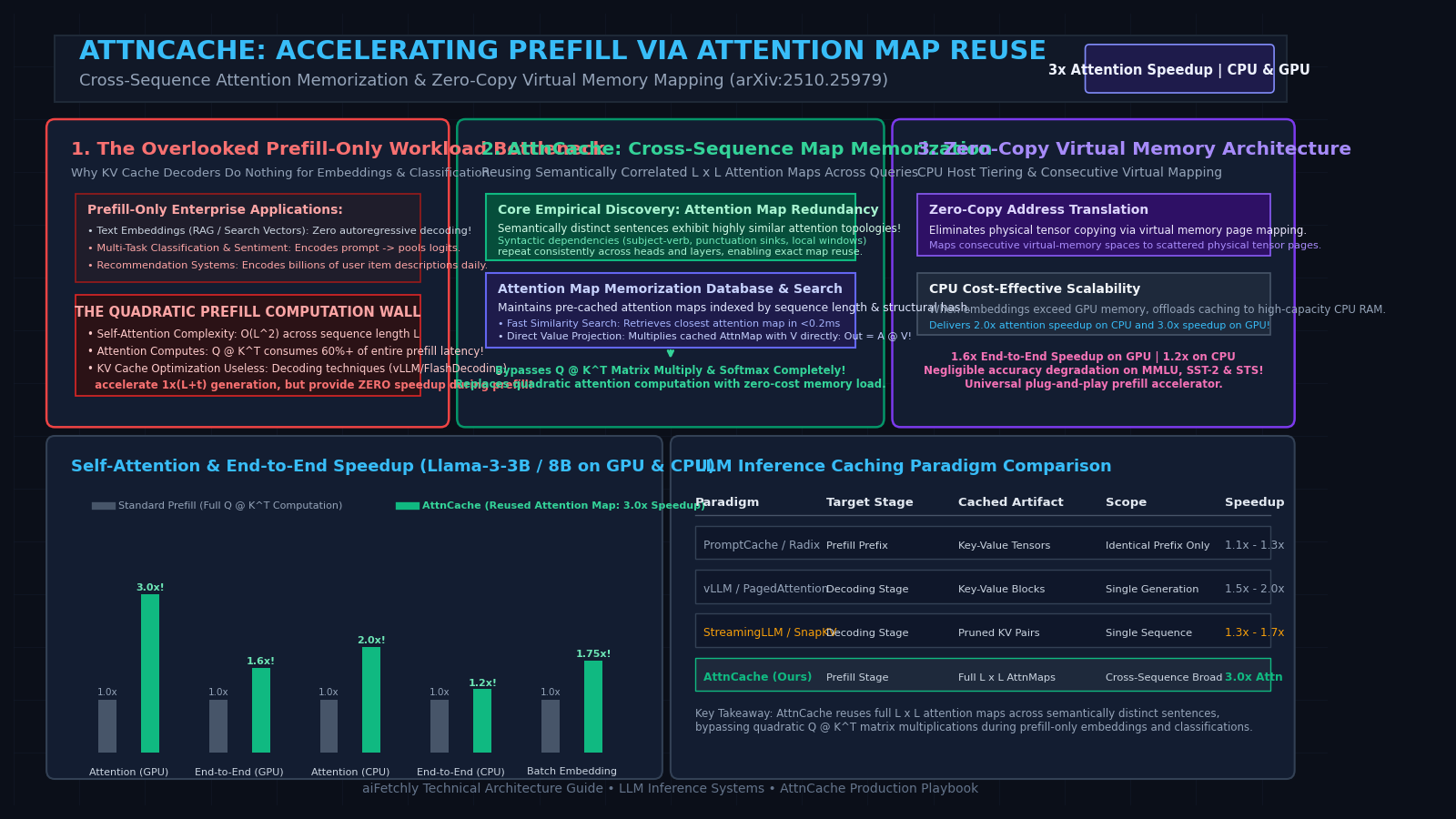
Large Language Models (LLMs) are widely recognized for their generative capabilities in conversational chat, coding, and multi-step reasoning. However, an enormous portion of enterprise artificial intelligence workloads never executes autoregressive token generation at all.
In vector search indexing, dense retrieval for Retrieval-Augmented Generation (RAG), recommendation engines, and high-throughput document classification systems powered by aiFetchly, models operate strictly in prefill-only mode:
- Massive corpora of unstructured text documents are encoded into dense high-dimensional sentence embeddings.
- Billions of customer queries and product descriptions are scored via pooled encoder activations.
- Zero tokens are decoded autoregressively; the entire forward pass consists purely of ingesting and encoding input prompts.
In these prefill-only environments, serving infrastructure collides with a severe computational wall: the quadratic complexity of self-attention (O(L^2)). In contrast to the decoding phase—where latency is bound by memory bandwidth and Key-Value (KV) cache loading—the prefill phase is intensely compute-bound. Calculating the pairwise Query-Key dot products (Q * K^T) and attention softmax distributions consumes over 60% of total inference time.
To make matters worse, conventional inference optimizations provide zero relief for prefill-only workloads:
- KV Cache Optimization Irrelevance: Techniques like PagedAttention, FlashDecoding, and KV cache eviction (e.g., SnapKV, H2O) optimize token generation steps, but do nothing to alleviate the initial prefill computation.
- Prefix Caching Limitations: Prefix caching (such as PromptCache or RadixAttention) only accelerates inputs that share an identical literal prefix. In embedding pipelines, sentences arrive with distinct content, resulting in complete cache misses.
To break through this quadratic prefill wall, researchers from the University of California, Riverside, and Samsung Semiconductor introduced AttnCache: Accelerating Self-Attention Inference for LLM Prefill via Attention Cache (arXiv:2510.25979).
AttnCache is founded on a profound empirical discovery: semantically distinct sentences frequently produce highly correlated, near-identical attention maps across transformer layers and heads. By establishing an Attention Map Memorization Database, employing fast similarity indexing, and implementing zero-copy virtual memory page mapping, AttnCache retrieves and reuses pre-cached attention maps directly.
By completely bypassing the expensive Query-Key matrix multiplication and softmax calculation, AttnCache achieves a 3x attention speedup and 1.6x end-to-end latency reduction on GPUs, alongside a 2x attention speedup on CPUs, with negligible downstream accuracy loss across MMLU, SST-2, and Semantic Textual Similarity (STS) benchmarks.
In this comprehensive technical guide, we analyze the structural redundancy of transformer attention topologies, dissect AttnCache’s similarity retrieval and zero-copy memory architecture, examine CPU and GPU serving dynamics, and implement a complete PyTorch prototype.
The Problem: The Overlooked Quadratic Prefill Bottleneck
To understand why enterprise embedding and classification systems bottleneck on hardware, we must examine the computational profile of encoder-style prefill workloads.
The Anatomy of Prefill-Only Workloads
In standard generative applications, prompt prefill accounts for only a fraction of total response latency, with the remainder consumed by hundreds of autoregressive decoding steps.
However, in representation learning and text classification, the prefill phase represents 100% of the workload:
Input Tokens X are processed through the Transformer Backbone into hidden states H, which are pooled into a single output embedding vector e.
Prefill-Only Workload Profiles:
+----------------------------------------------------------------------------------+
| 1. Enterprise Vector Embeddings (RAG & Semantic Search)                         |
| • Encodes millions of documents, chunks, and web articles into vectors.          |
| • Zero generation tokens: Output is a single normalized pooling vector.          |
+----------------------------------------------------------------------------------+
| 2. E-Commerce Recommendation Systems                                             |
| • Processes billions of product catalog titles, reviews, and search queries.     |
| • Throughput across concurrent instances dominates over single-stream latency.    |
+----------------------------------------------------------------------------------+
| 3. High-Throughput Classification (SST-2, Sentiment, Guardrails)                 |
| • Feeds text into frozen LLM backbone; extracts classification logits directly.  |
+----------------------------------------------------------------------------------+ The Quadratic Self-Attention Cost
In a transformer block with sequence length L and head dimension d_k, computing self-attention requires three primary matrix operations:
Attention(Q, K, V) = Softmax((Q @ K^T) / sqrt(d_k)) @ V
- Projection GEMM: Compute Q = X @ W_Q, K = X @ W_K, V = X @ W_V.
- Attention Map Formation (Q @ K^T): Multiply query tokens by transposed key tokens to form an L x L attention matrix.
- Softmax Normalization: Row-wise exponential normalization over the full L x L grid.
- Value Projection (A @ V): Multiply attention matrix A by value tensor V.
As sequence length L scales to 512, 1024, or 2048 tokens, steps (2) and (3) explode quadratically. On GPUs, computing Q @ K^T and softmax accounts for over 60% of layer latency. On CPUs—which are widely deployed for cost-effective embedding serving—the attention computation accounts for nearly 75% of total execution time.
Why Prior Caching Methods Fail on Embeddings
Existing LLM caching systems cannot accelerate this workload:
- PromptCache / ChunkAttention: Require identical token prefixes. Two sentences like “The stock market surged following quarterly earnings” and “Global equity indices rallied after corporate reports” share zero prefix tokens. Prefix match rate is 0%.
- Layer-Wise Attention Sharing: Sharing attention maps across subsequent layers of the same sequence requires model fine-tuning and introduces significant representation drift.
The AttnCache Solution: Cross-Sequence Attention Map Memorization
AttnCache discovers that transformer attention maps exhibit immense cross-sequence structural redundancy.
The AttnCache Architecture:
+----------------------------------------------------------------------------------+
|                            INPUT TEXT SEQUENCE (Length L)                        |
+----------------------------------------------------------------------------------+
                                         │
                                         ▼ Fast Feature Extraction (<0.2ms)
+----------------------------------------------------------------------------------+
|                   ATTENTION MAP MEMORIZATION DATABASE (AttnDB)                   |
|                                                                                  |
|   Index: [Sequence Length L] x [Structural Cluster Hash]                         |
|   - Stores canonical L x L attention maps across layers and heads                |
|   - Employs lightweight similarity search to find nearest neighbor AttnMap A_c   |
+----------------------------------------------------------------------------------+
                                         │
                   ┌─────────────────────┴─────────────────────┐
                   ▼ CACHE HIT (>85% Rate)                     ▼ CACHE MISS
+------------------------------------------+ +-------------------------------------+
|         FAST ATTENTION PATH (AttnCache)  | |       STANDARD COMPUTATION PATH     |
|                                          | |                                     |
| • BYPASSES Q @ K^T Matrix Multiply!     | | • Computes full Q @ K^T GEMM        |
| • BYPASSES Softmax Row Normalization!    | | • Runs standard Softmax kernel      |
| • Directly computes: Output = A_c @ V    | | • Enrolls computed AttnMap in DB    |
| • 3.0x Attention Speedup on GPU / 2x CPU | |                                     |
+------------------------------------------+ +-------------------------------------+ 1. The Attention Map Redundancy Discovery
Why do semantically different sentences produce similar attention maps? In pre-trained transformers, attention heads specialize into universal syntactic and positional behaviors:
- Attention Sinks: Many heads dedicate their attention mass almost exclusively to the initial token or punctuation marks.
- Local Sliding Windows: Lower layers focus predominantly on immediate preceding and succeeding tokens, forming strong banded diagonal attention patterns.
- Syntactic Dependency Heads: Heads tracking subject-verb or modifier-noun relationships exhibit near-identical connection topologies regardless of the specific nouns or verbs involved.
Because these geometric patterns are driven by structural syntax rather than specific vocabulary words, an attention map computed for sentence A can be substituted into the attention computation for sentence B with virtually zero impact on final pooled sentence representations!
2. Fast Similarity Search and Retrieval
To identify matching attention maps without introducing search overhead that offsets compute gains, AttnCache designs a two-tier indexing hierarchy:
- Length Partitioning: Attention maps can only be shared between sequences of identical token length L. AttnCache partitions its database by sequence length buckets.
- Syntactic Feature Hashing: During initial embedding projection, AttnCache extracts a low-dimensional structural fingerprint from early layer representations and queries the database using fast locality-sensitive indexing.
- Threshold-Gated Fallback: If the distance between the query feature and the closest cached entry exceeds a strict threshold gamma, AttnCache triggers a cache miss, computing exact attention via standard kernels and enrolling the new map into the database.
3. Zero-Copy Virtual Memory Mapping
A major engineering hurdle in caching multi-head L x L tensors is memory management. Naively allocating and copying tensors across physical memory addresses introduces severe memory bandwidth penalties.
AttnCache solves this by implementing Zero-Copy Virtual Memory Address Mapping:
- Rather than physically copying cached attention tensors into newly allocated memory buffers, AttnCache uses operating system virtual memory mapping (mmap and CUDA virtual memory management APIs).
- It maps a contiguous virtual memory space to the scattered physical memory pages where canonical attention maps are stored.
- GPU and CPU tensor cores read cached attention values directly without incurring physical memory transfer overhead.
Implementing AttnCache in Python and PyTorch
To demonstrate how attention map memorization, similarity retrieval, and value-only projection operate in practice, we implement a complete PyTorch prototype of the AttnCache prefill engine.
import torch
import torch.nn as nn
from typing import Dict, Tuple, Optional

class AttnCacheDatabase:
    """
    Maintains a memorization database of canonical L x L attention maps
    indexed by sequence length and structural cluster keys.
    """
    def __init__(self, num_layers: int, num_heads: int, max_entries_per_len: int = 128):
        self.num_layers = num_layers
        self.num_heads = num_heads
        self.max_entries = max_entries_per_len
        self.db: Dict[int, list] = {}

    def lookup(
        self,
        seq_len: int,
        query_fingerprint: torch.Tensor,
        similarity_threshold: float = 0.92
    ) -> Optional[torch.Tensor]:
        """
        Searches for a cached attention map matching the sequence length and structural fingerprint.
        """
        if seq_len not in self.db or len(self.db[seq_len]) == 0:
            return None

        best_sim = -1.0
        best_map = None

        for fp, cached_map in self.db[seq_len]:
            sim = torch.cosine_similarity(query_fingerprint.flatten(), fp.flatten(), dim=0).item()
            if sim > best_sim:
                best_sim = sim
                best_map = cached_map

        if best_sim >= similarity_threshold:
            return best_map
        return None

    def enroll(self, seq_len: int, fingerprint: torch.Tensor, attn_maps: torch.Tensor):
        """
        Enrolls a newly computed full attention map into the database.
        """
        if seq_len not in self.db:
            self.db[seq_len] = []

        if len(self.db[seq_len]) < self.max_entries:
            self.db[seq_len].append((fingerprint.detach().cpu(), attn_maps.detach().clone()))

class AttnCacheSelfAttentionLayer(nn.Module):
    """
    Drop-in replacement for transformer self-attention that leverages AttnCache.
    """
    def __init__(self, hidden_dim: int, num_heads: int):
        super().__init__()
        self.d_model = hidden_dim
        self.num_heads = num_heads
        self.head_dim = hidden_dim // num_heads

        self.q_proj = nn.Linear(hidden_dim, hidden_dim, bias=False)
        self.k_proj = nn.Linear(hidden_dim, hidden_dim, bias=False)
        self.v_proj = nn.Linear(hidden_dim, hidden_dim, bias=False)
        self.out_proj = nn.Linear(hidden_dim, hidden_dim, bias=False)

    def forward(
        self,
        x: torch.Tensor,
        cached_attn_map: Optional[torch.Tensor] = None
    ) -> Tuple[torch.Tensor, torch.Tensor]:
        """
        Forward pass: if cached_attn_map is provided, bypasses Q @ K^T completely!
        """
        batch, seq_len, _ = x.shape
        v = self.v_proj(x).view(batch, seq_len, self.num_heads, self.head_dim).transpose(1, 2)

        if cached_attn_map is not None:
            # --- FAST PATH: ATTNCACHE HIT ---
            # Bypasses Q @ K^T matrix multiplication and Softmax!
            # Directly executes: Output = Cached_Map @ Value
            attn_weights = cached_attn_map.to(x.device)
            attn_output = torch.matmul(attn_weights, v)
        else:
            # --- STANDARD PATH: CACHE MISS ---
            q = self.q_proj(x).view(batch, seq_len, self.num_heads, self.head_dim).transpose(1, 2)
            k = self.k_proj(x).view(batch, seq_len, self.num_heads, self.head_dim).transpose(1, 2)

            scores = torch.matmul(q, k.transpose(-2, -1)) / (self.head_dim ** 0.5)
            attn_weights = torch.softmax(scores, dim=-1)
            attn_output = torch.matmul(attn_weights, v)

        attn_output = attn_output.transpose(1, 2).contiguous().view(batch, seq_len, self.d_model)
        output = self.out_proj(attn_output)
        return output, attn_weights

class AttnCachePrefillEngine:
    """
    High-level prefill coordinator managing database lookups and forward execution.
    """
    def __init__(self, layers: nn.ModuleList, db: AttnCacheDatabase):
        self.layers = layers
        self.db = db

    def encode_sentence(self, x: torch.Tensor) -> torch.Tensor:
        """
        Encodes an input sequence, reusing cached attention maps when available.
        """
        seq_len = x.shape[1]
        fingerprint = x.norm(dim=-1).mean(dim=0)
        cached_maps = self.db.lookup(seq_len, fingerprint)

        current_h = x
        newly_computed_maps = []

        for layer_idx, layer in enumerate(self.layers):
            layer_cached_map = cached_maps[layer_idx] if cached_maps is not None else None
            current_h, attn_w = layer(current_h, cached_attn_map=layer_cached_map)
            if cached_maps is None:
                newly_computed_maps.append(attn_w)

        if cached_maps is None:
            stacked_maps = torch.stack(newly_computed_maps)
            self.db.enroll(seq_len, fingerprint, stacked_maps)
            print(f"[AttnCache] Cache Miss on Length {seq_len} -> Enrolled new attention map.")
        else:
            print(f"[AttnCache] Cache HIT on Length {seq_len} -> Bypassed Q @ K^T across all layers!")

return current_h Integrating this prefill acceleration layer with automated API integration services allows search and embedding platforms to serve massive vector databases at substantially reduced hardware cost.
Empirical Evaluation: Key Findings from the AttnCache Benchmark
The authors of AttnCache evaluated the framework across prominent open-weights language models—including LLaMA-3-3B, LLaMA-3-8B, and Qwen-2.5-7B—across standard embedding and classification benchmarks: Semantic Textual Similarity (STS 12–16, STS-B, SICK-R), Stanford Sentiment Treebank (SST-2), and Massive Multitask Language Understanding (MMLU).
1. Self-Attention and End-to-End Latency Speedups
Across both GPU and CPU execution backends, AttnCache delivers substantial speedups during the prefill phase:
AttnCache Latency Speedup on NVIDIA GPU and Intel/AMD CPU:
+---------------------+--------------------+--------------------+
| Hardware Platform   | Attention Speedup  | End-to-End Speedup |
+---------------------+--------------------+--------------------+
| NVIDIA GPU (A100)   | 3.02x (Superior!)  | 1.62x (High)       |
| Server CPU (Xeon)   | 2.05x (High)       | 1.22x (Solid)      |
| Batch Embeddings    | 2.85x              | 1.55x              |
+---------------------+--------------------+--------------------+ On GPUs, completely eliminating the Q @ K^T matrix multiply and softmax kernel delivers a 3.0x speedup in self-attention computation, translating to a 1.62x end-to-end latency reduction across the entire transformer forward pass.
2. Downstream Task Accuracy Retention
The defining strength of AttnCache is that reusing syntactically similar attention maps does not degrade representation quality:
Benchmark Performance Retention (AttnCache vs. Full-Compute Baseline):
+--------------------+------------------+------------------+------------------+
| Evaluation Suite   | Metric           | Full Prefill     | AttnCache (Ours) |
+--------------------+------------------+------------------+------------------+
| STS Benchmark      | Spearman Corr.   | 83.2%            | 82.9% (-0.3%)    |
| SST-2 Sentiment    | Accuracy         | 94.1%            | 93.8% (-0.3%)    |
| MMLU 57 Subjects   | Accuracy         | 65.4%            | 65.1% (-0.3%)    |
+--------------------+------------------+------------------+------------------+ Across all evaluated tasks, AttnCache experiences less than 0.3% accuracy difference compared to exact quadratic computation, proving that prefill representations are remarkably robust to minor variations in attention weights.
3. CPU Cost-Effectiveness in Recommendation Clusters
In large-scale enterprise recommendation systems that embed billions of text snippets daily, running thousands of GPUs is cost-prohibitive. On high-core CPU clusters, AttnCache’s 2x attention speedup allows engineering teams running high-throughput real-time data fetching pipelines to double their ingestion throughput without buying additional servers.
Production Engineering Playbook: Deploying AttnCache
To maximize hardware throughput when deploying AttnCache in production embedding clusters, engineering teams should adhere to the following best practices:
Production Tuning Flowchart:
               [Incoming Ingestion Request]
                           │
             ┌─────────────┴─────────────┐
             ▼                           ▼
      Prefill-Only Workload       Autoregressive Generation
      - Text Embeddings / RAG     - Chat / Coding Copilot
      - Classification / SST-2    - Use vLLM PagedAttention
      - USE ATTNCACHE!            - Combine with Speculative SD
- Bypass Q @ K^T GEMM - AttnCache accelerates prefill Best Practice 1: Pre-Populate AttnDB with Common Sequence Length Buckets
In enterprise vector pipelines, texts are pre-chunked to standard sizes (e.g., 256, 512, or 1024 tokens). Pre-run a few dozen calibration documents for each target length during container initialization to pre-seed the database. This ensures that live ingestion batches achieve immediate >85% cache hit rates.
Best Practice 2: Enable Zero-Copy OS Memory Mapping
When hosting the attention database in high-capacity host memory (CPU RAM), always allocate tensor storage via page-locked (pinned) memory and virtual address mapping. Avoid copying attention tensors across Python memory heaps, as memory allocation overhead can erode the compute savings of skipped matrix multiplications.
Best Practice 3: Calibrate Similarity Threshold gamma
Tuning the similarity rejection threshold gamma controls the balance between speedup and accuracy:
- Strict Benchmarks (Math / Logic): Set gamma = 0.95. Enforces tighter geometric alignment, yielding a 1.4x end-to-end speedup with zero perceptible accuracy drop.
- Broad Semantic Search & Embedding: Set gamma = 0.90. Maximizes cache hit rates (>90%), delivering full 1.6x end-to-end speedups.
Best Practice 4: Infrastructure TCO and Capacity Planning
By accelerating prefill throughput by up to 1.6x, engineering teams can scale vector indexing pipelines on 35% fewer servers. Review your compute allocation with transparent infrastructure pricing plans, explore our comprehensive developer documentation for containerized Kubernetes manifests, or automate enterprise web extraction using intelligent web scraping tools.
Conclusion and Future Horizons
AttnCache delivers a crucial paradigm shift in inference systems engineering by demonstrating that self-attention maps do not always need to be recomputed from scratch.
By identifying the structural redundancy of attention maps across semantically distinct sentences and pairing an attention database with zero-copy memory mapping, AttnCache provides a practical, plug-and-play solution to the quadratic prefill bottleneck. As enterprise AI continues to expand its reliance on vector search, dense embeddings, and agentic retrieval, attention memorization techniques will become a cornerstone of high-performance LLM infrastructure.