Arm Ethos-U85 Guide: Transformer MicroNPU for Edge AI
The TinyML Transformer Barrier: Why Legacy Microcontrollers Stall on Attention Mechanisms
The field of embedded artificial intelligence and TinyML (Tiny Machine Learning) has reached a critical architectural inflection point. For the past half-decade, machine learning at the extreme edge—operating inside battery-powered smart home sensors, industrial condition monitors, wearable medical telemetry patches, and automotive cabin controllers—relied almost exclusively on classical Convolutional Neural Networks (CNNs) and Recurrent Neural Networks (RNNs). First-generation micro-neural processing units (microNPUs), such as the Arm Ethos-U55 and Ethos-U65, were engineered specifically to accelerate these 2D spatial convolution and depthwise filtering workloads alongside microcontrollers.
However, modern deep learning research has decisively migrated toward Transformer architectures. Across visual perception (Vision Transformers, or ViT), speech recognition and acoustic modeling (Whisper, Conformer), and embedded natural language understanding, attention mechanisms have demonstrated overwhelming accuracy advantages over pure convolutions. Transformers capture long-range contextual relationships, exhibit greater robustness to visual occlusion, and adapt dynamically to complex sensory distributions.
Despite their algorithmic dominance, deploying transformer networks onto embedded microcontrollers and first-generation microNPUs presents four severe microarchitectural roadblocks:
- The Attention Matrix Multiplication Mismatch: First-generation microNPUs were hardwired around fixed 2D systolic arrays designed for uniform weight-stationary convolutions. In a transformer, the core primitive is the scaled dot-product attention mechanism: $$\text{Attention}(Q, K, V) = \text{softmax}\left(\frac{Q K^T}{\sqrt{d_k}}\right) V$$ This operation requires dynamic, dynamic-by-dynamic matrix multiplications between runtime activation tensors ($Q$ and $K^T$), followed immediately by non-linear row-wise Softmax normalization and a secondary multiplication against value tensors ($V$). First-generation microNPUs lack hardware support for activation-activation GEMM (General Matrix Multiply) operations, forcing the host CPU to intervene, fall back to slow software emulation, and stall the execution pipeline.
- Elementwise Arithmetic and Normalization Bottlenecks: Transformers rely heavily on non-convolutional mathematical layers: Root Mean Square Layer Normalization (RMSNorm), standard Layer Normalization, Gaussian Error Linear Units (GELU), and elementwise gating operations (SwiGLU). On legacy microcontrollers, calculating square roots, variances, and non-linear exponentials across thousands of activation elements consumes millions of CPU clock cycles, generating massive latency bubbles that negate hardware acceleration gains.
- Severe Memory Bandwidth and SRAM Constraints: Microcontroller systems operate with limited internal Static RAM (SRAM)—typically between 512 kilobytes and a few megabytes—paired with slower external Flash memory over quad-SPI (QSPI) or octal-SPI (OSPI) buses. In standard transformer execution, intermediate attention matrices ($Q K^T$) scale quadratically with sequence length ($\mathcal{O}(N^2)$). Without dedicated hardware buffer management and operator tiling, storing intermediate attention maps exhausts on-chip SRAM, triggering costly read/write cycles to external Flash memory that spike dynamic power consumption.
- The Host-to-NPU Communication Tax: In conventional TinyML deployments, whenever an unsupported operator (such as a matrix transpose, dynamic reshape, or Softmax) is encountered, execution drops back to the microcontroller CPU. The CPU must invalidate data caches, synchronize memory states, execute the operator via software loops (such as CMSIS-NN), and restart the hardware accelerator. This constant ping-ponging between host processor and accelerator introduces software interrupt latency that frequently exceeds the actual neural compute time.
To break through this barrier and enable modern generative vision, speech, and multimodal foundation models on sub-watt microcontrollers, the industry requires a modern, transformer-native microNPU architecture.
Introducing Arm Ethos-U85: High-Performance Transformer MicroNPU
The Arm Ethos-U85 emerges as Arm’s definitive third-generation microNPU, engineered specifically to bring native Transformer and next-generation CNN acceleration to microcontrollers and power-constrained edge platforms. Representing a major leap forward from the pioneering Ethos-U55 and Ethos-U65, the Ethos-U85 is the first microNPU in Arm’s portfolio designed from the ground up with native hardware acceleration for attention mechanisms and matrix-multiplication operations.
Fabricated as synthesizable semiconductor intellectual property (IP) for integration into custom silicon System-on-Chips (SoCs), the Ethos-U85 delivers a massive 4x performance increase and 20% higher energy efficiency compared to its predecessor, the Ethos-U65. Operating at clock frequencies up to 1 GHz, the Ethos-U85 scales from 128 to 2,048 multiply-accumulate (MAC) units per cycle, providing up to 4 TOPs of INT8 compute within an ultra-low power budget suitable for sub-watt and battery-powered applications.
Key microarchitectural innovations introduced in the Ethos-U85 include:
- Native Transformer Acceleration: Features dedicated hardware execution engines for matrix-matrix multiplication (MatMul), dynamic transposition, elementwise tensor arithmetic, Layer Normalization, and fast hardware-accelerated Softmax, allowing Vision Transformers (ViT) and Conformer models to execute end-to-end on the NPU without falling back to the host CPU.
- Tightly Coupled CPU Pairing: Designed to operate seamlessly alongside Arm’s highest-performance microcontrollers—specifically the Arm Cortex-M85 and Cortex-M55 (utilizing Arm Helium vector extensions)—as well as Arm Cortex-A application processors, connected via standard AMBA AXI5 and low-latency master/slave buses.
- TOSA (Tensor Operator Set Architecture) Compliance: Implements the open-standard Arm TOSA specification, guaranteeing long-term software stability and broad compatibility across leading edge runtime frameworks, including TensorFlow Lite for Microcontrollers (TFLM) and PyTorch ExecuTorch.
- Compiler-Driven Vela Toolchain: Supported by the open-source Arm Vela compiler, which analyzes pre-trained neural networks offline, automatically fuses operations, tiles large attention matrices, and schedules memory transfers across SRAM and external memory to achieve near-optimal hardware utilization.
Organizations deploying distributed sensor intelligence, smart camera networks, and automated edge inspection pipelines can connect their Ethos-U85 edge devices to centralized enterprise backbones using real-time data ingestion infrastructure to synchronize model weights, telemetry updates, and inference events across heterogeneous device fleets. By combining native transformer compute with microcontroller power efficiency, the Arm Ethos-U85 brings frontier neural architectures directly to the device edge.
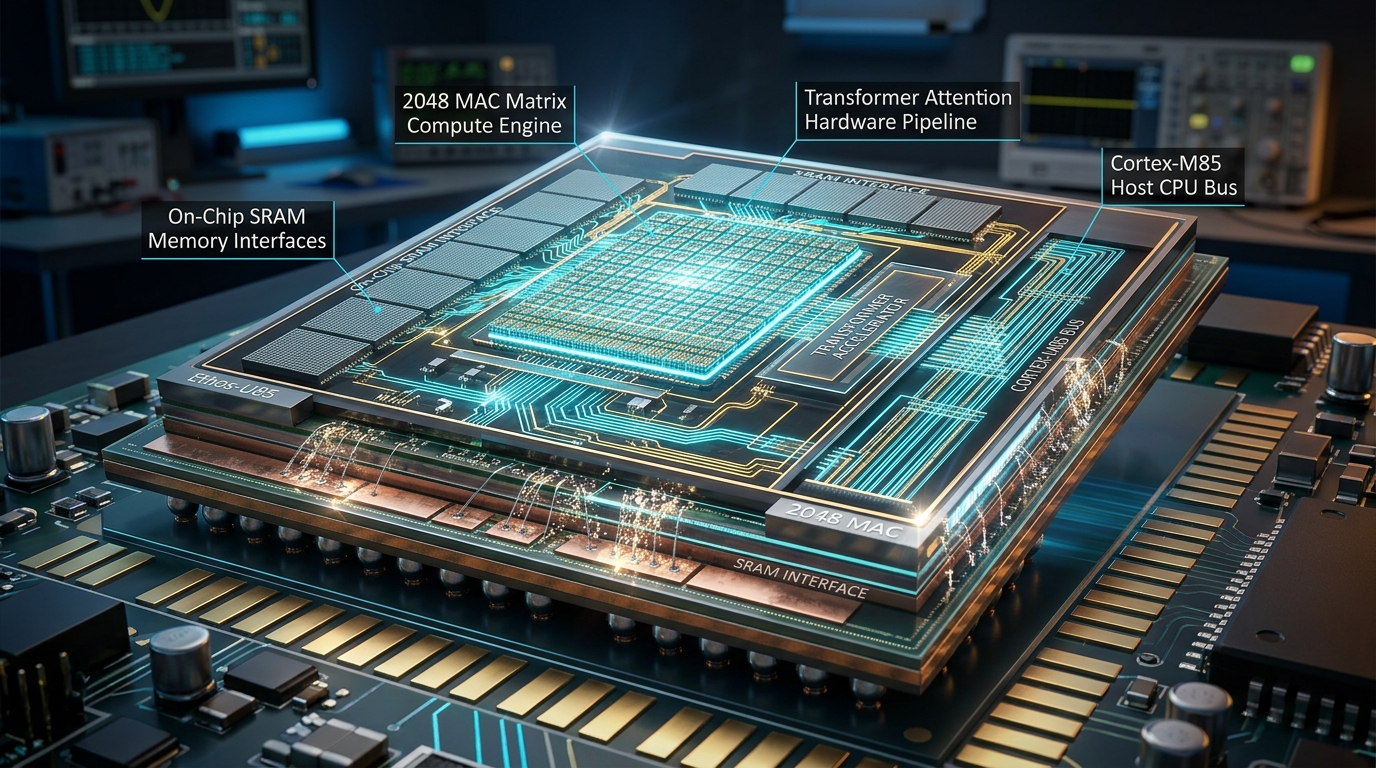
Architectural Deep Dive: 2048 MACs, Transformer Pipelines, and Memory Subsystems
Understanding the transformative capabilities of the Arm Ethos-U85 requires an in-depth examination of its internal microarchitecture across four primary dimensions: the scalable MAC compute engine, the native Transformer attention pipeline, the memory hierarchy and AXI5 interface, and the compiler-hardware co-design driven by the Vela toolchain.
Internal Microarchitectural Organization
The Ethos-U85 is organized into a modular, pipelined dataflow architecture that separates compute, memory staging, and hardware control logic into dedicated execution blocks:
+-----------------------------------------------------------------------+
|                    Arm Ethos-U85 MicroNPU Block Diagram               |
+-----------------------------------------------------------------------+
|  +------------------------+  +-------------------------------------+  |
|  | Host Interface (AMBA)  |  |    Memory DMA & Direct Streamers    |  |
|  | - AXI5 Master (64/128b)|  |    - Autonomous Multi-Channel DMA   |  |
|  | - APB / AXI Slave      |  |    - Weight Decompression Engine    |  |
|  | - Interrupt Controller |  |    - Circular SRAM Buffer Arbiter   |  |
|  +-----------+------------+  +------------------+------------------+  |
|              |                                  |                     |
|  +-----------v----------------------------------v------------------+  |
|  |               Central Control & Hardware Sequencer              |  |
|  +-----------------------------------------------------------------+  |
|        |                  |                  |                  |     |
|  +-----v-----+      +-----v-----+      +-----v-----+      +-----v-----+  |
|  | 2048 MAC  |      | Transform |      | Vector &  |      | Element-  |  |
|  | Compute   |      | Attention |      | Normal-   |      | wise &    |  |
|  | Engine    |      | Engine    |      | ization   |      | Scaling   |  |
|  | (INT8 /   |      | (MatMul / |      | Unit      |      | Unit      |  |
|  |  INT16)   |      |  Softmax) |      | (LayerNorm|      | (GELU,    |  |
|  |           |      |           |      |  RMSNorm) |      |  SwiGLU)  |  |
|  +-----+-----+      +-----+-----+      +-----+-----+      +-----+-----+  |
|        ^                  ^                  ^                  ^     |
|  +-----+------------------+------------------+------------------+--+  |
|  |           On-Chip High-Bandwidth Accumulator & Buffer Fabric     |  |
|  +-----------------------------------------------------------------+  |
+-----------------------------------------------------------------------+ The heart of the processing engine is a scalable matrix multiply-accumulate array that can be synthesized in configurations of 128, 256, 512, 1024, or 2048 MACs per clock cycle. In its flagship 2048-MAC configuration operating at 1 GHz, the Ethos-U85 achieves 4.096 Tera-Operations per Second (TOPs) on 8-bit integer (INT8) workloads, or 2.048 TOPs on 16-bit integer (INT16) workloads, providing the dynamic range required for high-fidelity audio and signal processing.
Native Transformer Attention Execution Pipeline
The most significant architectural departure from previous microNPUs is the inclusion of dedicated hardware logic for Transformer-specific operators:
- Activation-by-Activation Matrix Multiplication (MatMul): Conventional microNPUs were restricted to multiplying static weights against dynamic activations ($W \times X$). The Ethos-U85 introduces native hardware support for multiplying two dynamic runtime activation tensors ($Q \times K^T$), fully supporting batched and multi-head attention layouts in hardware.
- Integrated Hardware Softmax Engine: To compute row-wise attention probabilities: $$P_{ij} = \frac{\exp(S_{ij})}{\sum_k \exp(S_{ik})}$$ The Ethos-U85 incorporates a hardwired exponential approximation and reciprocal reduction pipeline. It calculates numerical maximum subtraction (for floating-point stability), fast exponential expansion, and accumulator normalization in streaming hardware without stalling the MAC engine.
- Fused Layer Normalization and RMSNorm Units: The hardware pipeline integrates dedicated normalization units capable of computing mean, variance, scaling, and offset parameters directly on streaming data tiles: $$\text{RMSNorm}(x) = \frac{x}{\sqrt{\frac{1}{d} \sum_{i=1}^d x_i^2 + \epsilon}} \odot \gamma$$ By fusing normalization directly into the memory write-back path, the Ethos-U85 avoids storing intermediate, un-normalized tensors back into memory.
Memory Hierarchy, Weight Decompression, and AXI5 Fabric
In edge microcontrollers, memory bandwidth is the primary determinant of overall system energy consumption. Fetching weight parameters from external Flash memory burns orders of magnitude more energy than executing the actual mathematical multiplication in silicon.
To address this, the Ethos-U85 implements an advanced three-tier memory management strategy:
- Hardware Weight Decompression Engine: Model weights are compressed offline by the Vela compiler using lossless entropy coding. The Ethos-U85 decodes these compressed weight bitstreams on the fly in hardware as they are streamed into the MAC array, reducing external memory bandwidth and Flash storage requirements by 30% to 50%.
- Circular On-Chip SRAM Buffering: The microNPU treats localized on-chip SRAM as an elastic circular buffer. While the compute engine processes layer $N$, the autonomous DMA engine pre-fetches the weights and feature maps for layer $N+1$ in the background, completely hiding external bus latency.
- Dual AXI5 Bus Interface: Features high-performance 64-bit or 128-bit AMBA AXI5 master interfaces. One interface connects directly to high-speed on-chip SRAM (delivering single-cycle access latency), while the secondary interface connects to system memory or external Flash controllers, preventing bus arbitration contention.
Mathematical Formulation of Ethos-U85 Quantized Arithmetic
To maximize energy efficiency while maintaining high accuracy, the Ethos-U85 operates natively on quantized integer representations conforming to the TOSA specification.
For an input tensor $X$ and weight tensor $W$ quantized into symmetric or asymmetric INT8 format, affine mapping is defined by real-valued scales ($S$) and zero-points ($Z$):
$$q = \text{clamp}\left( \left\lfloor \frac{X}{S} \right\rceil + Z, -128, 127 \right)$$
When calculating matrix contractions in the MAC array, intermediate accumulation is performed with full 32-bit integer precision (INT32):
$$Y_{INT32}[i, j] = \sum_{k=1}^K \left( X_{INT8}[i, k] - Z_X \right) \times \left( W_{INT8}[k, j] - Z_W \right)$$
The Ethos-U85 hardware scaling unit converts the 32-bit accumulated sum back into an 8-bit output tensor using a fixed-point multiplier ($M_0$) and bitwise arithmetic right-shift ($n$):
$$Y_{INT8}[i, j] = \text{clamp}\left( \left\lfloor \frac{M_0 \cdot Y_{INT32}[i, j]}{2^n} \right\rceil + Z_Y, -128, 127 \right)$$
where the effective scaling ratio $\frac{S_X \cdot S_W}{S_Y}$ is decomposed into fixed-point components ($M_0 \in [2^{30}, 2^{31}-1]$, $n \ge 0$). Because this rescale operation is executed in a single clock cycle by dedicated integer shift logic, the Ethos-U85 delivers exact bit-for-bit mathematical determinism without requiring floating-point hardware units.
Practical Implementation: Compiling Transformers with Vela and Cortex-M85 Integration
Deploying neural network models onto an Arm Ethos-U85 system involves a streamlined, two-stage compilation and runtime lifecycle: offline graph compilation using the open-source Arm Vela Compiler, followed by firmware execution on a coupled Arm Cortex-M85 or Cortex-M55 microcontroller using TensorFlow Lite for Microcontrollers (TFLM).
Offline Graph Compilation Using Arm Vela
The Arm Vela compiler takes an existing quantized .tflite model, optimizes the graph for the Ethos-U85 architecture, tiles large tensor dimensions, schedules memory allocations between SRAM and Flash, and embeds hardware micro-code instructions:
#!/usr/bin/env python3
# Arm Ethos-U85 Model Compilation and Optimization Script
# Uses the Arm Vela Compiler to optimize a quantized Vision Transformer for Ethos-U85.

import subprocess
import os
import sys

def compile_for_ethos_u85(
    input_tflite_path: str,
    output_dir: str,
    mac_config: int = 2048,
    sram_size_kb: int = 1024,
    system_config: str = "Ethos_U85_Sys_Embedded"
):
    """
    Invokes the Arm Vela Compiler to optimize and schedule an ML model
    for the Ethos-U85 microNPU architecture.
    """
    if not os.path.exists(input_tflite_path):
        raise FileNotFoundError(f"Input model not found: {input_tflite_path}")

    os.makedirs(output_dir, exist_ok=True)
    print(f"[Vela] Compiling {input_tflite_path} for Ethos-U85 ({mac_config} MACs)...")

    # Construct Vela command-line execution parameters
    vela_cmd = [
        "vela",
        input_tflite_path,
        "--output-dir", output_dir,
        "--accelerator-config", f"ethos-u85-{mac_config}",
        "--system-config", system_config,
        "--arena-cache-size", str(sram_size_kb * 1024),
        "--memory-mode", "Dedicated_Sram",
        "--tensor-allocator", "LinearAlloc",
        "--show-cpu-cycles",
        "--timing"
    ]

    print(f"[Vela] Executing: {' '.join(vela_cmd)}")
    result = subprocess.run(vela_cmd, capture_output=True, text=True)

    if result.returncode != 0:
        print(f"[Vela Error] Compilation failed:\n{result.stderr}")
        sys.exit(1)

    print("[Vela Success] Compilation Complete! Summary:")
    print(result.stdout)

    # Identify generated optimized model
    base_name = os.path.splitext(os.path.basename(input_tflite_path))[0]
    optimized_model = os.path.join(output_dir, f"{base_name}_vela.tflite")
    print(f"[Vela] Optimized hardware executable saved to: {optimized_model}")
    return optimized_model

if __name__ == "__main__":
    compile_for_ethos_u85(
        input_tflite_path="vit_tiny_patch16_quant.tflite",
        output_dir="./compiled_output",
        mac_config=2048,
        sram_size_kb=1024
) Embedded C Firmware on Arm Cortex-M85 with Ethos-U Driver
Once compiled, the resulting _vela.tflite model contains both standard TensorFlow Lite operators and custom Ethos-U hardware command streams. The following production C firmware demonstrates how the Arm Cortex-M85 microcontroller initializes the Ethos-U85 driver, registers the hardware accelerator with TensorFlow Lite for Microcontrollers, and executes inference with zero CPU stalls:
/**
* Arm Cortex-M85 & Ethos-U85 Embedded Inference Application
* Demonstrates hardware initialization, tensor arena setup, and inference invocation.
*/
#include <stdio.h>
#include <stdint.h>
#include <stdbool.h>
// Arm CMSIS and Ethos-U Driver Headers
#include "cmsis_os2.h"
#include "ethosu_driver.h"
#include "tensorflow/lite/micro/micro_interpreter.h"
#include "tensorflow/lite/micro/micro_mutable_op_resolver.h"
#include "tensorflow/lite/schema/schema_generated.h"
// Model data compiled by Vela and converted to C byte array
#include "vit_tiny_patch16_vela_model_data.h"
#define TENSOR_ARENA_SIZE_KB (768 * 1024) // 768 KB allocated in on-chip SRAM
static uint8_t tensor_arena[TENSOR_ARENA_SIZE_KB] __attribute__((aligned(16), section(".sram_data")));
// Ethos-U85 hardware driver instance structure
static struct ethosu_driver ethosu_drv;
// Hardware base address configuration (system-specific memory map)
#define ETHOS_U85_BASE_ADDR 0x50000000
bool Initialize_Ethos_U85_Hardware(void) {
printf("[System] Initializing Arm Ethos-U85 MicroNPU at 0x%08X...\n", ETHOS_U85_BASE_ADDR);
// Initialize Ethos-U85 driver handle
if (ethosu_init(ðosu_drv, (void*)ETHOS_U85_BASE_ADDR, NULL, 0, 1, 1) != 0) {
printf("[Error] Failed to initialize Ethos-U85 hardware driver!\n");
return false;
}
printf("[System] Ethos-U85 driver successfully initialized.\n");
return true;
}
int main(void) {
// 1. Initialize System Clocks, Cortex-M85 Core, and Helium Extensions
SystemInit();
printf("[System] Arm Cortex-M85 CPU initialized with Helium Vector Extensions.\n");
// 2. Initialize the Ethos-U85 MicroNPU Hardware
if (!Initialize_Ethos_U85_Hardware()) {
return -1;
}
// 3. Map Compiled Vela Model
const tflite::Model* model = tflite::GetModel(g_vit_tiny_patch16_vela_model_data);
if (model->version() != TFLITE_SCHEMA_VERSION) {
printf("[Error] Model schema mismatch!\n");
return -1;
}
// 4. Register Custom Ethos-U Operator Resolver
// The resolver maps both native CPU fallback ops and Ethos-U hardware custom ops
tflite::MicroMutableOpResolver<2> op_resolver;
op_resolver.AddEthosU(); // Directs Vela-compiled subgraphs to Ethos-U85 hardware
op_resolver.AddSoftmax(); // CPU fallback if needed
// 5. Instantiate TFLM Micro-Interpreter
tflite::MicroInterpreter interpreter(model, op_resolver, tensor_arena, TENSOR_ARENA_SIZE_KB);
if (interpreter.AllocateTensors() != kTfLiteOk) {
printf("[Error] Failed to allocate tensor arena in SRAM!\n");
return -1;
}
// 6. Obtain Input and Output Tensor Pointers
TfLiteTensor* input = interpreter.input(0);
TfLiteTensor* output = interpreter.output(0);
printf("[System] Model loaded: Input shape [%d, %d, %d, %d], Output classes: %d\n",
input->dims->data[0], input->dims->data[1], input->dims->data[2], input->dims->data[3],
output->dims->data[1]);
// Populate dummy normalized input data
for (int i = 0; i < input->bytes; ++i) {
input->data.int8[i] = (int8_t)(i % 128);
}
// 7. Execute Hardware Inference
printf("[System] Invoking Ethos-U85 hardware inference...\n");
uint32_t start_cycles = DWT->CYCCNT; // CPU cycle counter
TfLiteStatus invoke_status = interpreter.Invoke();
uint32_t elapsed_cycles = DWT->CYCCNT - start_cycles;
if (invoke_status != kTfLiteOk) {
printf("[Error] Inference execution failed!\n");
return -1;
}
printf("[System] Inference completed successfully in %u CPU cycles.\n", elapsed_cycles);
printf("[System] Top prediction output logit: %d\n", output->data.int8[0]);
return 0;
} Teams developing automated document scanning agents, embedded vision inspection systems, or edge data collection devices can integrate Ethos-U85 systems with scalable web-scraping agents to cross-reference localized visual classifications against enterprise catalog databases and remote knowledge graphs. To explore how microNPUs interface with broader cloud and edge intelligence architectures, visit our AI engineering knowledge hub.
Architectural Comparison: Arm Ethos-U85 vs. Competing Edge TinyML Processors
To evaluate the operational suitability of the Arm Ethos-U85 within consumer smart devices, industrial sensors, and wearable electronics, systems architects must evaluate competing edge silicon options across compute density, transformer acceleration, power budgets, and host coupling. The table below benchmarks the Ethos-U85 against the previous-generation Arm Ethos-U65, Google Coral Edge TPU, Syntiant NDP120, and NXP eIQ Neutron NPU.
| Architectural Feature | Arm Ethos-U85 | Arm Ethos-U65 | Google Coral Edge TPU | Syntiant NDP120 | NXP eIQ Neutron NPU |
|---|---|---|---|---|---|
| Primary Workload Target | Transformers & 2D CNNs | 2D CNNs & Classical RNNs | 2D CNNs (MobileNet) | Acoustic & Voice Models | 2D CNNs & Signal DSP |
| Peak Compute Throughput | Up to 4.0 TOPs (2048 MACs) | Up to 1.0 TOPs (512 MACs) | 4.0 TOPs (Static Systolic) | ~0.1 TOPs (In-Memory) | Up to 1.0 TOPs (512 MACs) |
| Native Transformer Support | Yes (MatMul, Softmax, Norm) | No (CPU fallback required) | No (Limited MatMul) | No (Strictly custom feedfwd) | No (Limited attention) |
| Typical Operating Power | 100 mW - 500 mW (Sub-watt) | 100 mW - 800 mW | 2,000 mW (2.0 Watts) | Sub-1 mW (Always-on) | 200 mW - 1,000 mW |
| Host Processor Pairing | Cortex-M55/M85 or Cortex-A | Cortex-M / Cortex-A | Host CPU required (PCIe/USB) | Embedded HiFi 3 DSP | NXP i.MX Microcontrollers |
| Energy Efficiency | Up to 8.0 TOPs / Watt | ~4.0 - 5.0 TOPs / Watt | ~2.0 TOPs / Watt | Extreme (for audio only) | ~3.5 - 4.5 TOPs / Watt |
| Data Precision Support | INT8, INT16, Sub-byte (TOSA) | INT8, INT16 | INT8 Strict | 1-bit to 8-bit Custom | INT8, INT16 |
| Compiler & Software Stack | Arm Vela & TOSA / TFLM | Arm Vela Compiler | Edge TPU Compiler | Syntiant Core Toolchain | NXP eIQ Toolkit |
| Weight Decompression | On-the-fly Hardware Engine | On-the-fly Hardware Engine | None (Raw weights) | None | Proprietary Decompression |
| Deployment Form Factor | Synthesizable SoC IP Core | Synthesizable SoC IP Core | Packaged M.2 / USB ASIC | Packaged WLCSP / QFN Chip | Integrated MCU Peripheral |
Analysis of Architectural Trade-offs
A detailed examination of this matrix highlights key engineering trade-offs:
- Native Transformer Acceleration vs. Legacy CNN Inflexibility: While the previous-generation Ethos-U65 and Google Coral deliver competitive performance on standard convolutional models (such as MobileNetV2), their lack of dynamic MatMul and Softmax hardware forces them to drop transformer models back to the host CPU. On a Vision Transformer (ViT-Tiny), the Ethos-U85 delivers up to a 4x to 6x latency reduction compared to the Ethos-U65 because attention blocks execute entirely in hardware.
- Sub-Watt Power Envelopes vs. Discrete Edge Accelerators: While the Google Coral Edge TPU provides equivalent peak INT8 throughput (4 TOPs), it operates as a standalone 2-watt peripheral chip requiring discrete PCIe or USB host bridges. In contrast, the Ethos-U85 synthesizes directly onto the microcontroller die, drawing under 500 milliwatts at peak load and eliminating external high-speed board traces.
- Open Standards and Ecosystem Maturity: Unlike proprietary microNPUs that rely on custom vendor toolchains with brittle operator coverage, the Ethos-U85 is anchored to open industry standards: the Arm TOSA specification, TensorFlow Lite for Microcontrollers, and PyTorch ExecuTorch. This guarantees software portability across dozens of silicon vendors licensing Arm IP.
Production Engineering: Silicon Integration, Thermal Budgets, and Telemetry Monitoring
Transitioning an Arm Ethos-U85-based SoC design from FPGA emulation and tape-out into mass-production commercial hardware requires strict adherence to bus arbitration hierarchies, thermal design constraints, and automated production telemetry monitoring.
Silicon Integration and Bus Fabric Design Guidelines
When designing an SoC incorporating the Ethos-U85 alongside an Arm Cortex-M85 processor, chip architects and physical layout teams should observe the following guidelines:
- AXI Bus Clock Domain Crossing (CDC) and Arbitration: Configure the Ethos-U85 AXI5 master interface with dedicated asynchronous FIFO buffers when crossing between the high-speed CPU clock domain (e.g., 500 MHz to 1 GHz) and the memory controller clock domain. Implement Quality-of-Service (QoS) arbiters on the internal interconnect to ensure NPU burst DMA transactions do not starve latency-critical CPU real-time interrupts.
- Thermal Dissipation in Encapsulated Systems: Operating at peak compute (2048 MACs at 1 GHz), the Ethos-U85 die area dissipates approximately 350 to 500 milliwatts. When encapsulated within compact plastic BGA or QFP packages without active airflow, ensure that the PCB features solid ground copper pours with thermal vias beneath the package to conduct heat away into the board substrate, maintaining junction temperatures ($T_j$) safely below 85°C.
- Power Gating and Dynamic Voltage and Frequency Scaling (DVFS): Implement independent power domains for the Ethos-U85 logic core. When no neural network inference is active, assert hardware power gating to completely cut leakage current to the MAC array, leaving only the Cortex-M85 awake to monitor low-power sensor wake events.
Production Telemetry and Fleet Health Monitoring Daemon
In deployed edge fleets, an operational monitoring agent must track inference latencies, SRAM allocation margins, core temperatures, and hardware watchdog counters. The following Python daemon demonstrates an automated monitoring agent interfacing with the system management interface of an Ethos-U85 edge gateway:
#!/usr/bin/env python3
# Arm Ethos-U85 Fleet Telemetry and Operational Health Daemon
# Collects hardware inference metrics, core temperature, and memory utilization.

import time
import logging
import json
import sys
from typing import Dict, Any

# Mock or production import of Arm Ethos-U Hardware Management Library
try:
    import ethosu_mgmt as emgmt
except ImportError:
    # Simulated management interface for standalone testing
    class MockEthosuMgmt:
        class Device:
            def __init__(self, idx): self.idx = idx
            def get_junction_temperature_c(self): return 42.6
            def get_power_consumption_mw(self): return 348.5
            def get_npu_active_cycles(self): return 148200000
            def get_mac_utilization_pct(self): return 87.4
            def get_sram_allocated_kb(self): return 640
            def get_sram_total_kb(self): return 1024
            def get_bus_axi_stall_cycles(self): return 1240
            def set_power_mode(self, mode): pass

        @staticmethod
        def init(): pass
        @staticmethod
        def device_count(): return 1
        @staticmethod
        def get_device(idx): return MockEthosuMgmt.Device(idx)
    emgmt = MockEthosuMgmt

logging.basicConfig(
    level=logging.INFO,
    format='%(asctime)s [%(levelname)s] [ETHOS-U85-MONITOR] %(message)s',
    handlers=[logging.StreamHandler(sys.stdout)]
)

class EthosU85HealthMonitor:
    def __init__(self, poll_interval_sec: float = 3.0, max_temp_c: float = 80.0):
        self.interval = poll_interval_sec
        self.max_temp_c = max_temp_c
        emgmt.init()
        self.num_devices = emgmt.device_count()
        self.devices = [emgmt.get_device(i) for i in range(self.num_devices)]
        logging.info(f"Initialized monitor for {self.num_devices} detected Ethos-U85 MicroNPU(s).")

    def collect_device_metrics(self, dev) -> Dict[str, Any]:
        """Polls real-time hardware telemetry registers from the Ethos-U85 core."""
        temp = dev.get_junction_temperature_c()
        power = dev.get_power_consumption_mw()
        mac_util = dev.get_mac_utilization_pct()
        sram_alloc = dev.get_sram_allocated_kb()
        sram_total = dev.get_sram_total_kb()
        bus_stalls = dev.get_bus_axi_stall_cycles()

        return {
            "device_id": dev.idx,
            "junction_temp_c": temp,
            "power_mw": power,
            "mac_utilization_pct": mac_util,
            "sram_usage_pct": round((sram_alloc / sram_total) * 100.0, 2),
            "sram_allocated_kb": sram_alloc,
            "axi_bus_stalls": bus_stalls
        }

    def verify_operational_safety(self, dev, metrics: Dict[str, Any]):
        """Evaluates hardware safety limits and detects thermal or bus congestion."""
        temp = metrics["junction_temp_c"]
        dev_id = metrics["device_id"]
        bus_stalls = metrics["axi_bus_stalls"]

        # 1. Thermal Emergency Trigger
        if temp >= self.max_temp_c:
            logging.critical(
                f"Device {dev_id} EXCEEDED THERMAL SAFEGUARD! Current: {temp:.1f}C, "
                f"Limit: {self.max_temp_c:.1f}C. Switching to low-frequency power mode!"
            )
            dev.set_power_mode("LOW_POWER")
        elif temp >= (self.max_temp_c - 8.0):
            logging.warning(f"Device {dev_id} approaching thermal threshold: {temp:.1f}C.")

        # 2. AXI Bus Contention Warning
        if bus_stalls > 10000:
            logging.warning(f"Device {dev_id} experiencing high AXI bus stall cycles ({bus_stalls})! Check DMA QoS.")

    def run_daemon(self):
        """Continuous execution loop exporting telemetry to Prometheus / FluentBit."""
        logging.info("Starting production monitoring cycle...")
        try:
            while True:
                for dev in self.devices:
                    metrics = self.collect_device_metrics(dev)
                    self.verify_operational_safety(dev, metrics)
                    logging.info(f"Telemetry Status: {json.dumps(metrics)}")
                time.sleep(self.interval)
        except KeyboardInterrupt:
            logging.info("Terminating Ethos-U85 Monitor daemon cleanly.")

if __name__ == "__main__":
    monitor = EthosU85HealthMonitor(poll_interval_sec=5.0)
    # Perform single initial diagnostic pass
    for dev in monitor.devices:
        stats = monitor.collect_device_metrics(dev)
        print("\n=== Initial Arm Ethos-U85 MicroNPU Diagnostic Pass ===")
        for k, v in stats.items():
            print(f"  {k:24s}: {v}")
        print("======================================================\n")
print("Diagnostic passed. MicroNPU ready for production inference service.") Production Readiness Verification Checklist
Prior to approving an Arm Ethos-U85 silicon implementation for commercial volume shipment, systems engineering teams must verify each operational requirement:
- Vela Offline Memory Allocation Parity: Verify that the compiled tensor arena footprint strictly fits within physical on-chip SRAM boundaries, confirming zero accidental Flash heap allocations during runtime inference.
- Thermal Stress and Package Dissipation: Conduct continuous 24-hour inference loops at peak ambient operating temperature (up to 85°C industrial rating) to verify zero thermal throttling or junction over-temperature trips.
- TOSA Operator Compliance Validation: Run the official Arm TOSA conformance test suite against the synthesized Ethos-U85 core to guarantee bit-exact numerical parity across all supported tensor operations.
- Cortex-M85 Interrupt Latency Verification: Confirm that the Ethos-U85 completion interrupt signals the Cortex-M85 NVIC (Nested Vectored Interrupt Controller) within 50 clock cycles, validating fast task switching in real-time control loops.
The Arm Ethos-U85 fundamentally redefines what is computationally possible at the microcontroller edge. By integrating native hardware acceleration for Transformers and attention mechanisms alongside classical convolutions, the Ethos-U85 bridges the gap between frontier artificial intelligence research and ultra-low-power embedded silicon. For hardware engineers, embedded developers, and system architects building the next generation of smart consumer devices, industrial robots, and intelligent vision systems, the Arm Ethos-U85 delivers scalable, sub-watt intelligence without compromise.