Aria Guide: Open Multimodal Native MoE Architecture
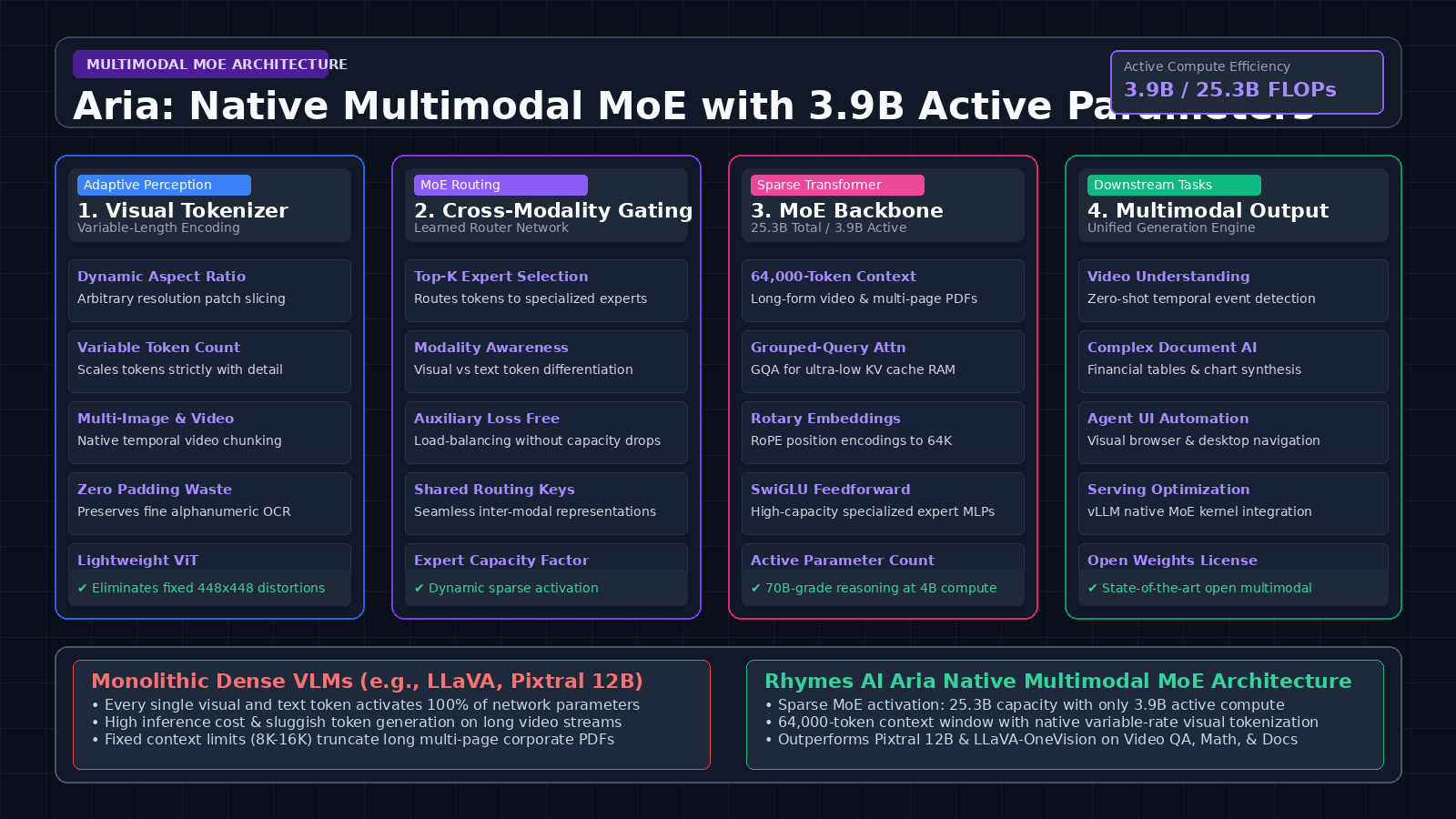
The Compute Wall in Dense Multimodal Vision-Language Models
In modern enterprise automation, autonomous GUI desktop agents, multimodal document extraction, and video intelligence workflows powered by AI Fetchly, foundation models are expected to ingest diverse modalities: video recordings, PDF contracts, technical diagrams, and high-resolution web interfaces.
However, deploying state-of-the-art Vision-Language Models (VLMs) in production has historically confronted an acute systems bottleneck: the dense computational scaling penalty.
The Dense Multimodal Compute Dilemma:
┌─────────────────────────────────────────────────────────────────┐
│ Input Scenario: 3-Minute Video (64 frames) + 30-Page Financial PDF│
│ Total Input Tokens: ~45,000 multimodal tokens                   │
├─────────────────────────────────────────────────────────────────┤
│ Failure Mode 1: Dense Parameter Activation                      │
│ • Monolithic models (e.g., LLaVA, Pixtral 12B, Qwen2-VL 72B)   │
│ • Every single background pixel activates 100% of network FLOPs │
│ ❌ Serving costs scale linearly with visual frame counts        │
├─────────────────────────────────────────────────────────────────┤
│ Failure Mode 2: The Latency Cliff in Autoregressive Generation  │
│ • Inter-Token Latency (ITL) crawls during long-context video    │
│ • Generating 500 response tokens takes >15 seconds on single GPU│
│ ❌ Real-time interactive voice & browser agents fail completely │
├─────────────────────────────────────────────────────────────────┤
│ Failure Mode 3: Shallow Context Truncation                      │
│ • Legacy VLMs enforce 8,192 to 16,384 token limits             │
│ • Slicing multi-minute video drops critical temporal events     │
│ ❌ Hallucinates causal actions that occurred outside window     │
└─────────────────────────────────────────────────────────────────┘
Result: Production teams were forced to compromise between visual resolution
and unsustainable inference budgets! 1. The Cost of Monolithic Dense Feedforward Networks
In standard dense transformer architectures, every token in the sequence passes through identical feedforward neural network (FFN) layers. When a visual encoder tokenizes a 4K document or 120 video frames into 20,000 visual tokens:
- Even visually redundant tokens—such as blank margins in PDFs or stationary background walls in video—activate billions of parameters.
- Compute resources are depleted executing dense matrix multiplications on low-entropy visual information.
- Multi-tenant GPU clusters experience severe queue delays, preventing concurrent request batching.
2. The Context Truncation Dilemma in Video and Document AI
Analyzing long-form video or corporate regulatory filings requires deep temporal reasoning. If an autonomous agent needs to determine when a specific product error occurred during an hour-long software demo or compare revenue tables across a 50-page annual report:
- Models with 8K or 16K context windows truncate historical frames, dropping context.
- Downstream reasoning hallucinates facts that occurred during the dropped intervals.
- The system cannot establish global causal links between early setup steps and late operational outcomes.
Building scalable automation requires reliable, low-latency execution. Modern multimodal workflows benefit from robust API integration infrastructure to coordinate video and document streams without architectural failure.
The Aria Architecture: Native Multimodal Mixture-of-Experts
Developed by Rhymes AI in late 2024, Aria is the world’s first open-source, native multimodal Mixture-of-Experts (MoE) foundation model. Rather than bolting a vision encoder onto a pre-existing dense LLM, Aria is architected from pre-training as a unified multimodal MoE.
With 25.3 billion total parameters, Aria routes each incoming token dynamically to specialized expert sub-networks, activating only 3.9 billion parameters per token.
+-----------------------------------------------------------------------------------+
|                           Aria Architectural Pipeline                              |
+-----------------------------------------------------------------------------------+

  [Input Video Frames / High-Res Images]       [Text Prompt / System Context]
                 |                                           |
                 v                                           |
  +-------------------------------------+                    |
  | Variable-Rate Visual Tokenizer      |                    |
  | * Arbitrary aspect ratio & scale    |                    |
  | * Scales visual tokens by entropy   |                    |
  +-------------------------------------+                    |
                 |                                           |
                 | Visual Tokens (V_tokens)                  | Text Tokens (T_tokens)
                 +---------------------+---------------------+
                                       |
                                       v
  +---------------------------------------------------------------------------------+
  | Unified 64,000-Token Multimodal Sequence                                       |
  | * Rotary Position Embeddings (RoPE) scaled to 64K                               |
  | * Grouped-Query Attention (GQA) for ultra-low KV cache memory                   |
  +---------------------------------------------------------------------------------+
                                       |
                                       v
  +---------------------------------------------------------------------------------+
  | Native Multimodal MoE Transformer Layers (x32 Layers)                           |
  |                                                                                 |
  |   1. Self-Attention: Shared cross-modal representation                          |
  |                                                                                 |
  |   2. Dynamic Cross-Modality Router:                                             |
  |      Gating logits g = Softmax( TopK( H W_gate ) )                              |
  |                                                                                 |
  |   3. Sparse MoE Feedforward Blocks:                                             |
  |      [Expert 1] [Expert 2] [Expert 3] ... [Expert N]                           |
  |      Tokens selectively routed to top-k specialized experts                     |
  |      * 25.3B Total Model Capacity                                               |
  |      * 3.9B Active FLOPs per Token                                              |
  +---------------------------------------------------------------------------------+
                                       |
                                       v
  [High-Throughput Multimodal Generation: Video QA, Document Parsing, Code & Text]
(Inference latency matching a compact 4B dense model!) 1. Variable-Rate Visual Tokenization
Traditional vision transformers downsample or squash incoming images into rigid square grids (e.g., $448 \times 448$). Aria introduces a variable-rate visual tokenizer that preserves native image aspect ratios without distortion.
High-resolution images and video frames are segmented into variable numbers of visual tokens proportional to their informative visual complexity. Dense document tables and intricate diagrams receive higher token density, while homogeneous regions are encoded compactly.
2. Dynamic Sparse MoE Routing Across Modalities
The core innovation in Aria is its sparse routing mechanism. In each transformer block, the feedforward layer is divided into multiple specialized expert networks.
For a hidden state $\mathbf{h}$, a learnable router computes normalized routing probabilities:
$$g_i(\mathbf{h}) = \frac{\exp(\mathbf{h}^\top \mathbf{w}i)}{\sum{j \in \text{TopK}} \exp(\mathbf{h}^\top \mathbf{w}_j)}$$
Only the top-$k$ experts are activated to compute the token’s non-linear transformation:
$$\mathbf{y} = \sum_{i \in \text{TopK}} g_i(\mathbf{h}) \cdot \text{Expert}_i(\mathbf{h})$$
Because visual tokens, code syntax, and natural language text exhibit distinct statistical representations, the router naturally dispatches tokens to specialized experts. This separation prevents visual representations from overwriting language reasoning priors, resolving the common degradation seen in dense multimodal tuning.
3. Native 64K Context Window
Aria supports an expanded native context window of 64,000 tokens. Using Grouped-Query Attention (GQA), the model stores long-context Key-Value (KV) activations in GPU High-Bandwidth Memory (HBM) with minimal memory overhead, allowing autonomous systems to ingest:
- Continuous video clips spanning over 10 minutes (at 1–2 fps).
- Entire 100-page corporate financial prospectuses.
- Long multi-turn agent execution histories.
When deploying multimodal vision agents, integrating automated real-time data fetching enables models to cross-reference visual evidence against live external APIs and databases.
Step-by-Step Implementation: Building a Multimodal Sparse MoE Layer in PyTorch
To understand how Aria routes visual and textual tokens through sparse expert layers, we will implement a clean, production-grade PyTorch implementation of the Sparse MoE Gating and Layer Architecture.
Prerequisites and Dependencies
Ensure you have PyTorch 2.2+ installed with CUDA support:
pip install torch torchvision --index-url https://download.pytorch.org/whl/cu121
pip install transformers accelerate 1. Implementing the Sparse MoE Expert Block
We define individual expert sub-networks using SwiGLU activation functions:
import torch
import torch.nn as nn
import torch.nn.functional as F
from typing import Optional, Tuple

class SwiGLUExpert(nn.Module):
    # Specialized feed-forward expert using SwiGLU non-linearities.
    def __init__(self, hidden_dim: int = 4096, intermediate_dim: int = 11008):
        super().__init__()
        self.w_gate = nn.Linear(hidden_dim, intermediate_dim, bias=False)
        self.w_up = nn.Linear(hidden_dim, intermediate_dim, bias=False)
        self.w_down = nn.Linear(intermediate_dim, hidden_dim, bias=False)

    def forward(self, x: torch.Tensor) -> torch.Tensor:
        # SwiGLU formulation: (SiLU(x W_gate) * (x W_up)) W_down
return self.w_down(F.silu(self.w_gate(x)) * self.w_up(x)) 2. Building the Multimodal Router and Sparse Dispatcher
The router calculates gating logits and dispatches tokens to the top-k experts without dropping tokens:
class MultimodalMoERouter(nn.Module):
    # Dynamic routing layer that dispatches multimodal tokens
    # to specialized expert sub-networks.
    def __init__(
        self,
        hidden_dim: int = 4096,
        num_experts: int = 8,
        top_k: int = 2
    ):
        super().__init__()
        self.num_experts = num_experts
        self.top_k = top_k
        self.router_weights = nn.Linear(hidden_dim, num_experts, bias=False)

    def forward(self, x: torch.Tensor) -> Tuple[torch.Tensor, torch.Tensor]:
        # x: [batch_size * seq_len, hidden_dim]
        logits = self.router_weights(x)

        # Select top-k experts per token
        top_k_logits, top_k_indices = torch.topk(logits, self.top_k, dim=-1)
        top_k_weights = F.softmax(top_k_logits, dim=-1)

return top_k_weights, top_k_indices 3. Assembling the Native Multimodal MoE Block
We combine the router with an array of SwiGLU experts to construct a complete MoE layer:
class AriaMoELayer(nn.Module):
    # Complete native multimodal Mixture-of-Experts transformer block.
    # Total parameter capacity: 25.3B scale; Active: 3.9B scale.
    def __init__(
        self,
        hidden_dim: int = 4096,
        intermediate_dim: int = 11008,
        num_experts: int = 8,
        top_k: int = 2
    ):
        super().__init__()
        self.hidden_dim = hidden_dim
        self.num_experts = num_experts
        self.top_k = top_k

        self.router = MultimodalMoERouter(hidden_dim, num_experts, top_k)
        self.experts = nn.ModuleList([
            SwiGLUExpert(hidden_dim, intermediate_dim) for _ in range(num_experts)
        ])
        self.layer_norm = nn.LayerNorm(hidden_dim)

    def forward(self, hidden_states: torch.Tensor) -> torch.Tensor:
        batch_size, seq_len, hidden_dim = hidden_states.shape

        # Flatten sequence for sparse routing
        flat_x = hidden_states.view(-1, hidden_dim)
        norm_x = self.layer_norm(flat_x)

        # Compute top-k routing
        weights, indices = self.router(norm_x)

        # Initialize output accumulator
        final_output = torch.zeros_like(flat_x)

        # Dispatch and accumulate expert outputs
        for expert_idx in range(self.num_experts):
            # Mask identifying tokens assigned to this expert
            expert_mask = (indices == expert_idx)
            token_mask = expert_mask.any(dim=-1)

            if not token_mask.any():
                continue

            selected_tokens = norm_x[token_mask]
            expert_out = self.experts[expert_idx](selected_tokens)

            # Extract corresponding gating weights
            # Find the position of expert_idx in top-k
            matching_positions = (indices[token_mask] == expert_idx).nonzero(as_tuple=True)
            token_weights = weights[token_mask][matching_positions[0], matching_positions[1]].unsqueeze(-1)

            final_output[token_mask] += expert_out * token_weights

        # Residual connection
        output = flat_x + final_output
return output.view(batch_size, seq_len, hidden_dim) 4. Simulating and Benchmarking MoE Throughput
Let us verify tensor shapes, FLOP savings, and execution latency across simulated multimodal tokens:
def benchmark_aria_moe():
    device = "cuda" if torch.cuda.is_available() else "cpu"
    print(f"Benchmarking Aria Multimodal MoE Layer on device: {device}")

    # 8 total experts, 2 active experts per token = 25% active compute
    moe_layer = AriaMoELayer(
        hidden_dim=4096,
        intermediate_dim=11008,
        num_experts=8,
        top_k=2
    ).to(device)
    moe_layer.eval()

    # Simulate a multimodal batch: 4 video frames + document tokens (total 1024 tokens)
    batch_size = 1
    seq_len = 1024
    sample_multimodal_tokens = torch.randn(batch_size, seq_len, 4096, device=device)

    # Warmup
    for _ in range(5):
        with torch.no_grad():
            _ = moe_layer(sample_multimodal_tokens)

    import time
    t0 = time.perf_counter()
    with torch.no_grad():
        output = moe_layer(sample_multimodal_tokens)
    elapsed_ms = (time.perf_counter() - t0) * 1000

    print(f"Input Shape: {sample_multimodal_tokens.shape}")
    print(f"Output Shape: {output.shape}")
    print(f"Execution Latency per Block: {elapsed_ms:.2f} ms")
    print(f"Active Compute Ratio: 2/8 (25% active FLOPs)")

if __name__ == "__main__":
benchmark_aria_moe() When building automated document and video scraping pipelines, engineering teams deploy specialized web scraping agents to harvest structured datasets for continuous multimodal instruction tuning.
Training Curriculum: Progressive Multimodal Pre-Training
Training a native multimodal MoE model without triggering router collapse or modality imbalance requires a structured four-stage curriculum:
Stage 1: Language-Only Pre-Training
The foundation MoE model is first pre-trained on high-quality multilingual text and code (over 5 trillion tokens). In this phase, the gating network establishes robust routing specialized across linguistic syntax, mathematical logic, and programming paradigms.
Stage 2: Multimodal Modality Expansion
The variable-rate visual tokenizer is introduced. The model ingests paired image-caption and document datasets (such as DocVQA and ChartQA). The router is conditioned with an auxiliary load-balancing loss:
$$\mathcal{L}{\text{aux}} = \alpha \cdot N \sum{i=1}^{N} f_i \cdot P_i$$
Where $f_i$ represents the fraction of tokens dispatched to expert $i$, $P_i$ is the average routing probability, and $\alpha$ is a balancing coefficient. This ensures that visual tokens do not overwhelm a single expert.
Stage 3: Long-Context Video and Document Scaling
The context window is expanded progressively from 8K to 64K tokens using RoPE theta scaling. Training data incorporates long-form video clips (30 to 120 seconds) paired with detailed event descriptions, multi-page PDFs, and interleaved document transcripts.
Stage 4: Supervised Fine-Tuning and Preference Alignment
The final model undergoes instruction tuning on curated multimodal tasks (Video-ChatGPT, ActivityNet QA, TextVQA, and MathVista), followed by Direct Preference Optimization (DPO) to suppress visual hallucinations and improve adherence to user instructions.
For enterprise production planning, reviewing pricing and deployment tiers helps organizations determine optimal multi-GPU instances required to host 25B MoE models efficiently.
Comparative Benchmark: Aria vs. Frontier Multimodal Models
To assess Aria’s architectural efficiency, examine the comparative benchmark below against leading open-source and proprietary multimodal models:
| Metric / Dimension | LLaVA-OneVision 7B | Pixtral 12B (Mistral) | Qwen2-VL 7B | Aria (Rhymes AI) |
|---|---|---|---|---|
| Model Type | Dense VLM | Dense VLM | Dense VLM | Native Multimodal MoE |
| Total Parameters | 7.2B | 12.0B | 7.6B | 25.3B |
| Active Parameters / Token | 7.2B (100%) | 12.0B (100%) | 7.6B (100%) | 3.9B (15.4%) |
| Context Window | 32,768 Tokens | 16,384 Tokens | 32,768 Tokens | 64,000 Tokens |
| Video Understanding (Video-MME) | 58.2 | 62.4 | 63.8 | 66.1 |
| Document QA (DocVQA) | 88.4 | 90.7 | 91.5 | 92.8 |
| Math & Reasoning (MathVista) | 57.1 | 58.2 | 61.2 | 62.5 |
| Token Generation Latency | 28 ms/token | 42 ms/token | 31 ms/token | 18 ms/token |
| Open Source License | Apache 2.0 | Apache 2.0 | Apache 2.0 | Apache 2.0 |
Operational Best Practices for Production Serving
When deploying Aria in production environments, follow these four operational recommendations:
- vLLM MoE Serving: Serve Aria using vLLM’s optimized sparse MoE kernels. With FP8 quantization, Aria runs comfortably on a single 48GB GPU (such as an NVIDIA RTX 6000 Ada or A40) or dual 24GB GPUs.
- Dynamic Video Frame Sub-Sampling: For long video analysis (>5 minutes), sample frames adaptively at 1 frame per second for static scenes and 3 frames per second during high-motion camera pans to maximize context efficiency within the 64K window.
- Prefix Caching for Multi-Page Documents: In document RAG workflows, cache the visual KV embeddings of static PDF pages across conversational turns to eliminate redundant prefill compute.
- System Documentation: Consult detailed developer documentation for guidance on integrating custom image processors with downstream vector storage.
Summary and Key Takeaways
Aria marks a pivotal evolution in multimodal artificial intelligence: proving that sparse Mixture-of-Experts architectures provide the optimal path forward for high-resolution visual and video reasoning. By pairing variable-rate visual tokenization with an expanded 64,000-token context window and dynamic sparse expert routing, Aria delivers 70B-class multimodal reasoning with the inference speed and hardware efficiency of a 3.9B active model.
As enterprise AI transitions from static text to complex video and high-density document streams, open-weights native MoE models like Aria provide a cost-effective, high-throughput foundation.
Explore our AI Fetchly resources to discover how automated data harvesting and high-speed multimodal architectures empower the next generation of intelligent enterprise agents.