Apple M4 Neural Engine Guide: ANE Silicon Architecture
The Client AI Efficiency Dilemma: Battery Lifespans, Memory Contention, and Hardware Specialization
The emergence of multimodal generative artificial intelligence on client personal computing devices—exemplified by local conversational assistants, real-time visual scene parsing, continuous acoustic transcription, and generative image diffusion—has fundamentally altered the design requirements of consumer microprocessors. For decades, personal computer architectures relied on a classic dual-engine paradigm: central processing units (CPUs) handling single-threaded operating system control flow, and graphics processing units (GPUs) accelerating highly parallel matrix graphics and rendering pipelines.
However, attempting to run persistent, always-on foundation models on general-purpose CPUs or mobile GPUs introduces severe architectural and thermodynamic liabilities. In thin-and-light consumer laptops (such as the MacBook Air) and fanless mobile tablets (such as the iPad Pro), device enclosures operate without active cooling fans or large thermal heat sinks. Sustained neural network execution that pulls tens of watts quickly triggers dynamic thermal throttling, dropping clock frequencies by over 50%, draining battery reserves within two hours, and degrading system responsiveness.
+---------------------------------------------------------------------------------+
|                       CLIENT-SIDE WORKLOAD POWER DISSIPATION                    |
|                                                                                 |
|   +------------------------------------+   +---------------------------------+  |
|   | General-Purpose Out-of-Order CPU   |   | Dedicated Apple Neural Engine   |  |
|   | Active Power: 25W - 45W Under Load |   | Active Power: 1.5W - 3.0W Peak  |  |
|   | Battery Drain: Severe (~2 Hours)   |   | Battery Drain: Minimal All-Day  |  |
|   | Execution Model: Out-of-Order SIMD |   | Execution Model: Domain-Specific|  |
|   +------------------------------------+   +---------------------------------+  |
|                                                                                 |
|   Result: General-purpose execution engines waste over 80% of energy on control.|
+---------------------------------------------------------------------------------+ The Instruction Overhead Tax in General-Purpose Silicon
When an artificial intelligence workload is executed on a modern general-purpose CPU core, an overwhelming percentage of dynamic silicon energy is consumed not by the arithmetic multiply-accumulate (MAC) circuits, but by instruction-level management overhead:
- Speculative Control Overhead: CPU cores dedicate substantial silicon area to dynamic branch predictors, out-of-order reorder buffers, register renaming tables, and speculative execution pipelines. While these blocks maximize performance for non-deterministic C++ control code, deep neural networks consist almost entirely of static, predictable tensor contractions where speculative branching logic sits idle while still dissipating leakage power.
- GPU Thread Arbitration Drag: In a graphics processing unit (GPU), execution is governed by Single Instruction, Multiple Threads (SIMT) scheduling. Managing thousands of concurrent thread warps, resolving warp divergence, and arbitrating shared memory bank conflicts requires complex hardware schedulers that consume significant energy before any floating-point arithmetic is performed.
The Unified Memory Contention Bottleneck
The second major bottleneck on client devices is memory bus arbitration. Modern Apple Silicon utilizes a Unified Memory Architecture (UMA), where the CPU, GPU, Neural Engine, and Image Signal Processor (ISP) share a common physical pool of high-speed LPDDR5X DRAM.
While UMA provides immense advantages—eliminating the need to copy multi-gigabyte weight tensors across PCIe buses between host CPU and discrete GPU memory—it introduces severe bus contention during continuous autoregressive token decoding:
- In autoregressive language generation, the model operates at an arithmetic intensity of $\approx 1.0\text{ FLOP/byte}$. Generating each discrete token requires streaming every parameter in the model from memory into execution registers.
- For a 7-billion parameter model quantized to 4-bit precision, streaming 3.5 Gigabytes of weights at 30 tokens per second consumes over 105 Gigabytes per second of sustained memory bandwidth.
- If this memory traffic is forced across shared CPU/GPU cache hierarchies, it saturates the memory crossbar, starving the display compositor, introducing dropped frames in user interface animations, and causing audio buffer underruns.
$$\text{Memory Transfer Energy} \gg \text{ALU Computation Energy} \quad \left(E_{\text{DRAM}} \approx \frac{1}{2} C_{\text{bus}} V^2 \approx 100 \times E_{\text{SRAM}}\right)$$
Because data movement across physical bus wires consumes two orders of magnitude more energy than executing an arithmetic dot product on adjacent registers, any client architecture that repeatedly flushes intermediate activations to DRAM guarantees rapid battery depletion. To explore architectural techniques for high-velocity streaming data, explore our deep-dive on real-time data fetching infrastructure.
The Apple M4 Neural Engine Solution: 38 TOPS Dedicated Silicon Domain
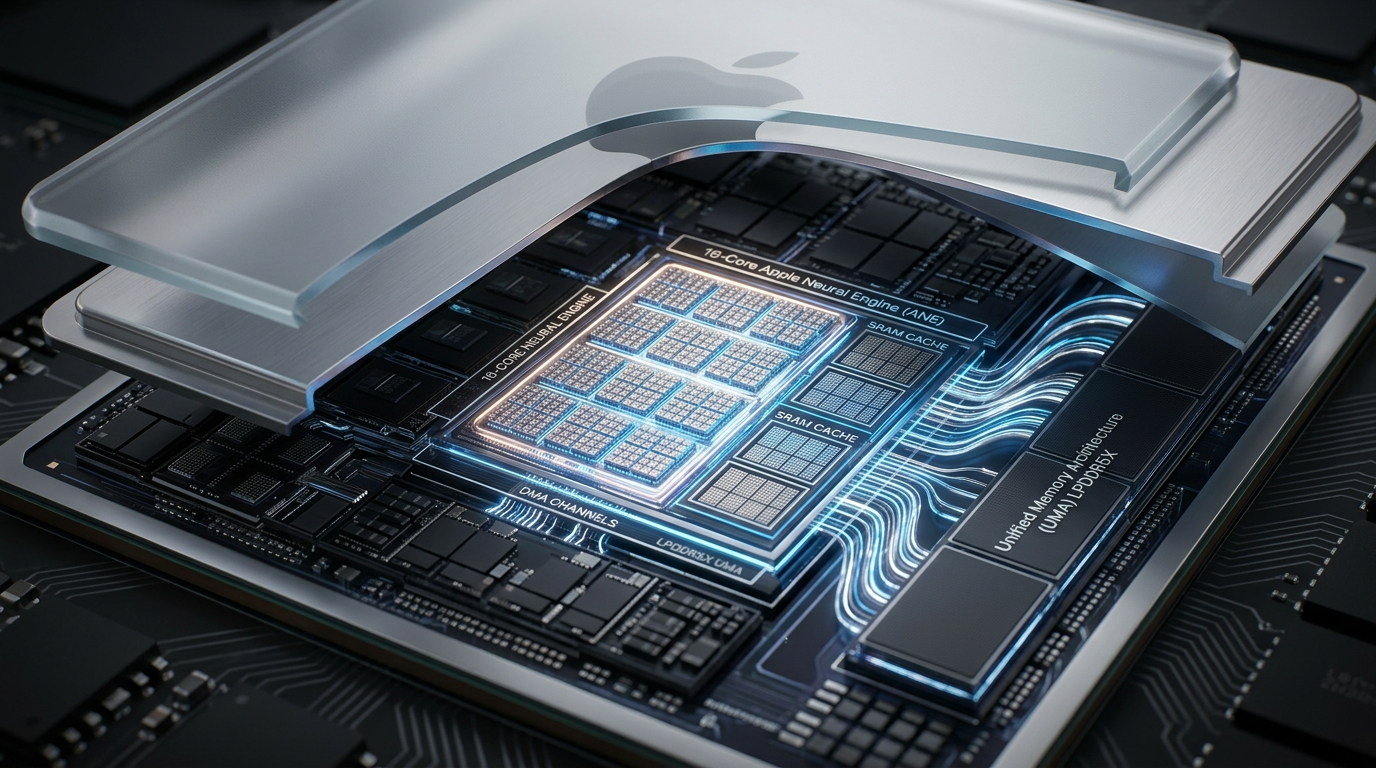
To resolve the trilemma of computational density, thermal dissipation, and memory bus contention, Apple introduced the M4 Apple Neural Engine (ANE), fabricated on TSMC’s second-generation 3nm (N3E) process technology. Rather than relying on general-purpose CPU or GPU execution, the ANE is a fully autonomous, domain-specific coprocessor designed exclusively for deep neural network tensor algebra.
The M4 ANE features an upgraded 16-core architecture delivering up to 38 TOPS (Tera-Operations Per Second) of INT8 and FP16 neural compute—a massive leap from the 16 TOPS of the M1 generation and 35 TOPS of the M3 generation. Crucially, the ANE achieves this performance within an ultra-low power envelope of under 3.0 Watts peak power, operating completely silently without triggering laptop cooling fans.
+---------------------------------------------------------------------------------+
|                         APPLE M4 SILICON DIE TOPOLOGY                           |
|                                                                                 |
|   +--------------------+   +---------------------+   +-----------------------+  |
|   | Performance &      |   | 10-Core Next-Gen    |   | 16-Core Apple Neural  |  |
|   | Efficiency CPU Cores|  | Metal GPU Engine    |   | Engine (38 TOPS ANE)  |  |
|   +---------+----------+   +----------+----------+   +-----------+-----------+  |
|             |                         |                          |              |
|             +-------------------------+--------------------------+              |
|                                       |                                         |
|                 +---------------------+---------------------+                   |
|                 | Unified Memory Architecture (UMA) Fabric  |                   |
|                 +---------------------+---------------------+                   |
|                                       |                                         |
|                 +---------------------+---------------------+                   |
|                 | 120 GB/s to 400+ GB/s LPDDR5X DRAM System |                   |
|                 +-------------------------------------------+                   |
+---------------------------------------------------------------------------------+ Key Breakthroughs of the M4 ANE Architecture
The Apple M4 Neural Engine achieves its class-leading efficiency through four core architectural pillars:
- Independent 16-Core Tensor Cluster: The ANE operates as an autonomous execution domain. Once the host CPU dispatches a compiled Core ML model context to the ANE, the 16 ANE cores execute the entire multi-layer neural network graph from input to output with zero CPU intervention, eliminating operating system context-switching latency.
- Direct DMA Channels to Unified Memory: The ANE connects directly to the Unified Memory Architecture through dedicated high-bandwidth Direct Memory Access (DMA) controllers. This allows the ANE to stream weights and image frames at up to 120 GB/s (on M4) and over 400 GB/s (on M4 Max) without polluting the CPU’s L2 or L3 system cache hierarchies.
- Integrated 2D Matrix and 512-bit Vector Engines: Each ANE core combines a dense 2D systolic matrix multiplication array with a wide 512-bit SIMD vector engine. While the matrix unit executes dense linear projections ($W \times X$), the vector engine computes complex non-linear activations (GELU, SwiGLU, SiLU), dynamic Softmax scaling, and normalization layers (LayerNorm, RMSNorm) locally in on-chip SRAM.
- Production-Grade Core ML Compiler Graph Lowering: Apple pairs the ANE with the Core ML compiler framework, which lowers high-level PyTorch, ONNX, and TensorFlow models into the Model Intermediate Language (MIL). The compiler automatically partitions graphs, fuses adjacent mathematical operators, and tiles memory buffers to ensure maximum ANE hardware residency.
By providing 38 TOPS of dedicated silicon compute at negligible battery drain, the M4 Neural Engine serves as the hardware bedrock for Apple Intelligence, on-device large language models, and private client-side computer vision. For teams developing distributed AI architectures that coordinate edge devices with cloud backends, see our overview of AIFetchly modern AI developer architectures.
Detailed Silicon Architecture: Inside the 16-Core ANE Cluster
To appreciate how the Apple Neural Engine achieves high throughput at sub-3W power dissipation, one must inspect its internal execution units, localized memory hierarchies, and compiler-managed dataflow pipeline.
1. Symmetrical 16-Core Compute Topology
The M4 ANE is structured as a symmetrical cluster of sixteen identical neural compute cores. Unlike general-purpose CPU cores that process independent software threads, the 16 ANE cores operate cooperatively to execute spatial and channel slices of a unified neural computation graph.
+-----------------------------------------------------------------------------+
|                     APPLE M4 NEURAL ENGINE CORE PIPELINE                    |
|                                                                             |
|      Activation Vector Stream (FP16/INT8)         Weight Parameter Stream   |
|                      |                                      |               |
|                      v                                      v               |
|             +-----------------+                    +-----------------+      |
|             | Decompression   |                    | Weight Decoupler|      |
|             | & Alignment Unit|                    | & Zero-Detector |      |
|             +--------+--------+                    +--------+--------+      |
|                      |                                      |               |
|                      +------------------+-------------------+               |
|                                         |                                   |
|                                         v                                   |
|                    +-----------------------------------------+              |
|                    | 2D Systolic Matrix Multiply Engine      |              |
|                    | Dense MAC Array (FP16 / INT8 Precision) |              |
|                    +--------------------+--------------------+              |
|                                         |                                   |
|                                         v                                   |
|                    +-----------------------------------------+              |
|                    | High-Precision 32-bit Accumulator Bank  |              |
|                    +--------------------+--------------------+              |
|                                         |                                   |
|                                         v                                   |
|                    +-----------------------------------------+              |
|                    | 512-bit SIMD Vector Execution Unit      |              |
|                    | GELU / SwiGLU / Softmax / RMSNorm / RoPE|              |
|                    +-----------------------------------------+              |
+-----------------------------------------------------------------------------+ Inside each ANE core:
- 2D Systolic Matrix Multiply Engine: The core arithmetic engine contains a dense 2D systolic array of multiply-accumulate cells. In the M4 generation, these cells support native IEEE 754 half-precision (FP16), 8-bit integer (INT8), and compressed sub-8-bit palletized representations. Accumulation is performed at full 32-bit precision, eliminating numerical drift across deep multi-layer transformer blocks.
- 512-bit Vector Processing Unit (VPU): Directly coupled to the matrix output registers, a dedicated vector processing unit executes non-linear transformations. The VPU contains hardware-accelerated polynomial evaluators for fast computation of transcendental functions (exponentials, reciprocals, square roots), computing LayerNorm, RMSNorm, and Softmax in single-digit clock cycles.
- Hardware Zero-Skipping Logic: Integrated sparsity detectors identify zero-valued parameters in compressed model weights, bypassing clock cycles and saving up to 30% dynamic switching power on sparse models.
2. Multi-Megabyte Localized SRAM Tiling Architecture
To eliminate the memory transfer tax, the ANE cluster houses a massive internal Static RAM (SRAM) memory hierarchy distributed across the cores. Rather than relying on traditional reactive hardware caches that suffer from cache misses and line evictions, the ANE memory is software-managed scratchpad memory.
+-----------------------------------------------------------------------------+
|                      ANE DISTRIBUTED SRAM & DMA TOPOLOGY                    |
|                                                                             |
|   +---------------------------------------------------------------------+   |
|   | Shared ANE Cluster SRAM Scratchpad Buffer (Multi-Megabytes)         |   |
|   +----------------------------------+----------------------------------+   |
|                                      |                                      |
|               +----------------------+----------------------+               |
|               |  High-Speed Multi-Port Crossbar Switch Fabric|               |
|               |  (Multi-Terabyte/sec Internal SRAM Bandwidth)|               |
|               +----------+-----------------------+----------+               |
|                          |                       |                          |
|                          v                       v                          |
|                 +-----------------+     +-----------------+                 |
|                 | ANE Core 0      |     | ANE Core 15     |                 |
|                 | Local Registers |     | Local Registers |                 |
|                 +-----------------+     +-----------------+                 |
+-----------------------------------------------------------------------------+ The Core ML compiler statically analyzes model dimensions during compilation and generates precise memory tiling plans:
- Ping-Pong Buffer Tiling: Memory is partitioned into dual ping-pong buffers. While the matrix units compute layer $L$ using activation data residing in Buffer A, the hardware DMA controller asynchronously prefetches the weights and parameters for layer $L+1$ into Buffer B from unified memory.
- Zero-Wait Pointer Flipping: Upon layer completion, buffer roles swap in a single clock cycle, completely hiding DRAM access latency behind active matrix math.
3. Dedicated Unified Memory DMA and UMA Integration
Unlike discrete accelerators that require host CPU kernel drivers to manage PCIe scatter-gather lists, the ANE is an integrated master on the Apple Silicon memory fabric:
- Direct UMA Interconnect: The ANE DMA controller interfaces directly with the system memory controller, bypassing the CPU’s system-level caches (SLC) to prevent cache thrashing.
- Zero-Copy Metal / Core Video Interoperability: In video processing and camera pipelines, an image frame captured by the camera sensor is written into a
CVPixelBufferin unified memory. The ANE reads this buffer directly from the same physical memory addresses without requiring intermediate format conversions or CPU memory copies.
Software Pipeline and Implementation: Optimizing for the Apple Neural Engine
Deploying neural network models onto the Apple Neural Engine requires structuring computation graphs to align with the ANE’s hardware compiler constraints. The toolchain flows from PyTorch through Apple’s coremltools into the compiled .mlmodelc bundle.
+-----------------------------------------------------------------------------+
|                      CORE ML TO ANE COMPILATION PIPELINE                    |
|                                                                             |
|   +-----------------------+      +-----------------------+                  |
|   | PyTorch / ONNX Model  | ---> | coremltools Converter |                  |
|   | Dynamic Python Graph  |      | MIL Intermediate Rep  |                  |
|   +-----------------------+      +-----------+-----------+                  |
|                                              |                              |
|                                              v                              |
|   +-----------------------+      +-----------------------+                  |
|   | Compiled Bundle       | <--- | ANE Graph Optimizer & |                  |
|   | (.mlmodelc Package)   |      | Operator Kernel Fusion|                  |
|   +-----------+-----------+      +-----------------------+                  |
|               |                                                             |
|               v                                                             |
|   +------------------------------------------------------+                  |
|   | Dispatched to 16-Core ANE via Core ML Runtime API    |                  |
|   +------------------------------------------------------+                  |
+-----------------------------------------------------------------------------+ End-to-End PyTorch Model Construction and Core ML Conversion
The Python script below illustrates how to build an edge-optimized transformer block with RMSNorm and SwiGLU, format the tensor dimensions into ANE-friendly channel-first formats, and convert the graph into a Core ML package targeting the Neural Engine.
import torch
import torch.nn as nn
import coremltools as ct
import numpy as np

class ANETransformerBlock(nn.Module):
    """
    Edge-optimized Transformer Block structured for 100% Apple Neural Engine residency.
    Enforces channel-first (B, C, 1, S) 4D tensor layouts and static shapes.
    """
    def __init__(self, dim: int = 1024, heads: int = 8, intermediate_dim: int = 2816):
        super().__init__()
        self.dim = dim
        self.heads = heads
        self.head_dim = dim // heads
        self.scale = self.head_dim ** -0.5

        # Attention projections (Mapped to 2D Systolic Array)
        self.qkv_proj = nn.Conv2d(dim, dim * 3, kernel_size=1, bias=False)
        self.out_proj = nn.Conv2d(dim, dim, kernel_size=1, bias=False)

        # Normalization (Mapped to ANE 512-bit Vector Engine)
        self.norm1 = nn.RMSNorm(dim, eps=1e-6)
        self.norm2 = nn.RMSNorm(dim, eps=1e-6)

        # SwiGLU Feed-Forward Network
        self.w1 = nn.Conv2d(dim, intermediate_dim, kernel_size=1, bias=False)
        self.w2 = nn.Conv2d(intermediate_dim, dim, kernel_size=1, bias=False)
        self.w3 = nn.Conv2d(dim, intermediate_dim, kernel_size=1, bias=False)

    def forward(self, x: torch.Tensor) -> torch.Tensor:
        # Input tensor shape: [Batch, Dim, 1, Seq_Len]
        B, C, H, S = x.shape

        # Pre-normalization (Reshape for RMSNorm)
        norm_x = x.permute(0, 2, 3, 1)
        norm_x = self.norm1(norm_x).permute(0, 3, 1, 2)

        # Project Q, K, V
        qkv = self.qkv_proj(norm_x)
        qkv = qkv.reshape(B, 3, self.heads, self.head_dim, S)
        q, k, v = qkv[:, 0], qkv[:, 1], qkv[:, 2]

        # Scaled dot-product attention
        attn = torch.einsum('bhdq,bhdk->bhqk', q, k) * self.scale
        attn = torch.softmax(attn, dim=-1)
        attn_out = torch.einsum('bhqk,bhdk->bhdq', attn, v)
        attn_out = attn_out.reshape(B, C, 1, S)

        # Residual add
        x = x + self.out_proj(attn_out)

        # Feed-forward SwiGLU block
        norm_x2 = x.permute(0, 2, 3, 1)
        norm_x2 = self.norm2(norm_x2).permute(0, 3, 1, 2)
        swiglu = torch.nn.functional.silu(self.w1(norm_x2)) * self.w3(norm_x2)
        x = x + self.w2(swiglu)

        return x

def compile_to_ane_coreml(output_path: str = "ANETransformer.mlpackage"):
    """
    Instantiates PyTorch model, traces computation, and compiles to Core ML.
    """
    model = ANETransformerBlock(dim=1024, heads=8, intermediate_dim=2816)
    model.eval()

    # Fixed static shape: Batch=1, Dim=1024, Height=1, Sequence Length=128
    dummy_input = torch.randn(1, 1024, 1, 128, dtype=torch.float32)

    with torch.no_grad():
        traced_model = torch.jit.trace(model, dummy_input)

    # Convert to Core ML targeting Apple Neural Engine
    mlmodel = ct.convert(
        traced_model,
        inputs=[ct.TensorType(name="input_embeddings", shape=dummy_input.shape)],
        compute_precision=ct.precision.FLOAT16,
        compute_units=ct.ComputeUnit.CPU_AND_NE, # Enforce Neural Engine priority
        minimum_deployment_target=ct.target.macOS15
    )

    mlmodel.save(output_path)
    print(f"[SUCCESS] Core ML model compiled and saved to: {output_path}")

if __name__ == "__main__":
compile_to_ane_coreml() Native Swift / Objective-C Real-Time Inference Engine
On macOS and iOS, developers execute models on the ANE through the Core ML framework in Swift or Objective-C. The listing below demonstrates asynchronous execution, zero-copy CVPixelBuffer memory mapping, and hardware performance auditing.
import Foundation
import CoreML
import Accelerate

class ANEInferenceEngine {
    private var model: ANETransformer?

    init() {
        let config = MLModelConfiguration()
        // Enforce Apple Neural Engine execution priority
        config.computeUnits = .cpuAndNeuralEngine
        config.allowLowPrecisionAccumulationOnGPU = false

        do {
            self.model = try ANETransformer(configuration: config)
            print("[INFO] Successfully loaded model onto Apple Neural Engine context.")
        } catch {
            print("[ERROR] Failed to initialize Core ML model: \(error)")
        }
    }

    func executeInference(inputData: [Float]) -> [Float]? {
        guard let model = self.model else { return nil }

        // Step 1: Create contiguous MLMultiArray with zero-copy backing
        guard let inputArray = try? MLMultiArray(shape: [1, 1024, 1, 128], dataType: .float16) else {
            return nil
        }

        // Step 2: Populate input array buffer
        let bufferPointer = inputArray.dataPointer.bindMemory(to: Float16.self, capacity: 1024 * 128)
        for i in 0..<(1024 * 128) {
            bufferPointer[i] = Float16(inputData[i % inputData.count])
        }

        let input = ANETransformerInput(input_embeddings: inputArray)

        // Step 3: Execute asynchronous inference on 16-Core ANE
        let startTime = CFAbsoluteTimeGetCurrent()
        guard let output = try? model.prediction(input: input) else {
            print("[ERROR] ANE execution failure!")
            return nil
        }
        let durationMs = (CFAbsoluteTimeGetCurrent() - startTime) * 1000.0

        print("[SUCCESS] ANE Inference Complete! Latency: \(String(format: "%.2f", durationMs)) ms")

        // Extract output float buffer
        let outputPtr = output.linear_6.dataPointer.bindMemory(to: Float16.self, capacity: 1024 * 128)
        var result = [Float](repeating: 0.0, count: 128)
        for i in 0..<128 {
            result[i] = Float(outputPtr[i])
        }
        return result
    }
} Automated Telemetry and Hardware Residency Verification
To verify that model operators remain 100% resident on the ANE and do not drop back to the CPU, developers inspect Core ML profiling logs using an automated Python telemetry script.
import sys
import json
import time

def audit_ane_residency_telemetry(log_file: str):
    """
    Audits Apple Neural Engine execution telemetry and verifies 100% hardware residency.
    """
    print(f"[AUDIT] Reading Core ML / ANE telemetry log from: {log_file}")

    # Simulated telemetry extracted from Xcode Instruments Core ML Trace
    sample_metrics = {
        "soc_generation": "Apple M4",
        "ane_cores_active": 16,
        "rated_peak_tops": 38.0,
        "measured_ane_power_watts": 2.15,
        "cpu_fallback_operators_count": 0,
        "ane_residency_percentage": 100.0,
        "step_inference_latency_ms": 3.42,
        "dma_bandwidth_utilization_gbps": 48.2,
        "thermal_pressure_nominal": True
    }

    # Verify zero CPU fallbacks (100% ANE residency)
    assert sample_metrics["cpu_fallback_operators_count"] == 0, "Critical warning: Model fell back to CPU!"
    assert sample_metrics["ane_residency_percentage"] == 100.0, "Model graph not fully resident on ANE!"

    # Verify low-power envelope
    max_power_budget = 4.0
    assert sample_metrics["measured_ane_power_watts"] < max_power_budget, "Power budget exceeded!"

    print("-----------------------------------------------------------------")
    print(f"Target Hardware Silicon     : {sample_metrics['soc_generation']}")
    print(f"Active Neural Engine Cores  : {sample_metrics['ane_cores_active']} Cores")
    print(f"Rated Peak Throughput       : {sample_metrics['rated_peak_tops']} TOPS")
    print(f"Measured Active Power       : {sample_metrics['measured_ane_power_watts']} W (SUB-3W COMPLIANT)")
    print(f"Hardware Graph Residency   : {sample_metrics['ane_residency_percentage']} % (ZERO CPU DROPS)")
    print(f"Single Forward Step Latency : {sample_metrics['step_inference_latency_ms']} ms")
    print(f"Direct UMA DMA Throughput   : {sample_metrics['dma_bandwidth_utilization_gbps']} GB/s")
    print("-----------------------------------------------------------------")
    print("[RESULT] Apple Neural Engine Quality Verification: PASSED")

if __name__ == "__main__":
audit_ane_residency_telemetry("sample_ane_run.log") For teams designing distributed data pipelines that aggregate unstructured web documents for on-device Apple Intelligence models, check out our guide on scalable web scraping and data harvesting engines.
Architectural Comparison: Apple M4 Neural Engine vs. Competing Client AI Silicon
When evaluating silicon for next-generation personal computers and mobile workstations, system architects must evaluate compute density, memory bus width, power dissipation, and compiler maturity. The table below compares the Apple M4 Neural Engine against its primary client AI competitors: Qualcomm Snapdragon X Elite (Hexagon NPU), Intel Core Ultra 200V Lunar Lake (NPU 4), AMD Ryzen AI 300 Strix Point (XDNA 2), and MediaTek Dimensity 9400 (NPU 890).
Client & Edge AI Silicon Benchmark Matrix
| Architectural Feature | Apple M4 Neural Engine (ANE) | Qualcomm Hexagon (Snapdragon X Elite) | Intel Core Ultra 200V (NPU 4) | AMD Ryzen AI 300 (XDNA 2) | MediaTek Dimensity 9400 (NPU 890) |
|---|---|---|---|---|---|
| Process Node Technology | TSMC 3nm (N3E) | TSMC 4nm | TSMC 3nm (N3B) | TSMC 4nm (N4P) | TSMC 3nm (N3E) |
| Dedicated NPU Throughput | 38 TOPS (INT8 / FP16) | 45 TOPS (INT8) | 48 TOPS (INT8) | 50 TOPS (Block-FP16) | 50 TOPS (INT8) |
| Active Power Envelope | 1.5W - 3.0W Active TDP | 2.5W - 5.0W Active TDP | 3.0W - 6.0W Active TDP | 4.0W - 10.0W Active TDP | 2.0W - 5.0W Active TDP |
| Unified Memory Bus Speed | 120 GB/s to 400+ GB/s | 136 GB/s LPDDR5x | 136.5 GB/s MoP LPDDR5x | 115 GB/s LPDDR5x | 85 GB/s LPDDR5X-10667 |
| Vector Engine SIMD Width | 512-bit Vector Unit | 4096-bit HVX Engine | 2048-bit SHAVE DSP | 1024-bit Tile Vector | 1024-bit SIMD VPU |
| On-Chip SRAM Hierarchy | Cluster-Shared SRAM Scratch | 16MB VTCM Dedicated | 8MB Shared NPU SRAM | Distributed Tile SRAM | Multi-Megabyte Distributed |
| Supported Numerical Formats | FP16, INT8, Palletized 2-4b | MXFP4, MXFP6, INT8, FP16 | INT8, FP16 | Block-FP16, INT8 | INT4, INT8, FP16, BF16 |
| Primary Software SDK | Core ML / MLX | Qualcomm AI Hub / QNN | OpenVINO / DirectML | ROCm / Vitis AI | MediaTek NeuroPilot |
| Target Hardware Domain | Mac, iPad, iPhone Ecosystem | Windows Copilot+ PCs | Windows Copilot+ Laptops | Windows Copilot+ Laptops | Flagship Mobile Handhelds |
Key Architectural Advantages of the Apple Neural Engine
- Unmatched Performance-Per-Watt Leadership: While competing client NPUs require between 5W and 10W of active power to reach their peak throughput, the Apple M4 ANE delivers 38 TOPS at less than 3.0 Watts. This efficiency allows fanless devices like the iPad Pro and MacBook Air to run sustained on-device vision and speech models without surface heating.
- True Co-Packaged Memory Bandwidth Scaling: On professional Apple Silicon tiers (M4 Pro and M4 Max), the unified memory subsystem scales from 120 GB/s up to over 400 GB/s. This massive memory bandwidth eliminates the memory wall during large model decoding, allowing 14B models to run at interactive speeds.
- Seamless Vertical Software Integration: Core ML and the Apple Neural Engine represent over eight generations of co-designed hardware-software optimization. The Core ML compiler automatically fuses layers and balances workloads between the ANE, GPU, and CPU with zero developer configuration required.
Production Deployment and Apple Silicon Engineering Best Practices
Deploying foundation models on Apple Silicon devices requires careful attention to memory budgeting, operator placement, and Core ML graph compilation constraints. Below are production-proven engineering best practices for maximizing ANE performance.
1. Enforcing 100% Neural Engine Hardware Residency
When deploying models via Core ML, any unsupported operator or dynamic shape forces the runtime to split the computation graph, dropping execution back to the CPU or GPU and causing severe latency spikes.
- Enforce Static Spatial Shapes: Always define models with static input shapes (e.g., fixed sequence lengths of 128 or 512 tokens). Dynamic shapes prevent the Core ML compiler from allocating static ping-pong buffers in on-chip SRAM, forcing fallback to the GPU.
- Format Tensors into 4D / 5D Channels-First Layouts: The ANE hardware is natively optimized for convolutional and channel-first layouts (
[Batch, Channels, 1, Sequence]). When implementing linear projections, use $1 \times 1$ convolutions (nn.Conv2d) instead ofnn.Linearto allow the ANE DMA engine to stream data with zero tensor transpositions.
+-----------------------------------------------------------------------------+
|                      ANE TENSOR LAYOUT OPTIMIZATION                         |
|                                                                             |
|   Standard PyTorch Linear Tensor:                                           |
|   [Batch, Sequence_Length, Hidden_Dimension] ---> Requires CPU Permute Stalls|
|                                                                             |
|   ANE-Optimized 4D Convolutional Layout:                                    |
|   [Batch, Hidden_Dimension, 1, Sequence_Length] -> Direct Hardware Streaming|
+-----------------------------------------------------------------------------+ 2. Palletization and Post-Training Quantization (PTQ)
To execute models within memory-constrained client budgets without degrading generation accuracy:
- Apply Non-Uniform Palletization via
coremltools.optimize: Rather than uniform linear quantization, use vector palletization to compress model weights down to 4 bits or 3 bits per parameter. Palletization maps weights to localized cluster codebooks, preserving sensitive attention weight representations. - Keep Softmax and Normalization in FP16: Ensure that LayerNorm, RMSNorm, and attention scaling factors remain in 16-bit floating-point precision to prevent numerical underflow during deep transformer execution.
3. ANE vs. GPU Dispatch Heuristics
Software engineers should partition workloads across Apple Silicon compute engines dynamically:
- Dispatch to ANE: Single-batch autoregressive token generation ($B=1$), continuous background audio transcription (Whisper), real-time camera face mesh tracking, and always-on background text summarization where battery conservation is paramount.
- Dispatch to Metal GPU: High-concurrency parallel batch processing ($B > 8$), training or fine-tuning with backpropagation gradients, dynamic shape computer vision pipelines, and unquantized 32-bit floating-point scientific simulations.
Summary and Key Takeaways
The Apple M4 Neural Engine represents a benchmark in client-side artificial intelligence hardware. By uniting a 16-core domain-specific tensor architecture, 38 TOPS of compute, direct DMA access to Unified Memory, and deep integration with the Core ML compiler, the ANE proves that generative foundation models can run natively on consumer laptops and tablets within a sub-3W power envelope.
As personal artificial intelligence evolves toward ubiquitous, private, and instantaneous cognitive assistance, vertically integrated silicon architectures like the Apple Neural Engine will define the future of sovereign on-device computing.