Anatomy of an AI Agent: Blueprint for Autonomous Systems
The Problem: The Stateless Constraint of Foundation Models
In modern enterprise automation, automated research pipelines, and high-frequency data extraction platforms like AiFetchly, foundation models have demonstrated extraordinary linguistic and pattern-matching abilities. However, deploying raw Large Language Models (LLMs) directly into real-world workflows reveals a fundamental limitation: isolated LLMs are fundamentally passive, stateless, and disembodied text predictors.
When a software engineer interacts with a standalone foundation model, the system operates purely on autoregressive token generation:
$$P(w_t \mid w_1, w_2, \dots, w_{t-1})$$
Given an input context, the model computes conditional probability distributions across its vocabulary and emits the next most likely token. While this capability suffices for single-turn copywriting, summarization, or interactive chat, it breaks down completely when tasked with autonomous operational objectives—such as auditing an enterprise codebase, crawling dynamic single-page web applications, or reconciling financial ledgers.
Deploying raw foundation models on autonomous tasks triggers four systemic architectural failure modes:
1. The Single-Turn Execution Gap
Standalone LLMs possess no intrinsic agency or temporal continuity. They cannot autonomously initiate actions, wait for environmental responses, or persist across multi-hour operational horizons:
- Zero Inherent Agency: A language model executes only when triggered by an external HTTP request. Once its forward pass completes and the final stop token is emitted, the process halts.
- The Execution Deadlock: If an extracted web page requires two-factor authentication or returns a temporary
HTTP 429 Too Many Requestsstatus, a raw LLM cannot pause execution, calculate an exponential backoff schedule, and retry. It simply hallucinates a polite closing message or fails outright.
2. Context Amnesia and Memory Dissipation
Transformer models possess no persistent internal state across independent inference invocations:
- Stateless Invocations: Every API call to an LLM begins with a blank slate. If an application requires context from earlier operations, developers must re-feed historical transcripts into the prompt context window.
- The Context Saturation Tax: As multi-step workflows accumulate terminal logs, JSON responses, and scrape outputs, feeding monolithic histories burns hundreds of thousands of prompt tokens per step. Time-to-First-Token (TTFT) latency balloons, and models succumb to the notorious “Lost in the Middle” attention degradation, forgetting foundational operational constraints stated in early turns.
- Zero Knowledge Accumulation: Once a session terminates, all experiential learnings—such as discovering that a specific API endpoint is deprecated or that a CSS selector changed—are completely dissipated.
3. The Unactioned Reasoning Dilemma
A foundation model’s output space is strictly constrained to text tokens:
- The Glass Wall: A model can output: “To fix this database issue, run
ALTER TABLE users ADD COLUMN active BOOLEAN;”, but it cannot execute the query against the database engine. - Syntactic Hallucination: Because the model receives no real-time runtime feedback from the host operating system, it cannot verify whether its proposed SQL syntax is valid on PostgreSQL 16, whether table locks are held, or whether permissions are sufficient.
- Lack of Physical Verification: Without real-time interaction with compilers, browsers, and terminal shells, reasoning remains purely theoretical.
4. Compounding Drift in Unmonitored Generation
When multi-step problem solving is attempted through single unguided generation chains, errors compound exponentially:
$$\text{Success Probability} = \prod_{i=1}^{N} p_i$$
Even if an advanced model boasts a 95% per-step success rate ($p_i = 0.95$), an unguided 15-step operational task achieves an aggregate completion rate of less than 46.3%:
$$0.95^{15} \approx 0.463$$
An unexamined assumption at Step 2 derails all downstream reasoning. Without an overarching cognitive architecture to decompose objectives, monitor intermediate state diffs, and invoke corrective actions, complex automation collapses into catastrophic drift.
The Architecture: The Four Pillars of the AI Agent System
To transform a passive next-token generator into an autonomous, proactive digital actor, software architects wrap the foundation model inside a comprehensive Agentic Cognitive Architecture.
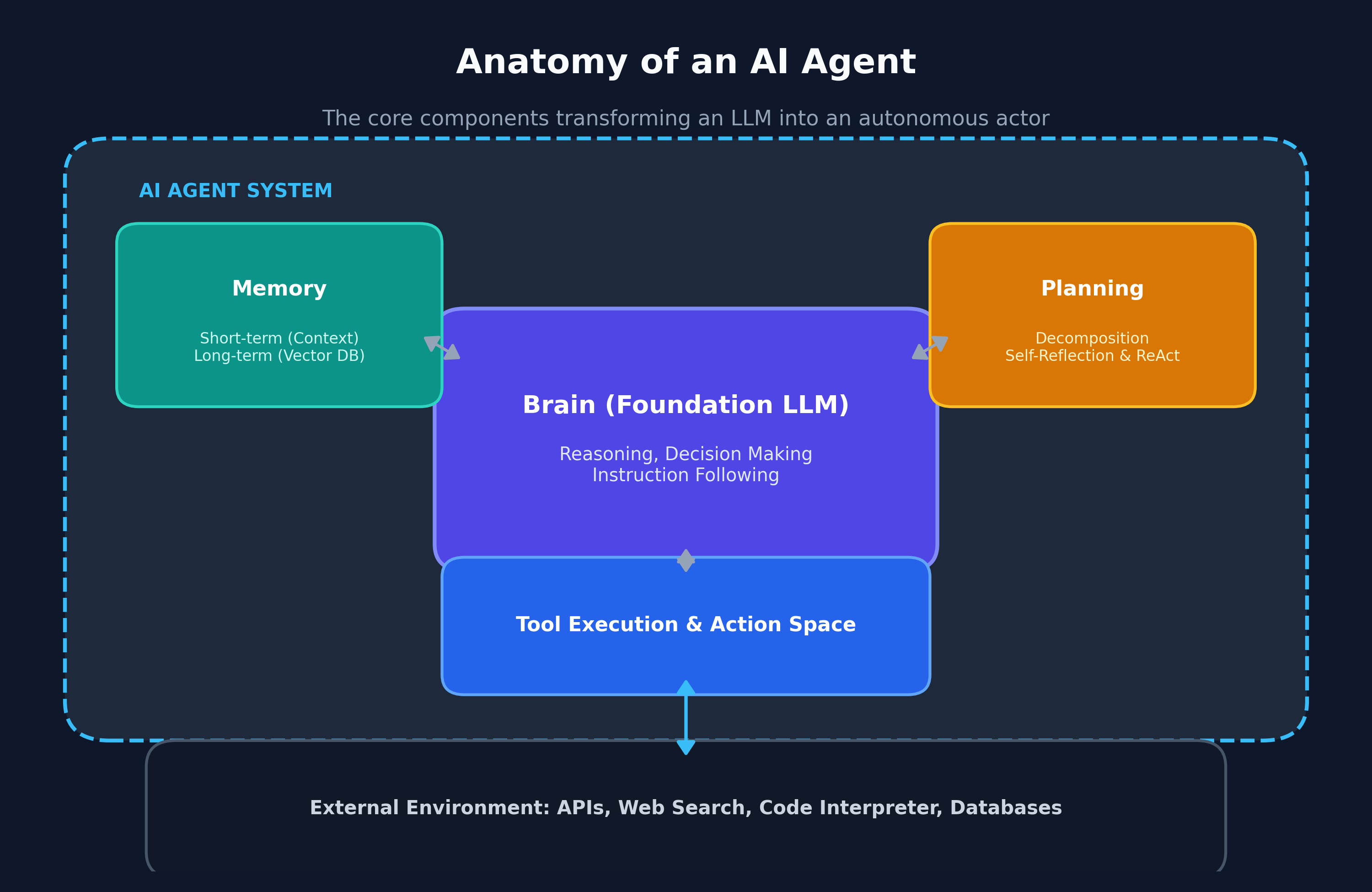
As illustrated in the system blueprint, an enterprise-grade AI agent decouples functionality across four coordinated subsystems:
┌────────────────────────────────────────────────────────────────────────┐
│                        AUTONOMOUS AI AGENT SYSTEM                       │
│                                                                        │
│   ┌────────────────────────────────────────────────────────────────┐   │
│   │                     BRAIN (Foundation LLM)                     │   │
│   │   • Multi-Step Reasoning         • Instruction Following       │   │
│   │   • Decision Making & Routing    • Semantic Synthesis          │   │
│   └───────────────────────────────┬────────────────────────────────┘   │
│                                   │                                    │
│        ┌──────────────────────────┼──────────────────────────┐         │
│        ▼                          ▼                          ▼         │
│ ┌──────────────┐          ┌──────────────┐          ┌──────────────┐   │
│ │    MEMORY    │          │   PLANNING   │          │TOOL EXECUTION│   │
│ │              │          │              │          │              │   │
│ │ • Short-Term │◄────────►│ • Decompose  │◄────────►│ • Web Browser│   │
│ │   (Context)  │          │ • ReAct Loop │          │ • Sandboxed  │   │
│ │ • Long-Term  │          │ • Reflection │          │   Code Exec  │   │
│ │   (Vector DB/│          │ • Tree Search│          │ • SQL / APIs │   │
│ │    Relational│          │              │          │ • Filesystem │   │
│ └──────────────┘          └──────────────┘          └──────────────┘   │
│                                                              │         │
└──────────────────────────────────────────────────────────────┼─────────┘
                                                               ▼
                                                    ┌────────────────────┐
                                                    │EXTERNAL ENVIRONMENT│
                                                    │Web, OS, Cloud DBs  │
└────────────────────┘ 1. The Brain: Foundation Models as Reasoning Cores
At the center of the agent sits the Brain—the underlying foundation model (such as Claude 3.5 Sonnet, GPT-4o, or DeepSeek-V3/R1). Rather than treating the LLM as the complete application, the agent treats the model as a modular central processing unit (CPU).
The Brain fulfills three fundamental cognitive duties:
- Semantic Parsing and Intent Extraction: Ingesting unstructured human instructions or environmental alerts and mapping them to structured, formal operational goals.
- Action Routing and Decision Logic: Determining what specific capability is required at each discrete step—deciding whether to query memory, formulate a web scrape request, generate Python code, or return a synthesized answer.
- Structured Parameter Synthesis: Formatting external tool arguments strictly according to programmatic schemas (such as JSON Schema or OpenAPI definitions), enforcing strict parameter types, enumerated values, and boundary constraints.
In modern agent stacks, systems increasingly leverage heterogeneous model tiering: routing routine data parsing and classification steps to compact Small Language Models (SLMs) running locally, while reserving frontier reasoning models for complex planning, code synthesis, and multi-variable reconciliation.
2. Memory: Bridging Ephemeral Context and Persistent Ground Truth
Human cognition relies heavily on the interplay between working memory and long-term memory. An autonomous agent mimics this structure through a Dual-Tier Memory System:
Short-Term Memory (In-Context Scratchpad)
- Active Working Context: The immediate prompt window loaded into the active model invocation. It contains the system prompt, current task objectives, available tool definitions, and immediate trajectory traces (the last few actions and observations).
- Episodic Window Management: To avoid context overflow, agents deploy sliding-window buffers, dynamic token truncation, and extractive summarization, keeping working context under strict latency and token budgets.
Long-Term Memory (Persistent Multi-Modal Store)
- Semantic Vector Storage: Ingests past task trajectories, reference manuals, scraped documents, and user preferences into dense vector databases (such as Qdrant, Milvus, or pgvector). When an agent encounters an unfamiliar error or new entity, it performs Approximate Nearest Neighbor (ANN) search to retrieve relevant precedent.
- Relational and Key-Value Ledgers: Stores deterministic facts, session metadata, authentication tokens, and audit trails in relational engines (such as SQLite or PostgreSQL). Unlike vector search, relational memory allows exact transactional consistency and atomic mutation updates.
- Hierarchical Memory Reconciliation: Advanced agents deploy automated reflection routines (e.g., Mem0) to extract atomic facts from completed tasks and update long-term knowledge graphs, enabling the agent to get smarter over time without updating model weights.
3. Planning: Decomposition, ReAct Loops, and Metacognitive Reflection
Without structured planning, language models execute greedily, committing to early mistakes. The Planning Engine breaks down monolithic goals into verifiable sequences of atomic operations.
Goal Decomposition
Complex enterprise requests (e.g., “Audit all vendor contracts expiring in Q4, extract pricing tiers, and notify account owners”) cannot be resolved in a single step. The planner constructs a Directed Acyclic Graph (DAG) of sub-tasks:
- Fetch all vendor contracts from document storage with expiration dates between October 1 and December 31.
- For each document, extract table schemas and parse pricing clauses into structured JSON.
- Query the CRM database to resolve vendor IDs to internal account owner email addresses.
- Draft review notifications and queue them for human approval.
Dynamic Execution Loops (ReAct)
The dominant operational pattern in modern agents is the ReAct (Reasoning + Acting) loop:
$$\text{Thought}_t \longrightarrow \text{Action}_t \longrightarrow \text{Observation}t \longrightarrow \text{Thought}{t+1}$$
- Thought: The Brain articulates an internal reasoning step assessing the current state against the overall goal.
- Action: The Brain emits a structured tool invocation targeting the external environment.
- Observation: The environment executes the action and returns the raw output (e.g., HTML response, SQL record set, compiler error) back into the agent’s context.
- Evaluation: The Brain analyzes the observation, determines whether the step succeeded, and plans the next action.
Metacognitive Reflection and Backtracking
When an action fails (e.g., a web scraper hits a CAPTCHA or a database query times out), naive agents enter infinite retry loops. Advanced planners incorporate Reflexion and Tree Search (LATS):
- Evaluating intermediate state rewards ($r \in [0.0, 1.0]$).
- Generating natural language self-critiques diagnosing the exact point of failure.
- Backtracking to earlier search branches and trying alternative paths rather than repeating failed actions.
4. Tool Execution & Action Space: Interfacing with the External World
The Tool Execution Engine represents the agent’s “hands and eyes”—the physical interface connecting abstract reasoning to real-world systems.
The action space of a production agent includes:
- Web Navigation and Data Extraction: Automated headless browser control (via Playwright or Chrome DevTools Protocol) capable of clicking elements, managing cookies, rendering JavaScript SPAs, and harvesting structured DOM trees.
- Sandboxed Code Execution: Isolated microVMs (e.g., Firecracker, gVisor, or Docker containers) allowing the agent to generate and execute arbitrary Python, Node.js, or Bash scripts with zero risk to the host filesystem.
- Relational & Vector Database Gateways: Native connectors executing parameterized SQL queries, schema inspections, and vector similarity searches.
- External Web APIs: Standardized interfaces leveraging the Model Context Protocol (MCP) or OpenAPI specifications to connect with enterprise CRMs, issue trackers, and file stores.
Crucially, modern tool engines implement Deterministic Gatekeepers: enforcing input sanitization, parameter type checking, human-in-the-loop authorization gates for high-risk actions (e.g., database writes or financial transfers), and cryptographic audit logging.
Architectural Comparison: Chatbots vs. Chained Pipelines vs. Autonomous Agents
| Dimension | Conversational Chatbot | Deterministic Pipeline (DAG) | Autonomous AI Agent |
|---|---|---|---|
| Operational Paradigm | Single-turn prompt-and-response | Hardcoded linear/branching logic | Dynamic closed-loop perception and action |
| Decision Authority | None (User drives conversation) | Fixed rules written by human developers | Autonomous (Brain chooses tools and order) |
| Environmental Interaction | None (Text output only) | Static pre-configured API calls | Dynamic, runtime-selected tool execution |
| Memory Architecture | Sliding conversational window | External state passed between steps | Dual-tier (Working scratchpad + Long-term DB) |
| Error Handling | Apologizes or hallucinates | Hard failure / exception crash | Self-reflection, retry, and branch backtracking |
| Adaptability | Low (Bound to immediate prompt) | Zero (Breaks on schema changes) | High (Discovers alternative operational paths) |
| Production Use Case | Customer Q&A, drafting content | ETL jobs, static data migrations | Autonomous research, web scraping, code repair |
Implementation: Building a Production Agent Architecture in Python
To understand how these four subsystems operate in unison, let us build a production-grade, extensible AI agent architecture in Python.
This implementation demonstrates:
- Typed Tool Registry with runtime schema validation.
- Dual-Tier Memory (Short-term working scratchpad + Persistent episodic store).
- ReAct Planning Loop with automatic error interception and self-correction.
import json
import logging
from typing import Callable, Any, Dict, List, Optional
from dataclasses import dataclass, field

logging.basicConfig(level=logging.INFO, format="%(asctime)s - [%(levelname)s] - %(message)s")
logger = logging.getLogger("AIAgentSystem")

# =====================================================================
# 1. SUBSYSTEM: TOOL REGISTRY & ACTION SPACE
# =====================================================================

@dataclass
class ToolDefinition:
    name: str
    description: str
    parameters: Dict[str, Any]
    handler: Callable[..., Any]

class ToolRegistry:
    """Manages the action space available to the agent."""
    def __init__(self):
        self._tools: Dict[str, ToolDefinition] = {}

    def register_tool(self, name: str, description: str, parameters: Dict[str, Any], handler: Callable[..., Any]):
        self._tools[name] = ToolDefinition(name, description, parameters, handler)
        logger.info(f"Registered tool: '{name}'")

    def get_tool_schemas(self) -> List[Dict[str, Any]]:
        return [
            {
                "name": tool.name,
                "description": tool.description,
                "parameters": tool.parameters
            }
            for tool in self._tools.values()
        ]

    def execute(self, tool_name: str, arguments: Dict[str, Any]) -> str:
        tool = self._tools.get(tool_name)
        if not tool:
            return json.dumps({"error": f"Tool '{tool_name}' not found in registry."})
        try:
            result = tool.handler(**arguments)
            return json.dumps({"status": "success", "result": result})
        except Exception as e:
            logger.error(f"Error executing tool '{tool_name}': {str(e)}")
            return json.dumps({"status": "error", "message": str(e)})

# Mock external environment tools
def search_web(query: str) -> str:
    """Simulates real-time web search."""
    return f"Search results for '{query}': Found 3 active endpoints with relevant pricing tiers."

def scrape_webpage(url: str, selector: str) -> Dict[str, Any]:
    """Simulates DOM extraction."""
    if "error" in url:
        raise ValueError("Connection timed out: Remote server returned 504 Gateway Timeout.")
    return {
        "url": url,
        "selector": selector,
        "extracted_data": [{"tier": "Enterprise", "price": "$499/mo", "seats": "Unlimited"}]
    }

def execute_sql(query: str) -> List[Dict[str, Any]]:
    """Simulates secure read-only SQL query execution."""
    return [{"account_id": "ACC-9921", "owner_email": "ops-lead@enterprise.com", "tier": "Enterprise"}]

# =====================================================================
# 2. SUBSYSTEM: DUAL-TIER MEMORY
# =====================================================================

@dataclass
class TrajectoryStep:
    thought: str
    action_tool: str
    action_args: Dict[str, Any]
    observation: str

class AgentMemory:
    """Dual-tier memory manager: short-term scratchpad and long-term ledger."""
    def __init__(self, max_working_steps: int = 10):
        self.max_working_steps = max_working_steps
        self.working_memory: List[TrajectoryStep] = []
        self.episodic_store: List[Dict[str, Any]] = []

    def record_step(self, thought: str, tool: str, args: Dict[str, Any], observation: str):
        step = TrajectoryStep(thought, tool, args, observation)
        self.working_memory.append(step)
        if len(self.working_memory) > self.max_working_steps:
            # Compress or consolidate oldest step into episodic store
            oldest = self.working_memory.pop(0)
            self.episodic_store.append({
                "summary": f"Action '{oldest.action_tool}' executed with result status: {oldest.observation[:60]}..."
            })

    def get_working_context_text(self) -> str:
        """Serializes current active memory for prompt ingestion."""
        if not self.working_memory:
            return "No previous steps taken in this session."
        trace = []
        for idx, step in enumerate(self.working_memory, 1):
            trace.append(
                f"Step {idx}:\n"
                f"  Thought: {step.thought}\n"
                f"  Action: {step.action_tool}({json.dumps(step.action_args)})\n"
                f"  Observation: {step.observation}"
            )
        return "\n".join(trace)

# =====================================================================
# 3. SUBSYSTEM: THE BRAIN & PLANNING ENGINE
# =====================================================================

class AutonomousAgent:
    """Core autonomous actor integrating Brain, Memory, Planning, and Tools."""
    def __init__(self, model_name: str, tools: ToolRegistry, memory: AgentMemory):
        self.model_name = model_name
        self.tools = tools
        self.memory = memory
        self.max_iterations = 6

    def _call_llm_oracle(self, system_prompt: str, user_prompt: str) -> Dict[str, Any]:
        """
        Mock LLM completion representing the reasoning Brain.
        In production, replace with real Anthropic/OpenAI client calls.
        """
        step_count = len(self.memory.working_memory)
        if step_count == 0:
            return {
                "thought": "I need to find the latest pricing tiers for Enterprise accounts from the documentation website.",
                "action": "search_web",
                "args": {"query": "aiFetchly enterprise pricing tiers"}
            }
        elif step_count == 1:
            return {
                "thought": "The search returned endpoints. Now I will scrape the specific pricing documentation page.",
                "action": "scrape_webpage",
                "args": {"url": "https://aifetchly.com/pricing", "selector": ".pricing-grid"}
            }
        elif step_count == 2:
            return {
                "thought": "I have extracted the pricing data. Now I need to query the internal database to check account owner emails.",
                "action": "execute_sql",
                "args": {"query": "SELECT account_id, owner_email, tier FROM accounts WHERE tier = 'Enterprise'"}
            }
        else:
            return {
                "thought": "I have successfully fetched all required web pricing data and matched it with internal CRM records.",
                "final_answer": "Audit Complete: Enterprise tier is $499/mo (Unlimited seats). Account ACC-9921 is managed by ops-lead@enterprise.com."
            }

    def run(self, user_goal: str) -> str:
        """Executes the autonomous ReAct planning loop until resolution."""
        logger.info(f"Initiating autonomous agent mission: '{user_goal}'")
        system_prompt = (
            "You are an autonomous AI agent. Use your available tools to systematically "
            "resolve the user goal. Reflect upon observations and adapt your strategy."
        )

        for iteration in range(1, self.max_iterations + 1):
            logger.info(f"--- Iteration {iteration}/{self.max_iterations} ---")

            # 1. Assemble prompt context from active memory
            context_scratchpad = self.memory.get_working_context_text()
            prompt = (
                f"Goal: {user_goal}\n\n"
                f"Tools available:\n{json.dumps(self.tools.get_tool_schemas(), indent=2)}\n\n"
                f"History:\n{context_scratchpad}\n\n"
                f"Determine the next step."
            )

            # 2. Brain generates next reasoning step and tool selection
            decision = self._call_llm_oracle(system_prompt, prompt)

            # Check if mission has converged to a final answer
            if "final_answer" in decision:
                logger.info("Goal successfully accomplished!")
                return decision["final_answer"]

            thought = decision.get("thought", "Evaluating next action.")
            tool_name = decision.get("action")
            tool_args = decision.get("args", {})

            logger.info(f"Thought: {thought}")
            logger.info(f"Action: Invoking '{tool_name}' with args {tool_args}")

            # 3. Tool execution in external environment
            observation = self.tools.execute(tool_name, tool_args)
            logger.info(f"Observation: {observation}")

            # 4. Record step in memory
            self.memory.record_step(thought, tool_name, tool_args, observation)

        return "Mission incomplete: Exceeded maximum allowed planning iterations."

# =====================================================================
# 4. EXECUTION DEMONSTRATION
# =====================================================================

if __name__ == "__main__":
    registry = ToolRegistry()
    registry.register_tool(
        name="search_web",
        description="Search real-time web for query.",
        parameters={"query": {"type": "string"}},
        handler=search_web
    )
    registry.register_tool(
        name="scrape_webpage",
        description="Extract DOM contents from URL using CSS selector.",
        parameters={"url": {"type": "string"}, "selector": {"type": "string"}},
        handler=scrape_webpage
    )
    registry.register_tool(
        name="execute_sql",
        description="Run safe SQL query against enterprise warehouse.",
        parameters={"query": {"type": "string"}},
        handler=execute_sql
    )

    agent_memory = AgentMemory(max_working_steps=5)
    agent = AutonomousAgent(model_name="claude-3-5-sonnet", tools=registry, memory=agent_memory)

    goal = "Retrieve Enterprise pricing from documentation and find the account owner in CRM."
    final_output = agent.run(goal)
    print("\n" + "="*70)
    print("FINAL AGENT DELIVERABLE:")
    print(final_output)
print("="*70) Key Implementation Mechanics
- Strict Decoupling of Capabilities: The Brain (
AutonomousAgent) has zero hardcoded knowledge of web scraping or SQL. All external interactions are routed through theToolRegistry, allowing new capabilities to be registered dynamically without modifying agent core logic. - Auditable Context Serialization: The
AgentMemorymaintains an explicit structured ledger of thoughts, actions, and observations, preventing context pollution while maintaining full transparency. - Graceful Exception Wrapping: External tool failures are captured and returned to the Brain as JSON observations (
status: "error"), providing the model with the exact diagnostic signal required to self-correct in subsequent iterations.
Production Best Practices for Enterprise Agent Deployment
Transitioning AI agents from sandbox demonstrations to mission-critical enterprise infrastructure requires rigorous engineering discipline.
1. Enforcing Hard Deterministic Guardrails over Soft Prompts
A common failure mode in early agent deployments is relying on natural language system prompts to enforce security (e.g., “Please do not modify production records”). System prompts are probabilistic guidelines, not security perimeters.
Enterprise architectures implement Deterministic Gateway Interceptors:
- PreToolUse Validation: Intercepting generated tool calls before dispatch to verify user authorization, rate limits, and SQL parameter safety.
- Strict Parameter Redaction: Automatically scrubbing API keys, credentials, and Personally Identifiable Information (PII) before logging observations.
- Read-Only Environments by Default: Enforcing database and file system permissions at the operating system level, rather than trusting the model to self-regulate.
2. Bounded Iteration Budgets and Circuit Breakers
Autonomous agents operating in open-ended environments can easily enter infinite loops when encountering unexpected edge cases:
- Maximum Step Budgets: Enforce strict iteration limits ($N \le 10$) per user task to prevent runaway token bills.
- Wall-Clock Timeouts: Enforce per-step and per-mission timeouts on all external network requests.
- Loop Detection Oracles: Track consecutive tool invocations. If an agent calls the identical tool with identical parameters more than twice in succession, trigger an automatic circuit breaker and escalate to human intervention.
3. Structured Data Fetching in Autonomous Workflows
In high-throughput agent systems, unstructured HTML scraping introduces immense token overhead and fragility. Advanced desktop platforms like AiFetchly solve this by providing native, structured extraction APIs:
- Pre-cleaning DOM boilerplate (stripping ads, navigation bars, and tracking scripts) before passing content to agent memory.
- Converting complex HTML tables and product listings into clean semantic Markdown or typed JSON.
- Slashing input token consumption by up to 80%, keeping agent working memory clean and responsive.
By anchoring foundation models within a disciplined architecture of memory, planning, and validated tool execution, engineering teams transform fragile next-token predictors into resilient, production-ready autonomous coworkers.