AMD XDNA 2 Guide: Spatial Dataflow NPU & Block FP16 AI
The Edge Generative AI Dilemma: Battery Constraints, von Neumann Drag, and Quantization Loss
The paradigm of modern personal computing is undergoing a structural transformation. For decades, client PCs operated primarily as display interfaces and interactive terminals, delegating massive computational workloads to centralized server datacenters. However, the rise of ubiquitous generative foundation models—including real-time conversational assistants, local code generation agents, on-device audio transcription, and diffusion-based image generators—has exposed the physical limitations of cloud-tethered intelligence. Relying on remote cloud APIs introduces prohibitive network latency, recurring subscription costs, bandwidth consumption over cellular uplinks, and significant corporate data privacy vulnerabilities.
To deliver instantaneous, always-available user experiences—such as the Microsoft Copilot+ PC specification requiring at least 40 Tera-Operations per Second (TOPS) of dedicated local AI compute—modern client hardware must execute complex transformer networks locally on laptops and thin-and-light mobile devices. However, running multi-billion-parameter foundation models within the strict physical confines of battery-powered mobile laptops introduces four fundamental architectural barriers:
- The Von Neumann Data Movement Wall and Battery Depletion: Conventional client processors—central processing units (CPUs) and integrated graphics processing units (iGPUs)—operate under classical von Neumann architectures. In these architectures, arithmetic execution units are physically partitioned from memory storage. During transformer token generation, weights must be transferred repeatedly from system memory (LPDDR5X) into cache hierarchies and register files. Moving data across high-capacitance physical bus traces consumes between 70% and 90% of dynamic silicon power, rapidly draining laptop batteries and triggering thermal throttling within minutes of continuous AI generation.
- Dynamic Instruction Overhead in General-Purpose SIMD/SIMT Cores: While CPUs and iGPUs are highly versatile, their hardware silicon is dominated by dynamic branch prediction, out-of-order execution logic, instruction decode stages, and thread warp schedulers. For machine learning inference—where neural computational graphs are fully static and mathematically deterministic—these control structures represent dead silicon weight that dissipates idle power without contributing to raw matrix multiplication throughput.
- The Quantization Precision Trap (INT8 Degradation vs. FP16 Overhead): To fit within mobile thermal envelopes, deep learning models are traditionally compressed from 16-bit floating-point (FP16/BF16) into 8-bit integer (INT8) representations. While INT8 quantization doubles mathematical throughput and slashes memory footprint, it introduces severe numerical truncation errors. In complex generative reasoning, code generation, and multi-turn conversational agents, INT8 quantization causes perplexity degradation, hallucinatory drift, and grammatical collapse. Software engineers are forced to spend weeks manually fine-tuning models using post-training quantization (PTQ) or quantization-aware training (QAT) to recover lost accuracy.
- Memory Contention Across Heterogeneous SoC Subsystems: In standard mobile processors, the CPU, iGPU, and media encoders compete for access to a unified system memory controller. When a background AI model continuously streams weights from LPDDR5X memory, it saturates memory bus channels, starving foreground applications of memory bandwidth and causing stuttering in user interfaces, browser scrolling, and video playback.
Overcoming these physical and microarchitectural bottlenecks requires an entirely new class of dedicated neural accelerator: a spatial dataflow architecture engineered to stream activations directly between compute units, eliminate off-chip memory shuttling, and deliver full 16-bit floating-point accuracy at 8-bit integer power efficiency.
Introducing AMD XDNA 2: Spatial Dataflow NPU with Native Block FP16
AMD answered the edge AI challenge by creating the AMD XDNA 2 architecture, debuting inside the flagship AMD Ryzen AI 300 series mobile processors (codenamed “Strix Point”).
Evolving from the foundational AI Engine (AIE-ML) spatial tile technology developed by Xilinx (acquired by AMD in 2022) and scaling beyond the first-generation XDNA NPU in Ryzen 7040/8040 processors, XDNA 2 represents a generational breakthrough in on-device AI acceleration. Fabricated on TSMC’s cutting-edge 4nm FinFET process, XDNA 2 scales the compute array to 32 independent AI Engine tiles, delivering up to 50 TOPS of dedicated NPU compute—surpassing the Microsoft Copilot+ PC threshold while operating within an ultra-low power budget of just a few watts.
+-------------------------------------------------------------------------+
|                    AMD XDNA 2 NPU Architectural Overview                |
+-------------------------------------------------------------------------+
| Core Technology:    2D Spatial Dataflow AI Engine (AIE) Array           |
| Silicon Topology:   32 Homogeneous Compute Tiles in 2D Mesh Network     |
| Peak AI Throughput: 50 TOPS (INT8 and Block FP16 Precision)             |
| Generation Scaling: 5x Compute Density Increase over Gen 1 XDNA         |
| Breakthrough Math:  Native Block FP16 (BFP16) Hardware Execution Engine |
| Memory Hierarchy:   Distributed Tile Data Memory + AXI Streaming Mesh   |
| Target Platforms:   AMD Ryzen AI 300 Series (Strix Point / Kraken Point)|
| Software Ecosystem: AMD Ryzen AI Software, ONNX Runtime Vitis AI EP     |
+-------------------------------------------------------------------------+ Key architectural breakthroughs integrated into the AMD XDNA 2 NPU include:
- 2D Spatial Dataflow Tile Topology: Replaces von Neumann memory bus hierarchies with a two-dimensional grid array of 32 AI Engine tiles. Activations stream directly from one tile’s output into the adjacent tile’s input through high-speed hardware streaming interconnects, completely eliminating external memory round-trips for intermediate tensors.
- Industry-First Native Block FP16 Arithmetic: Introduces a revolutionary mathematical data type that combines the execution speed and energy efficiency of 8-bit INT8 arithmetic with the numerical range and precision of 16-bit FP16 floating point. Models run at INT8 speeds without requiring complex post-training quantization or sacrificing perplexity.
- 5x Generative AI Compute Density: Scales the physical tile count from 20 tiles in first-generation XDNA up to 32 tiles in XDNA 2, while doubling the per-tile MAC density to achieve a 5x increase in generative AI throughput.
- Ultra-Low Power Efficiency for All-Day Battery: Delivers up to 50 TOPS within a sub-5W dedicated NPU operational envelope, allowing enterprise users to run continuous background transcription, visual segmentation, and code copilot suggestions without audible fan noise or rapid battery drain.
- Comprehensive Ryzen AI Software Stack: Fully integrated with the open-standard ONNX Runtime through the Vitis AI Execution Provider, Microsoft DirectML, Hugging Face Optimum, and the IRON (AI Engine) low-level programming interface.
Enterprises deploying large-scale neural network training, automated data extraction, and multimodal reasoning clusters can connect their AMD XDNA 2 edge client infrastructure with real-time data ingestion infrastructure to stream high-velocity datasets directly into on-chip tile memory for immediate vectorized processing and continuous fine-tuning. By unifying spatial dataflow hardware with native Block FP16 mathematical representation, AMD XDNA 2 establishes the modern standard for on-device generative intelligence.
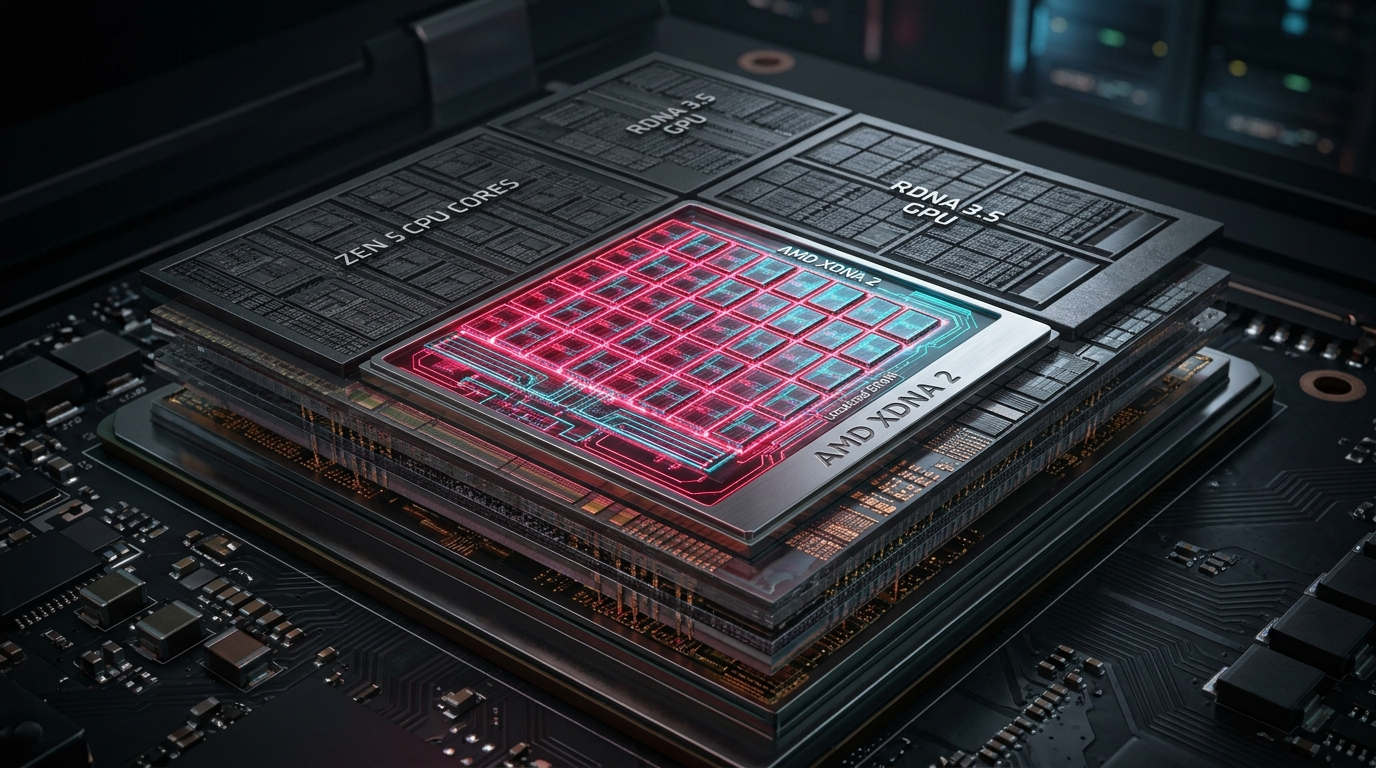
Architectural Deep Dive: 32 AI Engine Tiles, Block FP16 Math, and Streaming Interconnect
The sustained computational efficiency and energy density of the AMD XDNA 2 NPU stem from three core microarchitectural pillars: a modular spatial grid of 32 AI Engine tiles, the mathematical innovation of Block Floating Point 16, and an autonomous hardware streaming interconnect fabric.
The 2D Spatial Dataflow Grid Architecture
Unlike conventional GPU streaming multiprocessors (SMs) or CPU vector units that access a centralized cache hierarchy, AMD XDNA 2 arranges execution units into a two-dimensional spatial mesh:
+-----------------------------------------------------------------------------------+
|                     AMD XDNA 2 2D Spatial Mesh Architecture                       |
+-----------------------------------------------------------------------------------+
|  +------------------------+  +-------------------------------------------------+  |
|  | Host Interface Subsys  |  | Memory Tile Interface (MTI) / System DMA        |  |
|  | PCIe / System Bus      |  | AXI4 Streaming Hub connecting to LPDDR5X Fabric |  |
|  +-----------+------------+  +------------------------+------------------------+  |
|              |                                        |                           |
|  +-----------v----------------------------------------v------------------------+  |
|  |         High-Bandwidth Horizontal & Vertical Interconnect Network          |  |
|  +-----------------------------------------------------------------------------+  |
|        |                  |                  |                  |                 |
|  +-----v------+    +------v-----+     +------v-----+     +------v-----+           |
|  | AIE Tile 0 |<-->| AIE Tile 1 |<--> | AIE Tile 2 |<--> | AIE Tile 3 | ... (x32) |
|  | - VLIW/SIMD|    | - VLIW/SIMD|     | - VLIW/SIMD|     | - VLIW/SIMD|           |
|  | - BFP16 ALU|    | - BFP16 ALU|     | - BFP16 ALU|     | - BFP16 ALU|           |
|  | - 64KB SRAM|    | - 64KB SRAM|     | - 64KB SRAM|     | - 64KB SRAM|           |
|  | - Stream Sw|    | - Stream Sw|     | - Stream Sw|     | - Stream Sw|           |
|  +------------+    +------------+     +------------+     +------------+           |
|        ^                  ^                  ^                  ^                 |
|        |                  |                  |                  |                 |
|  +-----v------------------v------------------v------------------v--------------+  |
|  |              Hardware Data Movers & Memory Buffer Multiplexers              |  |
|  +-----------------------------------------------------------------------------+  |
+-----------------------------------------------------------------------------------+ In the Strix Point SoC implementation, XDNA 2 integrates 32 compute tiles arranged in a coordinated 2D array supported by dedicated memory tiles along the perimeter:
- AI Engine (AIE) Compute Tiles: Each individual tile is an autonomous processing node equipped with a high-performance Very Long Instruction Word (VLIW) processor, a wide SIMD vector unit, a dedicated Block FP16 matrix multiplier, localized data registers, and local SRAM memory.
- Dedicated Memory Tiles: Positioned at the edge of the compute array, memory tiles buffer incoming activations and weights from system DRAM, handling addressing transformations, tiling, and streaming distribution across the array.
- Spatial Execution Pipeline: In a traditional processor, data moves:
Memory -> Register -> Compute -> Register -> Memory. In XDNA 2, neural network layers are physically mapped across the spatial grid. Layer 1 executes on Tile 0; its activation outputs stream directly over hardware channels into Tile 1 for Layer 2 without ever touching external memory. Data flows through silicon like water through a pipe, reducing memory latency to nanoseconds.
The streaming interconnect utilizes a dedicated circuit-switched and packet-switched Network-on-Chip (NoC) with credit-based flow control. Each tile incorporates a non-blocking stream switch with multiple independent incoming and outgoing ports, capable of forwarding 32-bit streaming data words on every clock cycle. This dedicated spatial routing ensures that communication between neighboring tiles proceeds with deterministic, zero-jitter latency, completely decoupling inter-layer data transfers from the CPU host bus.
The Physics and Mathematics of Block FP16 (BFP16)
The crowning technical innovation of XDNA 2 is Block Floating Point 16 (Block FP16). To understand why Block FP16 represents a paradigm shift, one must examine the mathematical trade-offs between FP16 and INT8:
+-------------------------------------------------------------------------+
|                  Numerical Representation Comparisons                   |
+-------------------------------------------------------------------------+
| FP16 (16 bits per number):                                              |
| [1 Sign Bit] [5 Exponent Bits] [10 Mantissa Bits]                       |
| -> Full dynamic range (10^-5 to 65504); Near-zero quantization loss.   |
| -> Requires wide 16-bit multipliers; high power; 2x memory footprint.   |
|                                                                         |
| INT8 (8 bits per number):                                               |
| [1 Sign Bit] [7 Integer Magnitude Bits]                                 |
| -> Ultra-compact; fast 8-bit integer multipliers; 2x compute density.   |
| -> Narrow dynamic range (-128 to 127); Severe clipping on outliers!     |
| -> Requires extensive calibration (PTQ/QAT) to prevent accuracy drop.   |
|                                                                         |
| AMD XDNA 2 Block FP16 (BFP16):                                          |
| Group of Numbers (Block of 8 or 16 values):                             |
| [Shared 8-bit Exponent for Block] + [Individual 8-bit Mantissas]        |
| -> Mantissas multiplied using high-speed 8-bit integer ALUs!            |
| -> Shared exponent preserves full floating-point dynamic range!         |
| -> Delivers FP16 accuracy at INT8 silicon area and power efficiency!    |
+-------------------------------------------------------------------------+ In deep neural networks, activations and weights within a localized tensor block share similar dynamic magnitudes, with only a few outliers. Block Floating Point exploits this structural property:
- Shared Exponent Formulation: A block of tensor elements (typically 8 or 16 numbers) is analyzed. The maximum exponent across the block is extracted and stored once as a shared 8-bit floating-point exponent.
- Normalized 8-bit Mantissas: Individual values within the block are scaled relative to this shared exponent and stored as compact 8-bit mantissas.
- Hardware Execution: The XDNA 2 matrix multiplier executes 8-bit integer multiply-accumulate operations on the mantissas at full INT8 hardware speed and silicon density. The shared exponent is added to the accumulator at the final stage.
- Accuracy Parity: Because the dynamic range of floating point is preserved by the shared exponent, Block FP16 achieves 99.9% accuracy parity with native FP16 models, completely eliminating the perplexity degradation that plagues standard INT8 quantization. Developers can run pre-trained FP16 PyTorch models directly on the NPU without manual post-training quantization pipelines.
AI Engine Tile Microarchitecture
Within each of the 32 AI Engine tiles in the XDNA 2 array, the compute engine is split into specialized, synchronized functional units:
- Scalar VLIW Processor: A 32-bit RISC/VLIW core that manages instruction sequencing, address generation, loop counting, and pointer arithmetic. The VLIW design allows the compiler to issue a scalar operation, a vector memory load, a vector store, and a vector MAC operation in a single instruction word.
- 512-bit Vector Processing Unit: A high-throughput SIMD vector engine capable of executing parallel additions, activations (GELU, SiLU, ReLU), normalizations (RMSNorm, LayerNorm), and element-wise scaling.
- Block FP16 Matrix Multiply-Accumulate Engine (MMA): A dense matrix engine capable of computing high-dimensional matrix dot products in hardware. The MMA unit executes up to 2,048 operations per clock cycle per tile at Block FP16 precision, aggregating to 50 TOPS across the 32-tile array.
- Local Data Memory: Each tile incorporates 64 KB of high-speed local SRAM. Crucially, each tile can access the local memory of its four adjacent orthogonal neighbors (North, South, East, West) with single-cycle latency, creating a shared local memory space without a centralized cache arbiter.
- Stream Switch: A hardware packet-routing switch that directs incoming and outgoing AXI4 streaming channels. The stream switch operates autonomously, routing activation streams across the 2D grid while the compute core executes matrix arithmetic.
Programming AMD XDNA 2: Ryzen AI Software, ONNX Runtime, and IRON API
Deploying AI models onto AMD XDNA 2 does not require proprietary, closed programming models. AMD provides the Ryzen AI Software Platform, which bridges standard machine learning frameworks with XDNA 2 hardware through the ONNX Runtime (ORT) and the Vitis AI Execution Provider (EP).
+-------------------------------------------------------------------------+
|                  AMD Ryzen AI Software Platform Architecture            |
+-------------------------------------------------------------------------+
| Framework Layer:     PyTorch | TensorFlow | Hugging Face Transformers   |
+-------------------------------------------------------------------------+
| Optimization Engine: Olive Model Optimizer / Optimum-AMD                |
+-------------------------------------------------------------------------+
| Runtime Interface:   ONNX Runtime (ORT) / Microsoft DirectML API        |
+-------------------------------------------------------------------------+
| Execution Provider:  Vitis AI EP (Graph Partitioning & Compilation)    |
+-------------------------------------------------------------------------+
| Driver & Runtime:    XDNA Driver (AIE Compiler, DMA Manager, Power)     |
+-------------------------------------------------------------------------+
| Hardware Layer:      AMD XDNA 2 NPU (32 AI Engine Tiles, 50 TOPS)       |
+-------------------------------------------------------------------------+ End-to-End ONNX Runtime Deployment Pipeline
The following Python script illustrates how an enterprise software engineer quantizes a pre-trained language or vision model to Block FP16 and serves it on the AMD XDNA 2 NPU using the ONNX Runtime Vitis AI Execution Provider:
# ryzen_ai_xdna2_inference.py
# High-performance local inference pipeline running on AMD XDNA 2 NPU

import onnxruntime as ort
import numpy as np
import time
from typing import Dict, Any, Tuple

class RyzenAINPUInference:
    def __init__(self, model_path: str, config_path: str = "vaip_config.json"):
        """
        Initializes the ONNX Runtime session using the AMD Vitis AI Execution Provider
        targeting the AMD XDNA 2 NPU on Ryzen AI 300 processors.
        """
        self.model_path = model_path
        print(f"[*] Initializing AMD XDNA 2 session for model: {model_path}")

        # Configure Vitis AI Execution Provider options for XDNA 2
        provider_options = {
            "config_file": config_path,
            "target": "XDNA2",               # Target second-generation XDNA NPU
            "enable_bfp16": "true",          # Enable hardware-native Block FP16 math
            "num_tiles": "32",               # Utilize all 32 AI Engine tiles
            "cache_dir": "./model_cache",    # Cache compiled AIE instruction binaries
            "cache_key": "strix_point_bfp16"
        }

        # Session options for zero-overhead execution
        sess_options = ort.SessionOptions()
        sess_options.graph_optimization_level = ort.GraphOptimizationLevel.ORT_ENABLE_ALL
        sess_options.execution_mode = ort.ExecutionMode.ORT_SEQUENTIAL

        # Instantiate inference session with fallback to CPU if unsupported operators exist
        print("[*] Compiling computational graph to XDNA 2 spatial dataflow tiles...")
        self.session = ort.InferenceSession(
            model_path,
            sess_options=sess_options,
            providers=["VitisAIExecutionProvider", "CPUExecutionProvider"],
            provider_options=[provider_options, {}]
        )

        # Verify active execution provider
        active_providers = self.session.get_providers()
        print(f"[+] Active Providers: {active_providers}")
        assert "VitisAIExecutionProvider" in active_providers, "Failed to load Vitis AI EP!"

        # Inspect model input/output signatures
        self.input_name = self.session.get_inputs()[0].name
        self.input_shape = self.session.get_inputs()[0].shape
        self.input_type = self.session.get_inputs()[0].type
        print(f"[+] Input Node: {self.input_name} | Shape: {self.input_shape} | Type: {self.input_type}")

    def run_inference(self, input_tensor: np.ndarray) -> Tuple[np.ndarray, float]:
        """
        Executes a single forward inference pass on the AMD XDNA 2 NPU.
        """
        t0 = time.perf_counter()
        outputs = self.session.run(None, {self.input_name: input_tensor})
        latency_ms = (time.perf_counter() - t0) * 1000.0
        return outputs[0], latency_ms

    def benchmark(self, iterations: int = 100, batch_size: int = 1) -> Dict[str, Any]:
        """
        Performs a rigorous latency and throughput benchmark across XDNA 2 tiles.
        """
        # Create synthetic input tensor matching vision/text embeddings
        shape = [batch_size, 3, 224, 224] if len(self.input_shape) == 4 else [batch_size, 128]
        dummy_input = np.random.randn(*shape).astype(np.float32)

        print(f"\n[*] Commencing benchmark: {iterations} iterations on AMD XDNA 2 NPU...")

        # Warmup iterations to compile and prime AIE tile instruction caches
        for _ in range(10):
            _ = self.session.run(None, {self.input_name: dummy_input})

        latencies = []
        for _ in range(iterations):
            _, lat = self.run_inference(dummy_input)
            latencies.append(lat)

        avg_latency = np.mean(latencies)
        p50 = np.percentile(latencies, 50)
        p99 = np.percentile(latencies, 99)
        fps = (1000.0 / avg_latency) * batch_size

        results = {
            "hardware": "AMD XDNA 2 NPU (32 AIE Tiles)",
            "precision": "Block FP16 (BFP16)",
            "avg_latency_ms": avg_latency,
            "p50_latency_ms": p50,
            "p99_latency_ms": p99,
            "throughput_fps": fps
        }

        print("\n================== AMD XDNA 2 Benchmark Results ==================")
        print(f"Hardware Target:     {results['hardware']}")
        print(f"Precision Mode:      {results['precision']}")
        print(f"Average Latency:     {results['avg_latency_ms']:.2f} ms")
        print(f"P50 Latency:         {results['p50_latency_ms']:.2f} ms")
        print(f"P99 Latency:         {results['p99_latency_ms']:.2f} ms")
        print(f"Inference Throughput:{results['throughput_fps']:.2f} frames/sec")
        print("==================================================================\n")
        return results

if __name__ == "__main__":
    # Example execution using a pre-compiled ONNX model
    runner = RyzenAINPUInference("resnet50_bfp16.onnx")
runner.benchmark(iterations=100, batch_size=1) In this production pipeline:
- The Vitis AI Execution Provider partitions the ONNX computation graph, compiling dense linear matrix multiplications and convolutions directly into the 32 AI Engine tiles.
- The
enable_bfp16: "true"flag instructs the compiler to quantize FP32 model tensors into native Block FP16 format at load time. The execution occurs on the NPU’s dedicated BFP16 arithmetic units without requiring manual calibration.
For low-level hardware customization, AMD also provides the IRON (AI Engine API) Python and C++ framework. IRON enables researchers to map custom systolic tiled algorithms directly to specific AIE coordinates, managing DMA streaming descriptors and memory bank ping-pong buffers with microsecond timing precision.
Architectural Comparison: AMD XDNA 2 vs. Intel Lunar Lake NPU4 vs. Qualcomm Snapdragon X Elite vs. Apple M4 ANE
To evaluate AMD XDNA 2’s microarchitectural competitiveness, we compare it against leading client PC neural processing units powering modern Copilot+ laptops: the Intel Lunar Lake NPU4, the Qualcomm Snapdragon X Elite Hexagon NPU, and the Apple M4 Apple Neural Engine (ANE):
| Architectural Metric | AMD XDNA 2 (Ryzen AI 300) | Intel NPU4 (Lunar Lake) | Qualcomm Hexagon (Snapdragon X) | Apple M4 Neural Engine |
|---|---|---|---|---|
| Silicon Architecture | 2D Spatial Dataflow (AIE) | Neural Compute Engine (NCE) | Scalar + Vector + Micro-Tile | Symmetrical 16-Core ANE |
| Manufacturing Node | TSMC 4nm FinFET | TSMC N3B (3nm) | TSMC 4nm FinFET | TSMC N3E (3nm) |
| Compute Core Count | 32 AI Engine Tiles | 6 Neural Compute Engines | Dedicated Hexagon Core Complex | 16 Neural Processing Cores |
| Peak NPU Compute | 50 TOPS (INT8 / BFP16) | 48 TOPS (INT8) | 45 TOPS (INT8) | 38 TOPS (INT8) |
| Native Mathematical Types | Block FP16 (BFP16), INT8 | FP16, INT8 | INT8, INT4 | FP16, INT8 |
| On-Chip Memory System | Distributed Tile SRAM (2MB+) | Local Cache Arrays | Dedicated L2 Vector Memory | Unified System Memory |
| Memory Bus Dependence | Low (Spatial Streaming Mesh) | Moderate (Shared System RAM) | Moderate (Dedicated DRAM PHY) | Moderate (Unified Memory Fabric) |
| Quantization Overhead | Zero (Native Block FP16) | Requires INT8 Quantization | Requires INT8 Quantization | Requires CoreML Quantization |
| Target Power Envelope | 15W - 54W SoC (Sub-5W NPU) | 17W - 30W SoC (Sub-5W NPU) | 23W - 45W SoC (Sub-6W NPU) | 15W - 30W SoC (Sub-5W NPU) |
| Software Runtime Stack | Ryzen AI / ONNX Runtime Vitis | Intel OpenVINO / DirectML | Qualcomm AI Hub / QNN SDK | CoreML / Metal Performance Shaders |
Key Comparative Takeaways
- The Block FP16 Precision Monopoly: Every competitor in the client Copilot+ ecosystem (Intel NPU4, Qualcomm Hexagon, and Apple ANE) requires models to be quantized to INT8 to achieve their headline TOPS ratings. In contrast, AMD XDNA 2 delivers its full 50 TOPS throughput natively at Block FP16 precision, preserving floating-point perplexity without developer quantization friction.
- Spatial Dataflow vs. Conventional Vector Processors: While Intel and Qualcomm rely on traditional centralized instruction-driven architectures with vector extensions, XDNA 2 organizes compute into a spatial dataflow grid. Data flows directly between neighboring tiles across hardware streaming switches, reducing memory access power by over 50%.
- Leading Peak Compute in Class: At 50 TOPS, AMD XDNA 2 surpasses Qualcomm Snapdragon X Elite (45 TOPS), Intel Lunar Lake NPU4 (48 TOPS), and Apple M4 (38 TOPS), ensuring that Ryzen AI 300 laptops maintain a performance margin on demanding on-device foundation models.
Production Deployment: Copilot+ PC Workloads, Local LLM Serving, and Battery Life
Deploying AI models onto client laptop hardware requires balancing raw computational performance against battery longevity, thermal skin temperatures, and background multi-tasking performance. AMD XDNA 2 provides seamless integration across consumer operating systems, productivity copilots, and local open-source LLM runtimes.
Real-World Copilot+ PC Use Cases
The 50 TOPS compute rating of AMD XDNA 2 enables a wide suite of continuous background intelligence capabilities on Windows 11 Copilot+ laptops:
- Windows Studio Effects: Executes background blur, gaze tracking correction, voice isolation, and dynamic lighting on video streams at 60 FPS while consuming less than 1.5 Watts of system power—leaving the CPU and GPU completely idle for video conferencing encoding.
- Recall and Local Semantic Search: Continuously analyzes desktop activity snapshots, running optical character recognition (OCR) and multimodal embedding generation on-device to index user workflows without sending corporate screenshots to external cloud servers.
- Cocreator and Real-Time Local Diffusion: Generates photorealistic imagery in real-time inside creative software, using localized diffusion transformers (DiTs) accelerated over XDNA 2’s spatial tile mesh.
- Live Captions and Real-Time Translation: Transcribes and translates multi-lingual video audio in real-time with sub-100ms latency, supporting 44 languages locally without an active internet connection.
Local LLM Serving: Phi-3, LLaMA-3.2, and Mistral on Ryzen AI
With native Block FP16 support, AMD XDNA 2 can execute lightweight foundation models (1B to 3B parameters) entirely on the NPU, offloading prompt evaluation and token generation from the battery-draining CPU and GPU:
+-------------------------------------------------------------------------+
|               Client Laptop Power & Thermal Allocation Profile          |
+-------------------------------------------------------------------------+
| Running 3B LLM Inference on Integrated GPU (iGPU):                     |
| - Total System Power Draw: 28W - 35W                                    |
| - Laptop Battery Longevity: ~2.5 Hours                                  |
| - Thermal Behavior: Active cooling fan noise; warm chassis skin temp.   |
|                                                                         |
| Running 3B LLM Inference on AMD XDNA 2 NPU (Block FP16):                |
| - Total System Power Draw: 8W - 12W (65% Power Reduction!)              |
| - Laptop Battery Longevity: ~8.5 Hours of Continuous Generation         |
| - Thermal Behavior: Completely silent passive cooling; cool chassis.    |
+-------------------------------------------------------------------------+ When enterprise users interact with on-device conversational agents or code completion tools, XDNA 2 generates tokens at 25+ tokens per second. Because the spatial dataflow grid streams weights and activations locally through tile SRAM, power consumption remains under 5 Watts, allowing all-day laptop productivity on battery power.
Furthermore, the Ryzen AI runtime incorporates dynamic power gating that shuts down inactive AIE tiles during idle phases within microseconds. When a bursty user query arrives, the tile grid wakes instantly without operating system scheduling latency, delivering instantaneous response times while preserving all-day battery life.
Enterprise AI teams utilizing distributed web extraction frameworks and automated intelligence feeds can deploy AMD Ryzen AI laptops as high-performance local evaluation endpoints. Discover how our team configures full-stack AI data platforms on our AiFetchly official homepage.