AMD Pensando Pollara 400 Guide: UEC 400G AI NIC
Scaling modern distributed artificial intelligence systems has fundamentally reshaped the role of the datacenter network adapter. In previous generations of cloud computing, network interface cards (NICs) acted as passive bridges between host memory and top-of-rack Ethernet switches. Their primary design criteria focused on raw bandwidth, low virtualization overhead, and offloading standard TCP/IP checksums. Standard cloud workloads exhibited asynchronous, uncorrelated “mice flows”—millions of independent connections spanning web servers, microservice APIs, and transactional databases that distributed cleanly across multi-path Clos fabrics.
The rapid ascendancy of frontier generative foundation models, reasoning architectures, and automated agent data pipelines powered by AI Fetchly has permanently disrupted this paradigm. Whether orchestrating enterprise document ingestion pipelines using real-time data fetching or harvesting unstructured web graphs via automated web scraping, modern machine learning workloads execute tightly coupled collective communication primitives. During distributed training and high-throughput inference across thousands of accelerators, models synchronize weight tensors and activation maps simultaneously through All-Reduce, All-to-All, and Reduce-Scatter routines.
Under these workloads, standard network adapters hit an existential communication wall. Conventional Remote Direct Memory Access over Converged Ethernet (RoCEv2) relies on static Equal-Cost Multi-Path (ECMP) hashing and Priority Flow Control (PFC) to maintain lossless delivery. In clusters scaling from thousands to tens of thousands of GPUs, ECMP hashing triggers catastrophic hash collisions (polarization), while PFC pause frames cascade through switch buffers, creating buffer bloat, head-of-line blocking, and deadlocks. A single congested queue stalls an entire multi-million-dollar accelerator supercluster.
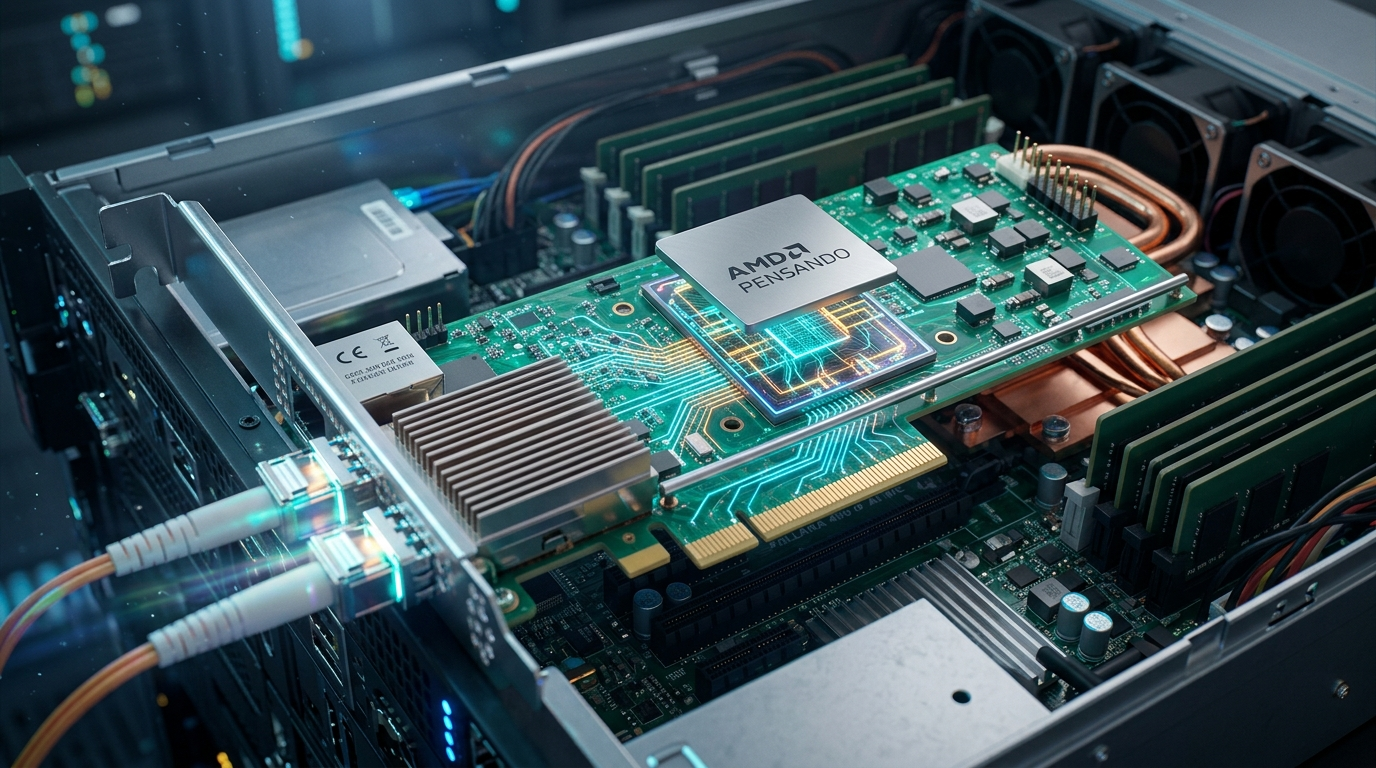
To shatter these networking bottlenecks, AMD engineered the AMD Pensando Pollara 400 AI NIC. Positioned as the industry’s first Ultra Ethernet Consortium (UEC)-ready, fully programmable AI NIC, the Pollara 400 departs from fixed-function ASIC silicon. Built on AMD Pensando’s third-generation P4 programmable packet processing architecture, the Pollara 400 combines 400 Gbps line-rate networking, PCIe Gen 5 x16 host connectivity, hardware-accelerated Ultra Ethernet Transport (UET), Multipath Reliable Connection (MRC), and native packet spraying with out-of-order reassembly.
In this comprehensive architectural guide, we dissect the systemic communication bottlenecks of traditional AI clusters, unpack the silicon microarchitecture and P4 packet processing pipeline of the Pollara 400, explore UEC transport acceleration and congestion control algorithms, provide step-by-step Linux driver configuration and ROCm RCCL tuning scripts, compare performance metrics against competing AI network adapters, and evaluate production multi-rail cluster designs for AMD Instinct superclusters.
Problem: The Scale-Out AI Communication Barrier and Legacy RoCEv2 Breakdown
To appreciate why hyperscale artificial intelligence demands an advanced AI NIC like the AMD Pensando Pollara 400, systems architects must examine the physical realities of collective communication across distributed accelerator fabrics.
The Physics of Collective Communication in Trillion-Parameter Models
Distributed machine learning workloads differ fundamentally from traditional cloud enterprise traffic across four distinct physical characteristics:
Traditional Cloud Web Traffic vs. AI Collective Communication:
+-----------------------------------------------------------------------------------+
| TRADITIONAL CLOUD TRAFFIC (Uncorrelated Mice Flows):                              |
| - Millions of asynchronous, independent TCP/HTTP connections                      |
| - Low bandwidth per flow (<100 Mbps); randomized source/destination pairs         |
| - ECMP 5-tuple hashing distributes flows evenly across redundant spine links      |
| - Latency jitter has minimal impact on decoupled microservice web servers         |
+-----------------------------------------------------------------------------------+
| AI COLLECTIVE COMMUNICATION (Synchronized Elephant Flows):                        |
| - Tens of thousands of GPUs synchronize in lock-step execution barriers           |
| - Gigabytes of tensor gradients pushed at 400G/800G line rate simultaneously      |
| - ECMP hashing causes hash collisions: multiple elephant flows hit the same link  |
| - Tail latency dominates: the slowest GPU link stalls the entire cluster (JCT)    |
+-----------------------------------------------------------------------------------+ When training foundation models such as LLaMA-3.1 405B or DeepSeek-V3 across thousands of GPUs, execution progresses through alternating phases of computation (forward and backward passes) and communication. In data-parallel, pipeline-parallel, and tensor-parallel layouts, accelerators must exchange parameter updates before the next iteration can begin.
Because distributed collective primitives (such as Ring All-Reduce or Tree All-Reduce) depend on strict barrier synchronization, cluster throughput is bounded by the tail latency of the slowest participating link—the well-known straggler effect. If 999 GPUs complete their network transfer in 50 microseconds, but a single GPU suffers queue congestion or packet drops that delay its transfer to 2 milliseconds, all 1,000 GPUs sit idle, burning megawatts of electricity without executing floating-point operations.
The Structural Failure Modes of Legacy RoCEv2
For over a decade, datacenters adapted Remote Direct Memory Access (RDMA) over Converged Ethernet (RoCEv2) as an alternative to proprietary InfiniBand fabrics. While RoCEv2 delivered low CPU utilization and kernel-bypass zero-copy memory transfers for moderate workloads, its foundational design choices break down at extreme AI cluster scale:
1. Static ECMP Hashing and Polarization
RoCEv2 relies on Equal-Cost Multi-Path (ECMP) routing at intermediate Ethernet switches. ECMP calculates a pseudo-random hash over the 5-tuple of each packet header (Source IP, Destination IP, Protocol, Source Port, Destination Port) to assign the packet to an egress uplink.
Because RoCEv2 mandates strictly in-order packet delivery, all packets within an RDMA Queue Pair (QP) connection must share the identical 5-tuple to prevent packet reordering. When hundreds of line-rate 400 Gbps elephant flows traverse a spine switch with 64 or 128 redundant uplinks, the birthday paradox guarantees that multiple elephant flows will hash onto the exact same physical link. This hash collision—known as hash polarization—overwhelms egress buffers on collided links while adjacent uplinks sit completely idle.
2. The Priority Flow Control (PFC) Fragility Trap
Because legacy RoCEv2 cannot tolerate out-of-order packets or packet drops without catastrophic go-back-N retransmission penalties, network operators must enforce a lossless Ethernet fabric using IEEE 802.1Qbb Priority Flow Control (PFC).
PFC operates by transmitting hop-by-hop pause frames when switch input buffers exceed high watermarks. In hyperscale AI fabrics, PFC introduces severe systemic failure modes:
- PFC Deadlocks: Circular buffer dependencies across multi-stage Clos topologies cause switches to pause each other in a loop, freezing entire network segments.
- Pause Storms: A single malfunctioning NIC or congested queue continuously transmits PFC pause frames, propagating pause back-pressure across the entire datacenter fabric and halting unrelated traffic classes.
- Head-of-Line (HoL) Blocking: Pausing a physical egress port to protect one congested queue blocks all other non-congested flows sharing that physical priority queue.
3. Inflexible Fixed-Function ASIC Silicon
Standard commodity NICs are hardwired ASICs with fixed state machines. When cloud operators identify emerging congestion control schemes, new telemetry headers, or advanced transport protocols (such as those drafted by the Ultra Ethernet Consortium), fixed-function NICs cannot adapt. Hardware replacement cycles require multi-year procurement delays and billions of dollars in infrastructure overhauls.
Mathematical Quantification of ECMP Hash Collision Probability
To mathematically illustrate the failure of ECMP hashing during distributed AI training, consider an All-to-All collective operation where $N$ GPUs concurrently transmit gradient blocks to $N$ destination endpoints across $K$ equal-cost spine uplinks. Under standard 5-tuple hash distribution, the probability $P_{\text{collision}}$ that at least two high-bandwidth flows collide onto the exact same spine uplink follows the classical generalized birthday problem:
$$P_{\text{collision}} = 1 - \prod_{i=0}^{N-1} \left(1 - \frac{i}{K}\right)$$
When $N = 32$ parallel elephant flows traverse a switch with $K = 64$ available paths, the mathematical probability of at least one hash collision exceeds 99.99%. Even worse, the expected number of collided flows sharing a single uplink causes persistent queue buildup, inducing packet drop rates that trigger catastrophic go-back-N retransmissions under standard RoCEv2. In contrast, by operating at the packet grain rather than the flow grain, the Pollara 400 decouples packet path selection from flow identifiers, reducing path variance to near zero.
Solution: The Ultra Ethernet Consortium Paradigm and the Programmable AI NIC
To overcome the architectural dead-ends of RoCEv2 and eliminate vendor lock-in associated with proprietary interconnects, the technology industry established the Ultra Ethernet Consortium (UEC) under the Linux Foundation. Backed by AMD, Arista, Broadcom, Cisco, Meta, Microsoft, and other hyperscale leaders, the UEC specification re-engineers Ethernet from the physical layer up to the transport layer specifically for AI scale-out fabrics.
The Paradigm Shift: Legacy RoCEv2 vs. UEC / AMD Pensando Pollara 400:
+-----------------------------+------------------------------------+------------------------------------+
| Architectural Dimension     | Legacy RoCEv2 Deployment           | AMD Pensando Pollara 400 (UEC)     |
+-----------------------------+------------------------------------+------------------------------------+
| Transport Layer Protocol    | RoCEv2 over UDP (Port 4791)        | Ultra Ethernet Transport (UET)     |
| Multi-Path Load Balancing   | Static 5-tuple ECMP per QP         | Per-Packet Spraying via Dynamic EV |
| Packet Delivery Order       | Strict In-Order Required           | Native Out-of-Order Reassembly     |
| Fabric Loss Model           | Lossless Fabric Required (PFC/ECN) | Lossy Best-Effort IP Fabric        |
| Congestion Management       | Reactive DCQCN (Coarse-Grained)    | Receiver Credit-Based Control RCCC |
| Packet Drop Recovery        | Go-Back-N Retransmission           | Microsecond Selective SACK Trimming|
| Silicon Pipeline            | Fixed-Function Hardwired State     | Fully Programmable P4 Pipeline     |
+-----------------------------+------------------------------------+------------------------------------+ Decoupling Fabric Delivery from Lossless Enforcements
The fundamental insight of the Ultra Ethernet architecture is that lossless enforcement belongs at the network endpoints, not inside intermediate switch buffers. By engineering an AI NIC with high-speed packet reordering engines and selective retransmission capabilities, the network fabric can operate as an open, high-throughput, lossy best-effort IP network.
Intermediate switches no longer need to generate dangerous PFC pause frames. If temporary congestion occurs, switches can perform fine-grained packet trimming—stripping the packet payload while forwarding the header to the destination. The destination AI NIC detects the trimmed packet, notes the exact missing byte offset, and issues a selective negative acknowledgment (SACK/NACK) back to the sender within microseconds.
Per-Packet Multipath Spraying
Instead of forcing an entire 100-gigabyte gradient exchange through a single static hash bucket, the Pollara 400 executes per-packet multipath spraying. For every packet transmitted within an AI collective transfer, the NIC’s programmable pipeline dynamically assigns a randomized or flowlet-based Entropy Value (EV) into the UDP source port field.
As these packets traverse standard leaf-spine Ethernet switches, standard ECMP and dynamic load balancing hash each individual packet across different spine paths. Network bisection bandwidth utilization surges from 50%–60% under RoCEv2 to over 90% under UET packet spraying, completely eliminating hash polarization and tail-latency stragglers.
Architecture: Silicon Microarchitecture and P4 Pipeline of Pollara 400
The AMD Pensando Pollara 400 represents the convergence of high-bandwidth networking silicon and deep domain-specific programmability. Unlike conventional network adapters that marry a standard Ethernet MAC to a fixed RDMA offload engine, the Pollara 400 is constructed around a massive, multi-stage P4 programmable packet processing engine inherited from Pensando’s enterprise DPU heritage.
AMD Pensando Pollara 400 Silicon Microarchitecture:
+-----------------------------------------------------------------------------------+
|                        PCIe Gen 5 x16 Host Interface                              |
|                   (64 GB/s Full-Duplex Host Memory Access)                        |
+-----------------------------------------------------------------------------------+
                                         ▲
                                         │ Direct DMA / GPU-Direct
                                         ▼
+-----------------------------------------------------------------------------------+
|              On-Chip Memory & Hardware Packet Reassembly Buffers                  |
|  - Ultra-deep on-chip SRAM for out-of-order reassembly and credit tracking        |
|  - High-bandwidth scratchpad memory for queue context state descriptors          |
+-----------------------------------------------------------------------------------+
                                         ▲
                                         │ Internal High-Speed Interconnect
                                         ▼
+-----------------------------------------------------------------------------------+
|                   P4 Programmable Packet Processing Pipeline                     |
|  +-----------------------+ +-----------------------+ +-------------------------+  |
|  | Parser & Header       | | Match-Action Units    | | Transport Engine        |  |
|  | Extraction Units      | | (MAUs - Ingress/Egress| | (UET / MetaRoCE / MRC)  |  |
|  +-----------------------+ +-----------------------+ +-------------------------+  |
|  +-----------------------+ +-----------------------+ +-------------------------+  |
|  | Dynamic Entropy Spray | | Receiver Credit-Based | | Hardware Selective      |  |
|  | Generator Engine      | | Flow Controller (RCCC)| | SACK Trimming Handler   |  |
|  +-----------------------+ +-----------------------+ +-------------------------+  |
+-----------------------------------------------------------------------------------+
                                         ▲
                                         │ Line-Rate Streaming
                                         ▼
+-----------------------------------------------------------------------------------+
|                     400 GbE MAC & PHY (QSFP-DD / OSFP)                            |
|             (8x 53.125 Gbps PAM4 or 4x 106.25 Gbps PAM4 SerDes Lanes)             |
+-----------------------------------------------------------------------------------+ The Third-Generation P4 Packet Processing Engine
At the core of the Pollara 400 sits a high-performance array of Match-Action Units (MAUs) executing compiled P4 programs at line rate. P4 (Programming Protocol-Independent Packet Processors) is the open domain-specific language for packet forwarding.
By utilizing P4 at 400 Gbps:
- Custom Protocol Decapsulation: The Pollara 400 can parse standard IPv4/IPv6, UDP, RoCEv2, MetaRoCE, Multi-path Reliable Connection (MRC), and Ultra Ethernet Transport (UET) encapsulation formats simultaneously.
- Dynamic Header Mutation: The ingress pipeline dynamically alters packet headers on the fly—calculating dynamic entropy seeds, inserting in-band network telemetry (INT) probes, and rewriting sequence numbers without pipeline stalls.
- Field Programmability: As the Ultra Ethernet Consortium ratifies subsequent revisions of the UET specification (e.g., UET 1.1 or 1.2), the Pollara 400 can be upgraded via firmware without requiring physical board revisions.
Hardware-Accelerated Transport Subsystems
The Pollara 400 silicon partitions transport acceleration into dedicated hardware accelerators tightly coupled to the P4 pipeline:
1. Out-of-Order Reassembly Engine
When packets are sprayed across multiple switch paths, differential latency across optical fibers and intermediate queues causes packets to arrive out of order. The Pollara 400 features a dedicated hardware reassembly engine backed by on-chip SRAM:
- Tracks expected byte sequence ranges for each active transfer context.
- Places out-of-order data directly into host or GPU memory via direct memory access (DMA) without CPU interaction.
- Emits a completion event only when all byte spans within a message descriptor have arrived successfully.
2. Receiver Credit-Based Flow Control (RCCC)
Rather than relying solely on reactive windowing protocols like TCP, the Pollara 400 implements Receiver Credit-based Congestion Control. The receiver allocates explicit buffer credits and grants transmission rights to senders based on real-time buffer occupancy and link drain rates. Senders transmit packets only when credits are available, eliminating congestion drops at the receiver ingress queues.
3. PCIe Gen 5 x16 and GPU-Direct RDMA
The Pollara 400 interfaces with the host system across a PCIe Gen 5 x16 physical connector, providing up to 64 GB/s of bidirectional bandwidth. The adapter supports native peer-to-peer (P2P) GPU-Direct transfers:
- The Pollara 400 reads and writes directly to the High-Bandwidth Memory (HBM3/HBM3e) of AMD Instinct MI300X/MI325X accelerators across the PCIe bus and host bridge.
- System CPU DRAM and OS kernels are completely bypassed during collective communication loops, eliminating context-switch jitter.
Hardware-Accelerated Packet Trimming and Selective NACK Processing
A signature architectural innovation of the AMD Pensando Pollara 400 is its specialized hardware handling of in-flight packet trimming. In traditional Ethernet networks, when an intermediate switch queue approaches full capacity, standard active queue management (AQM) mechanisms drop entire frames. When a 9000-byte jumbo frame is dropped, the sender remains unaware of the drop until a timer expires or duplicate acknowledgments arrive, causing multi-millisecond tail stalls.
Under the Ultra Ethernet Consortium transport specification implemented on the Pollara 400:
- When a compliant switch experiences imminent buffer exhaustion, it trims the packet payload, retaining only the packet headers (the first 64 to 128 bytes containing IP, UDP, and UET metadata), marks the ECN congestion bit, and forwards the truncated packet header downstream.
- Upon arriving at the Pollara 400 ingress parser, the dedicated P4 pipeline recognizes the trimmed frame header, extracts the exact transaction ID and byte offset range, and immediately generates a hardware-accelerated Selective Negative Acknowledgment (Selective NACK) frame back to the transmitting node.
- Because the sender receives explicit feedback within a single round-trip time (RTT)—typically under 2 to 3 microseconds across a datacenter fabric—it retransmits exclusively the trimmed payload bytes without stalling unrelated queue streams.
Implementation: Linux Stack, ROCm RCCL Tuning, and Benchmark Workflows
Deploying the AMD Pensando Pollara 400 in an enterprise AI cluster requires configuring the Linux kernel drivers, optimizing network sysctls for high-throughput RDMA/UET transport, and tuning AMD’s ROCm Communication Collectives Library (RCCL).
Linux Driver Architecture and Module Configuration
The Pollara 400 software ecosystem comprises the core PCIe kernel driver (ionic / pensando_ionic), the RDMA provider (ionic_rdma), and user-space libraries integrating with the OpenFabrics Alliance libfabric and rdma-core frameworks.
#!/usr/bin/env bash
# ==============================================================================
# AMD Pensando Pollara 400 AI NIC - Driver Verification and Interface Setup
# ==============================================================================
set -euo pipefail

echo "==> Verifying AMD Pensando Pollara 400 PCIe Enumeration..."
lspci -nn | grep -i "Pensando" || { echo "ERROR: Pollara 400 NIC not detected on PCIe bus"; exit 1; }

echo "==> Loading Pensando Pollara kernel modules..."
sudo modprobe ionic
sudo modprobe ionic_rdma

# Verify RDMA link status
echo "==> Checking RDMA Link State:"
rdma link show

# Optimize Linux Network Core for 400Gbps Line-Rate Ingestion
echo "==> Applying Host Kernel Network Tuning for High-Bisection AI Fabrics..."
sudo sysctl -w net.core.rmem_max=67108864
sudo sysctl -w net.core.wmem_max=67108864
sudo sysctl -w net.core.rmem_default=33554432
sudo sysctl -w net.core.wmem_default=33554432
sudo sysctl -w net.core.optmem_max=2048576
sudo sysctl -w net.ipv4.tcp_rmem="4096 87380 67108864"
sudo sysctl -w net.ipv4.tcp_wmem="4096 65536 67108864"
sudo sysctl -w net.core.netdev_max_backlog=250000
sudo sysctl -w net.ipv4.tcp_no_metrics_save=1

# Configure Pollara interface MTU for Jumbo Frames (9000 bytes)
INTERFACE_NAME=$(ip -o link show | awk -F': ' '/ionic/ {print $2}' | head -n 1 || echo "eth1")
echo "==> Configuring Interface ${INTERFACE_NAME} for 9000-byte Jumbo Frames..."
sudo ip link set dev "${INTERFACE_NAME}" mtu 9000 up

echo "==> Pollara 400 Host Interface successfully initialized." Advanced RCCL Tuning for AMD Instinct MI300X Clusters
When running distributed training or inference across AMD Instinct accelerators, collective operations are orchestrated by RCCL (ROCm Communication Collectives Library). The following production configuration enables Pollara 400 hardware packet spraying, Multi-path Reliable Connection (MRC), and GPU-Direct peer-to-peer RDMA:
# ==============================================================================
# Environment Configuration: ROCm RCCL with AMD Pensando Pollara 400 AI NIC
# ==============================================================================

# Enable RCCL high-verbosity logging for fabric verification
export NCCL_DEBUG=INFO
export NCCL_DEBUG_SUBSYS=INIT,COLL,ENV,NET

# Direct RCCL to bind explicitly to the Pensando Pollara RDMA provider
export NCCL_NET_GDR_LEVEL=5          # Full GPU-Direct RDMA support (NVLink/PCIe P2P)
export NCCL_NET_GDR_READ=1           # Enable direct read from GPU HBM memory
export NCCL_CROSS_NIC=1              # Support multi-rail cross-adapter ring topologies
export NCCL_BUFFSIZE=16777216        # 16 MB ring communication buffer for high bandwidth

# Enable Multi-Path Packet Spraying and Entropy Generation
export RCCL_ENABLE_POLLARA_SPRAY=1    # Enable dynamic UDP source port entropy
export RCCL_TRANSPORT_TYPE=UET        # Request Ultra Ethernet Transport profile
export RCCL_MAX_NCHANNELS=32          # Maximize concurrent GPU-Direct network rings

# Bind interface explicitly to Pollara RDMA device
export NCCL_IB_HCA=ionic_rdma0:1
export NCCL_IB_GID_INDEX=3 # RoCEv2 / UET GID index Python PyTorch Distributed All-Reduce Verification Harness
To benchmark communication latency and bandwidth saturation across Pollara 400 interfaces, engineers can execute this automated PyTorch distributed collective testing harness:
#!/usr/bin/env python3
# Distributed All-Reduce Latency and Bandwidth Benchmark for AMD Pensando Pollara 400
# Utilizes PyTorch with RCCL backend to measure collective throughput across cluster nodes.

import os
import sys
import time
import torch
import torch.distributed as dist

def initialize_distributed():
    if not dist.is_initialized():
        dist.init_process_group(
            backend="nccl",  # PyTorch maps 'nccl' to RCCL when executed under ROCm
            init_method="env://"
        )
    local_rank = int(os.environ.get("LOCAL_RANK", 0))
    torch.cuda.set_device(local_rank)
    return local_rank, dist.get_rank(), dist.get_world_size()

def benchmark_all_reduce(local_rank, rank, world_size, tensor_size_mb=256, iterations=50):
    num_elements = (tensor_size_mb * 1024 * 1024) // 2  # BFloat16 elements (2 bytes each)
    device = torch.device(f"cuda:{local_rank}")

    # Allocate tensor directly in GPU High-Bandwidth Memory (HBM)
    data_tensor = torch.ones(num_elements, dtype=torch.bfloat16, device=device) * float(rank)

    # Warmup iterations to trigger kernel compilation and memory pinning
    for _ in range(10):
        dist.all_reduce(data_tensor, op=dist.ReduceOp.SUM)
    torch.cuda.synchronize(device)

    dist.barrier()
    start_time = time.perf_counter()

    for _ in range(iterations):
        dist.all_reduce(data_tensor, op=dist.ReduceOp.SUM)

    torch.cuda.synchronize(device)
    end_time = time.perf_counter()

    elapsed_seconds = end_time - start_time
    avg_latency_ms = (elapsed_seconds / iterations) * 1000.0

    # Calculate effective algorithmic and bus bandwidth
    # For Ring All-Reduce, Bus Bandwidth = 2 * ((world_size - 1) / world_size) * (data_bytes / time)
    data_bytes = tensor_size_mb * 1024 * 1024
    bus_factor = 2.0 * ((world_size - 1) / world_size)
    bus_bandwidth_gbps = (data_bytes * bus_factor * 8) / ((elapsed_seconds / iterations) * 1e9)

    if rank == 0:
        print("\n=======================================================")
        print(" AMD PENSANDO POLLARA 400 - RCCL COLLECTIVE BENCHMARK  ")
        print("=======================================================")
        print(f" Cluster World Size       : {world_size} GPUs")
        print(f" Message Size per Node    : {tensor_size_mb} MB")
        print(f" Iterations Evaluated     : {iterations}")
        print(f" Average All-Reduce Time  : {avg_latency_ms:.3f} ms")
        print(f" Effective Bus Bandwidth  : {bus_bandwidth_gbps:.2f} Gbps")
        print("=======================================================\n")

if __name__ == "__main__":
    try:
        local_rank, rank, world_size = initialize_distributed()
        benchmark_all_reduce(local_rank, rank, world_size, tensor_size_mb=512, iterations=100)
    except Exception as exc:
        print(f"Benchmark execution failed: {exc}", file=sys.stderr)
sys.exit(1) Comparison: Technical Analysis Against Competing AI Network Adapters
The enterprise artificial intelligence landscape features intense competition among network interface architectures. The following comparative scorecard evaluates the AMD Pensando Pollara 400 against the leading high-bandwidth AI adapters: the NVIDIA ConnectX-7, the NVIDIA BlueField-3 SuperNIC, the Intel Gaudi 3 Integrated NIC, and the Broadcom Thor 2 (BCM57608).
Detailed Architectural Comparison Matrix:
+------------------------+-------------------+-------------------+-------------------+-------------------+-------------------+
| Feature Specification  | AMD Pensando      | NVIDIA ConnectX-7 | NVIDIA BlueField-3| Intel Gaudi 3     | Broadcom Thor 2   |
|                        | Pollara 400       |                   | SuperNIC          | Integrated NIC    | BCM57608          |
+------------------------+-------------------+-------------------+-------------------+-------------------+-------------------+
| Max Line-Rate Speed    | 400 Gbps          | 400 Gbps          | 400 Gbps          | 24x 200 Gbps      | 400 Gbps / 800Gbps|
| Silicon Architecture   | 3rd-Gen P4 Engine | Fixed-Function    | ARM + ConnectX-7  | On-Die Integrated | Fixed-Function    |
| Programmability        | Fully P4 Programm.| Proprietary ASIC  | DOCA / C / Rust   | Fixed Hardware    | Fixed Hardware    |
| UEC Transport (UET)    | Native Hardware   | Roadmap (CX-8)    | Software-Assisted | Proprietary RoCE  | Roadmap UEC       |
| Multi-Path Spraying    | Per-Packet Dynamic| Coarse-Grained    | Packet Spraying   | Dual-Port ECMP    | Flowlet Hashing   |
| Out-of-Order Engine    | On-Chip Hardware  | Limited/Go-Back-N | Hardware Assisted | Limited Hardware  | Limited Buffer    |
| Congestion Management  | RCCC, DCQCN, ECN  | DCQCN, ECN        | DCQCN, Round-Trip | Advanced RoCEv2   | DCQCN, Cong. Notif|
| Host Interface         | PCIe Gen 5 x16    | PCIe Gen 5 x16    | PCIe Gen 5 x16    | Direct On-Substr. | PCIe Gen 5 x16    |
| Open Ecosystem Support | Fully Open / UEC  | Closed (Mellanox) | Closed (Mellanox) | Habana SynapseAI  | Open Standards    |
+------------------------+-------------------+-------------------+-------------------+-------------------+-------------------+ Key Architectural Differentiators
1. Native Ultra Ethernet Consortium Alignment vs. Proprietary Extensions
While competitors like NVIDIA rely on proprietary closed-source extensions (such as InfiniBand SHARP or proprietary Spectrum-X RoCE enhancements requiring end-to-end NVIDIA switches and NICs), the AMD Pensando Pollara 400 is architected explicitly around open standards. It delivers advanced multi-pathing, packet trimming, and out-of-order reassembly across standard merchant silicon switches (including Broadcom Tomahawk 5, Cisco Silicon One G200, and Marvell Teralynx 10).
2. Fully Programmable P4 Pipeline vs. Fixed-Function Rigidity
Fixed-function adapters like ConnectX-7 require microcode compromises or full silicon respins to support new transport semantics. Because the Pollara 400 embeds a full-pipeline P4 Match-Action architecture, datacenter operators can compile and deploy updated telemetry protocols, custom congestion control state machines, and security wrappers directly to running cards.
3. Granular Packet Spraying vs. Flowlet and ECMP Polarization
Traditional adapters partition traffic based on flowlet timers or static 5-tuples. Under heavy collective All-to-All operations, flowlet gaps rarely materialize, degrading performance into polarized static links. The Pollara 400’s hardware reassembly engine allows true per-packet spraying, ensuring equal distribution across all available Clos fabric paths regardless of flow duration.
Production: Deployment Topologies, Multi-Rail Configurations, and Resilience
Deploying the AMD Pensando Pollara 400 across production enterprise infrastructure requires implementing robust multi-rail topologies that align with modern accelerator node designs.
Production Multi-Rail AI Supercluster Topology:
+-----------------------------------------------------------------------------------+
|                        SPINE SWITCH FABRIC (Spine Tier)                           |
|       (Non-Blocking 51.2T Merchant Switches - Tomahawk 5 / Silicon One G200)      |
+-----------------------------------------------------------------------------------+
       ▲                 ▲                 ▲                 ▲
       │ 400GbE          │ 400GbE          │ 400GbE          │ 400GbE
       ▼                 ▼                 ▼                 ▼
+-----------------------------------------------------------------------------------+
|                         LEAF SWITCH TIER (Leaf Tier)                              |
|           (Dedicated Rail-0 to Rail-7 Top-of-Rack AI Fabric Switches)             |
+-----------------------------------------------------------------------------------+
       ▲                 ▲                 ▲                 ▲
       │ Rail 0          │ Rail 1          │ Rail 6          │ Rail 7
       ▼                 ▼                 ▼                 ▼
+-----------------------------------------------------------------------------------+
|            AMD INSTINCT MI300X / MI325X ACCELERATED SERVER CHASSIS                |
|  +-----------------------------------------------------------------------------+  |
|  | GPU 0   | GPU 1   | GPU 2   | GPU 3   | GPU 4   | GPU 5   | GPU 6   | GPU 7   |  |
|  +----+----+----+----+----+----+----+----+----+----+----+----+----+----+----+----+  |
|       │         │         │         │         │         │         │         │     |
|       ▼         ▼         ▼         ▼         ▼         ▼         ▼         ▼     |
|  +----+----+----+----+----+----+----+----+----+----+----+----+----+----+----+----+  |
|  | NIC 0   | NIC 1   | NIC 2   | NIC 3   | NIC 4   | NIC 5   | NIC 6   | NIC 7   |  |
|  | (Pol400)| (Pol400)| (Pol400)| (Pol400)| (Pol400)| (Pol400)| (Pol400)| (Pol400)|  |
|  +-----------------------------------------------------------------------------+  |
+-----------------------------------------------------------------------------------+ Multi-Rail Network Architecture
In an 8-GPU server (such as an AMD Instinct MI300X platform), the compute node features eight independent Pollara 400 adapters:
- Rail Alignment: Each Pollara 400 card connects directly to a dedicated Leaf switch representing an independent network rail (Rail 0 through Rail 7).
- Rail-Optimized Collectives: When executing multi-node All-Reduce, communication across nodes proceeds concurrently across all eight rails without intra-node contention.
- Intra-Node Scaling: Local accelerators communicate over high-bandwidth internal fabrics (such as AMD Infinity Fabric at 896 GB/s), offloading cross-node synchronization to the Pollara 400 multi-rail network.
Automated Telemetry and Production Health Monitoring
To ensure fabric stability in production, network operations teams must continuously audit interface drops, out-of-order reassembly buffers, and PFC activity. The following Python automation script queries the Pollara 400 hardware counters via Linux sysfs and netlink:
#!/usr/bin/env python3
# Automated Hardware Telemetry and Health Audit for AMD Pensando Pollara 400
# Continuously audits packet spraying entropy, reassembly buffer health, and drop counters.

import os
import glob
import json
import time

def get_pollara_interfaces():
    interfaces = []
    for path in glob.glob("/sys/class/net/*/device/driver"):
        driver_name = os.path.basename(os.readlink(path))
        if "ionic" in driver_name:
            ifname = path.split("/")[4]
            interfaces.append(ifname)
    return interfaces

def read_hw_counters(ifname):
    stats_path = f"/sys/class/net/{ifname}/statistics"
    counters = {}
    if os.path.exists(stats_path):
        for metric in ["rx_packets", "tx_packets", "rx_dropped", "tx_dropped", "rx_errors", "tx_errors"]:
            metric_file = os.path.join(stats_path, metric)
            if os.path.exists(metric_file):
                with open(metric_file, "r") as f:
                    counters[metric] = int(f.read().strip())
    return counters

def audit_cluster_health():
    interfaces = get_pollara_interfaces()
    if not interfaces:
        print("WARNING: No AMD Pensando interfaces detected on local host.")
        return

    print(f"Discovered {len(interfaces)} AMD Pensando Pollara interface(s): {', '.join(interfaces)}")
    print("-" * 70)
    print(f"{'Interface':<12} | {'TX Packets':<15} | {'RX Packets':<15} | {'Drops':<8} | {'Status'}")
    print("-" * 70)

    healthy = True
    for ifname in interfaces:
        counters = read_hw_counters(ifname)
        rx = counters.get("rx_packets", 0)
        tx = counters.get("tx_packets", 0)
        drops = counters.get("rx_dropped", 0) + counters.get("tx_dropped", 0)

        status = "HEALTHY"
        if drops > 0:
            status = "DEGRADED"
            healthy = False

        print(f"{ifname:<12} | {tx:<15} | {rx:<15} | {drops:<8} | {status}")

    print("-" * 70)
    if healthy:
        print(">> AUDIT RESULT: All Pollara 400 network interfaces operating at optimal line rate.")
    else:
        print(">> AUDIT ALERT : Packet drops detected. Inspect switch buffer watermarks and UET settings.")

if __name__ == "__main__":
audit_cluster_health() Production Checklist for 100,000-Accelerator Fabrics
Before scaling an AMD Instinct cluster into full production, verify the following operational safeguards:
- Jumbo Frames: Enforce an end-to-end MTU of 9000 bytes across all host adapters, leaf switches, and spine directors to minimize packet header overhead.
- Dynamic Entropy Spraying: Verify that leaf switches inspect UDP source ports for ECMP hash distribution rather than relying solely on destination IP addresses.
- Lossless Fallbacks: While UET enables lossy fabric operation, ensure that legacy RoCEv2 VLANs maintain conservative PFC and ECN thresholds to prevent tail drops during migration periods.
- Firmware Consistency: Ensure all Pollara 400 adapters run verified P4 firmware releases aligned with your ROCm and RCCL distribution versions.
The AMD Pensando Pollara 400 breaks the networking monopoly in generative AI infrastructure. By uniting the open governance of the Ultra Ethernet Consortium with the line-rate adaptability of a third-generation P4 pipeline, the Pollara 400 empowers enterprise organizations to build open, high-performance, and cost-effective supercomputing fabrics for the next decade of artificial intelligence.