Alibaba Hanguang 800 Guide: T-Head Datacenter AI NPU
The Hyperscale Cloud Inference Bottleneck: Latency Jitter, TCO Inflation, and Memory Traps
In modern cloud computing environments, hyperscale consumer platforms, and high-velocity enterprise data pipelines, deep learning inference constitutes the overwhelming majority of computational spending. While model training historically commanded front-page venture funding headlines, production operations are dictated by the economics of inference: once a foundation neural network or vision classifier is trained, it must be evaluated hundreds of billions of times every day. In high-throughput visual search systems like Alibaba Taobao’s Pailitao (拍立淘), recommendation engines processing billions of user-item interactions, and autonomous intelligence pipelines powered by enterprise platforms, server fleets must process millions of queries per second under rigorous sub-millisecond service level agreements (SLAs).
Historically, cloud service providers attempted to absorb these immense inference workloads by deploying massive clusters of general-purpose graphics processing units (GPUs). However, attempting to scale production cloud inference on conventional GPU architectures introduces four acute, systemic failure modes:
- The Von Neumann Data Movement Tax and Off-Chip Memory Starvation: Conventional GPUs rely on wide external memory buses connecting silicon compute logic to off-chip memory (such as GDDR6 or High-Bandwidth Memory). During neural network inference, where batch sizes are small and activations must be processed sequentially, data buses become saturated. Fetching weights and intermediate activations across macroscopic silicon traces consumes up to 80% of total electrical power and introduces memory access latencies exceeding several hundred nanoseconds. When processing real-time visual search queries, ALUs sit idle while waiting for external memory lines to populate.
- Dynamic Instruction Scheduling Overhead and Latency Jitter: Graphics architectures were originally engineered for single-instruction multiple-thread (SIMT) parallelism with dynamic warp scheduling, branch divergence hardware, and complex out-of-order execution arbiters. For deep learning inference—where neural execution graphs are entirely deterministic and statically compile-able—these hardware schedulers represent dead silicon weight. Furthermore, dynamic warp contention creates tail-latency spikes that breach cloud SLA latency boundaries, forcing cloud operators to over-provision hardware by 300% to handle peak loads.
- Thermal and Energy Density Ceilings in Cloud Datacenters: Standard enterprise server racks are electrically engineered to dissipate between 10 and 15 kilowatts of thermal energy. Standard general-purpose datacenter GPUs operate with thermal design power ratings between 300W and 700W per card. Stacking these chips into high-density inference clusters requires costly facility revamps, liquid cooling retrofits, and high operating expenditures. Hyperscale cloud providers require energy-efficient silicon capable of delivering hundreds of inferences per second per watt (IPS/W) within standard PCIe power envelopes.
- Virtualization and Multi-Tenancy Fragmentation: In hyperscale cloud environments, hardware accelerators must be partitioned securely across virtual machines (VMs), bare-metal instances, and containerized microservices without performance interference. Standard GPUs often exhibit severe virtualization penalties and memory leaks when slicing compute across heterogeneous tenant workloads, complicating orchestration in container platforms like Kubernetes.
Solving these foundational problems requires an application-specific neural processing unit engineered from the silicon floor up for high-density inference, massive on-chip memory residency, deterministic tensor instruction execution, and seamless cloud virtualization.
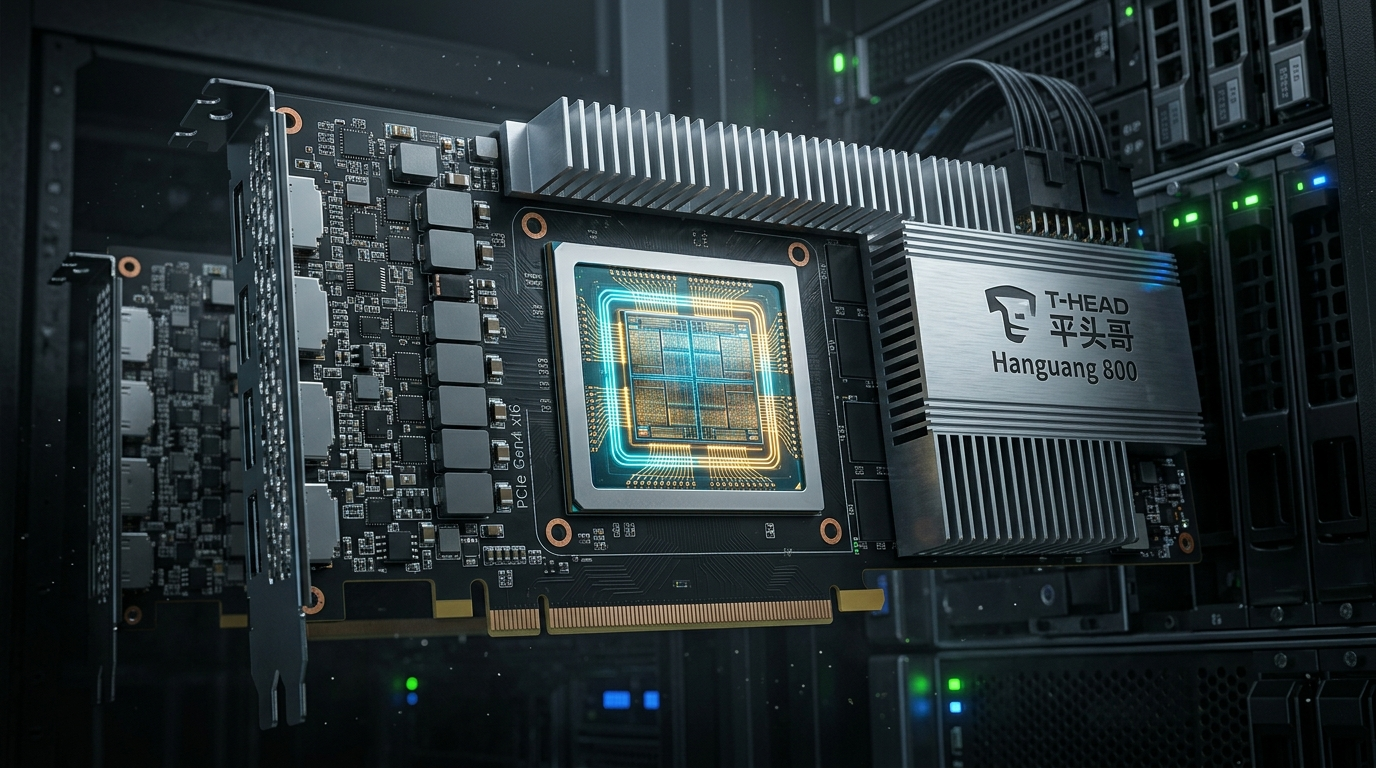
Introducing Alibaba Hanguang 800: The T-Head Datacenter AI NPU
Alibaba Cloud—through its dedicated semiconductor division T-Head (平头哥半导体) and the advanced research institute Alibaba DAMO Academy—solved the datacenter inference bottleneck by creating the Hanguang 800 (含光800) Neural Processing Unit.
Unveiled by Alibaba Group Chairman and CEO Daniel Zhang at the Apsara Conference and detailed at the prestigious IEEE Hot Chips 32 symposium, Hanguang 800 represents one of the most commercially impactful custom silicon designs in cloud history. Fabricated on a mature, cost-effective 12nm FinFET process by TSMC, the chip packs 17 billion transistors onto a single silicon die. Hanguang 800 shattered industry records by achieving 78,563 images per second (IPS) on the industry-standard ResNet-50 inference benchmark, reaching an unprecedented peak efficiency of 500 IPS/Watt—delivering nearly four times the throughput and three times the energy efficiency of contemporary flagship GPU accelerators.
+-------------------------------------------------------------------------+
|                  Alibaba T-Head Hanguang 800 Silicon Overview           |
+-------------------------------------------------------------------------+
| Architecture:       Custom Symmetrical 4-Core Neural Processing Unit    |
| Manufacturing Node: TSMC 12nm FinFET (17 Billion Transistors)           |
| On-Chip Memory:     192 MB Ultra-High-Bandwidth Distributed SRAM        |
| Interconnect:       High-Bandwidth Bi-Directional Ring Bus Network      |
| Host Interface:     PCIe Gen 4.0 x16 Interface (64 GB/s Full-Duplex)    |
| Peak Performance:   78,563 ResNet-50 IPS | 820 INT8 TOPS Peak Density   |
| Energy Efficiency:  500 IPS/Watt (ResNet-50 v1 INT8 Benchmark)          |
| Cloud Architecture: Native Integration with Alibaba Cloud X-Dragon MPU  |
+-------------------------------------------------------------------------+ Key architectural breakthroughs integrated into the Hanguang 800 NPU include:
- Symmetrical Quad-Core Ring Architecture: Integrates four independent, high-performance NPU execution cores interconnected via an ultra-wide bi-directional ring bus network, coordinated by an intelligent hardware Command Processor (CP).
- Massive 192 MB On-Chip SRAM Memory Hierarchy: Eliminates off-chip memory latency by storing entire neural network weights, feature maps, and activation tensors locally on-die, completely bypassing external DRAM during steady-state inference.
- Coarse-Grained CISC-Like Tensor Instruction Set: Replaces micro-coded instructions with high-level tensor operation primitives that fuse convolution, batch normalization, activation, and pooling into monolithic execution pipelines directly in hardware.
- Seamless Cloud Virtualization with X-Dragon Architecture: Integrates natively with Alibaba Cloud’s proprietary X-Dragon (神龙) MPU architecture, enabling zero-overhead hardware virtualization across containers, bare-metal nodes, and multi-tenant virtual machines.
- Production-Scale E-Commerce Deployment: Powers mission-critical Alibaba workloads, including Taobao Pailitao visual search (indexing 1 billion product images daily, slashing search latency from 100 milliseconds to single-digit milliseconds), recommendation rankings, and automated speech recognition.
Enterprises deploying large-scale neural network training, automated data extraction, and multimodal reasoning clusters can connect their Alibaba Hanguang 800 server infrastructure with real-time data ingestion infrastructure to stream high-velocity datasets directly into on-chip SRAM for immediate vectorized processing and continuous fine-tuning. By pairing specialized tensor microarchitecture with enterprise cloud infrastructure, Hanguang 800 establishes an enduring template for sovereign AI acceleration.
Architectural Deep Dive: 4-Core Ring Bus, 192MB SRAM, and CISC Tensor ISA
The exceptional inference density and deterministic sub-millisecond execution times of the Alibaba Hanguang 800 stem from three fundamental microarchitectural design choices: a decoupled multi-core ring topology, a massive on-chip static memory footprint, and a coarse-grained domain-specific instruction set.
Symmetrical Quad-Core Ring Topology
Rather than organizing execution logic into hundreds of tiny compute threads, T-Head engineers structured Hanguang 800 as four massive, homogeneous NPU cores connected by an ultra-fast ring network:
+-----------------------------------------------------------------------------------+
|                     Alibaba T-Head Hanguang 800 SoC Topology                      |
+-----------------------------------------------------------------------------------+
|  +------------------------+  +-------------------------------------------------+  |
|  | Host Interface Subsys  |  | Hardware Command Processor (CP)                 |  |
|  | PCIe Gen 4.0 x16       |  | Task Scheduling, Queue Arbitrament & Barriers   |  |
|  +-----------+------------+  +------------------------+------------------------+  |
|              |                                        |                           |
|  +-----------v----------------------------------------v------------------------+  |
|  |          High-Throughput Bi-Directional Coherent Ring Bus Network           |  |
|  +-----------------------------------------------------------------------------+  |
|        |                     |                        |                     |     |
|  +-----v-----------+   +-----v-----------+      +-----v-----------+   +-----v-----+   |
|  | NPU Core 0      |   | NPU Core 1      |      | NPU Core 2      |   | NPU Core 3|   |
|  | - Matrix Engine |   | - Matrix Engine |      | - Matrix Engine |   | - Matrix  |   |
|  | - Vector Engine |   | - Vector Engine |      | - Vector Engine |   | - Vector  |   |
|  | - 48MB On-Chip  |   | - 48MB On-Chip  |      | - 48MB On-Chip  |   | - 48MB    |   |
|  |   SRAM Storage  |   |   SRAM Storage  |      |   SRAM Storage  |   |   SRAM    |   |
|  | - Local Control |   | - Local Control |      | - Local Control |   | - Control |   |
|  +-----+-----------+   +-----+-----------+      +-----+-----------+   +-----+-----+   |
|        |                     |                        |                     |     |
|  +-----v---------------------v------------------------v---------------------v--+  |
|  |                 Direct Memory Access (DMA) & System Interconnect             |  |
|  +-----------------------------------------------------------------------------+  |
+-----------------------------------------------------------------------------------+ The Command Processor (CP) acts as the autonomous silicon orchestrator. It receives task descriptors from the host operating system, manages multiple hardware submission queues, decomposes high-level computational graphs into core-specific workloads, and synchronizes cross-core data transfers across the ring bus without interrupting the host CPU.
The bi-directional ring bus provides terabits-per-second of inter-core bandwidth, allowing cores to exchange feature map slices, share intermediate activations, or pool on-chip memory seamlessly. When running deep neural networks, the four cores can operate in either data-parallel mode (each core processing a separate batch of images) or model-parallel pipeline mode (each core executing specific layers of a deep network).
The ring bus implements a dedicated credit-based flow control protocol that guarantees deadlock-free packet transmission between the four cores. Each ring station features independent request, response, and data routing channels. When intermediate feature maps must be broadcast across cores—such as during cross-channel pooling or multi-head attention projections—the ring bus delivers single-cycle hop latencies, ensuring that pipeline execution bubbles remain negligible.
192 MB On-Chip SRAM Memory Hierarchy
The defining microarchitectural feature of the Hanguang 800 is its deliberate rejection of heavy external dynamic memory (DRAM or HBM) for inference execution. While pre-training accelerators like NVIDIA H100 require massive 80GB HBM capacities to store multi-gigabyte optimizer states, neural network inference is strictly bounded by weight and activation sizes:
- The Zero-DRAM Inference Goal: A standard computer vision foundation model (such as ResNet-50, YOLO, or MobileNet) or natural language encoder (such as BERT-Base) contains between 25 million and 110 million parameters. In quantized 8-bit integer (INT8) representation, these models require between 25 MB and 110 MB of memory storage.
- Massive Distributed SRAM: Hanguang 800 embeds 192 Megabytes (MB) of ultra-dense static RAM (SRAM) directly onto the silicon die (48 MB per NPU core).
- Infinite Memory Bandwidth at Zero Off-Chip Latency: Because the entire model parameter set resides permanently in on-chip SRAM, execution latency drops from hundreds of nanoseconds to single clock cycles. The internal SRAM array delivers multi-terabyte-per-second effective internal bandwidth, consuming less than 1 picojoule per bit (pJ/bit)—over 50 times less energy than reading operands from external DRAM chips across package solder balls.
Each 48 MB local SRAM block is further organized into dozens of independent, interleaved memory banks connected via a wide crossbar matrix. This fine-grained banking enables the Matrix Engine and Vector Engine to read activation vectors and weight tiles simultaneously across multiple spatial dimensions without encountering bank conflicts. In addition, dedicated hardware double-buffering allows the Direct Memory Access (DMA) engine to stage the next input batch into SRAM while arithmetic execution units compute over the current batch, achieving 100% compute-memory overlap.
Coarse-Grained CISC-Like Tensor Instruction Set Architecture
Conventional processors employ Reduced Instruction Set Computer (RISC) or SIMT instruction architectures that break operations down into primitive scalar or micro-vector instructions. While RISC architectures offer flexibility, they create catastrophic instruction decoding overhead when executing matrix mathematics:
+-------------------------------------------------------------------------+
|                     RISC vs. Hanguang CISC Tensor ISA                   |
+-------------------------------------------------------------------------+
| Traditional RISC / GPU Execution Flow:                                 |
| 1. Loop over batch dimensions (hundreds of branch instructions)         |
| 2. Fetch input vector chunk (load instructions)                         |
| 3. Fetch weight vector chunk (load instructions)                        |
| 4. Multiply-accumulate elements (FMUL/FADD instructions)                |
| 5. Store intermediate to register file                                  |
| 6. Fetch intermediate, apply Bias, apply ReLU activation, apply MaxPool |
| 7. Write intermediate back to memory cache                              |
| Result: Millions of instructions issued; massive decoding power wasted. |
|                                                                         |
| Hanguang 800 CISC Tensor Execution Flow:                                |
| Instruction: TENSOR_CONV2D_FUSED_RELU_POOL (TensorA, TensorW, TensorOut)|
| -> A single instruction initiates an entire multi-stage tensor pipeline!|
| -> Hardware decomposes tensor coordinates into internal spatial grids   |
| -> Compute passes directly: GEMM -> Bias Add -> Activation -> Pooling  |
| -> Data remains stationary in registers until final output tensor forms |
| Result: Extremely compact instruction stream; 99% of energy in compute! |
+-------------------------------------------------------------------------+ Hanguang 800’s instruction set operates on coarse-grained multi-dimensional tensor descriptors. A single CISC instruction specifies input tensor dimensions, kernel geometries, stride configurations, and fused post-processing operations. The hardware decoder decompresses this single instruction into hundreds of thousands of synchronized multiply-accumulate and activation cycles, eliminating instruction cache thrashing and achieving near-100% arithmetic utilization across the matrix engines.
By elevating the instruction abstraction from fine-grained scalar arithmetic to full tensor operations, Hanguang 800 reduces program code size by up to 95% compared to standard GPU assembly. This dramatic compression means that an entire deep learning inference graph can fit comfortably inside the Command Processor’s micro-instruction cache, eliminating instruction fetch stalls during high-frequency inference loops.
Coarse-to-Fine Core Microarchitecture: Matrix and Vector Engines
Within each of the four NPU cores, compute logic is split into specialized sub-engines:
- High-Density Matrix Engine (ME): Features a dense 2D systolic array of multiply-accumulate units optimized for INT8 and INT16 integer GEMM operations. The Matrix Engine processes hundreds of matrix elements per cycle, achieving over 200 INT8 TOPS per core (aggregating to 820 INT8 TOPS across the 4-core SoC).
- Flexible Vector Engine (VE): A wide vector processor executing non-linear activations (Sigmoid, Tanh, GeLU), softmax normalizations, layer normalizations, and element-wise tensor arithmetic. Operating concurrently with the Matrix Engine, the Vector Engine consumes output tensors directly as they emerge from the systolic array, preventing intermediate write-backs to memory.
- Hardware Memory Engine (HME): Handles multi-dimensional tensor transposition, zero-padding, im2col feature transformations, and spatial re-ordering on the fly, entirely offloading data alignment from the host software stack.
Programming Alibaba Hanguang 800: SynData SDK, Compiler Stack, and PyTorch Serving
To deploy high-throughput models on Hanguang 800, machine learning engineers utilize Alibaba’s proprietary SynData SDK and the Hanguang Graph Compiler. The compiler stack ingests trained neural networks from standard frameworks—including PyTorch, TensorFlow, Caffe, and ONNX—and performs automated quantization, operator fusion, and SRAM memory scheduling.
+-------------------------------------------------------------------------+
|                  Hanguang SynData Full-Stack Software Stack             |
+-------------------------------------------------------------------------+
| Application Layer:   PyTorch | TensorFlow | ONNX | Caffe                |
+-------------------------------------------------------------------------+
| SynData Quantizer:   Post-Training INT8 Calibration & Quantization-Aware|
+-------------------------------------------------------------------------+
| Graph Compiler:      Hanguang Graph Compiler (IR Opt, Op Fusion, Memory)|
+-------------------------------------------------------------------------+
| Runtime Engine:      SynData Runtime (Task Dispatch, Queue Management)  |
+-------------------------------------------------------------------------+
| Driver Layer:        Hanguang Kernel Driver (PCIe, DMA, Interrupts)     |
+-------------------------------------------------------------------------+
| Hardware Layer:      Alibaba T-Head Hanguang 800 NPU (17B Transistors)  |
+-------------------------------------------------------------------------+ Model Quantization and Compilation Pipeline
The following Python script illustrates how an enterprise engineering team quantizes an FP32 PyTorch model into an INT8 Hanguang execution binary using the SynData Python SDK:
# hanguang_compile_pipeline.py
# Automated quantization and compilation pipeline for Alibaba Hanguang 800

import torch
import torchvision.models as models
import syndata_sdk as syndata
import os
import numpy as np

def build_calibration_dataset(num_samples: int = 500):
    """
    Generates representative input calibration data for INT8 quantization.
    """
    print(f"[*] Generating {num_samples} calibration samples...")
    # Calibration requires realistic data distribution to calculate optimal clipping scales
    for _ in range(num_samples):
        yield np.random.randn(1, 3, 224, 224).astype(np.float32)

def compile_for_hanguang(model_name: str, output_binary: str):
    """
    Compiles a PyTorch model into an optimized Hanguang 800 execution binary.
    """
    print(f"[*] Initializing model: {model_name}")
    model = models.resnet50(pretrained=True)
    model.eval()

    # Step 1: Export PyTorch model to ONNX intermediate representation
    onnx_path = f"{model_name}.onnx"
    dummy_input = torch.randn(1, 3, 224, 224)
    print(f"[*] Exporting to ONNX IR: {onnx_path}")
    torch.onnx.export(
        model,
        dummy_input,
        onnx_path,
        input_names=["input_tensor"],
        output_names=["output_logits"],
        opset_version=13
    )

    # Step 2: Initialize SynData Graph Optimizer
    print("[*] Launching SynData Optimization Pipeline...")
    optimizer = syndata.GraphOptimizer(target_hardware="hanguang800")

    # Enable aggressive operator fusion (Conv + BatchNorm + ReLU -> Monolithic CISC instruction)
    optimizer.set_optimization_level(syndata.OptLevel.O3)
    optimizer.enable_fusion(conv_relu=True, conv_batchnorm=True, conv_add=True)

    # Step 3: Run KL-Divergence Calibration for INT8 Quantization
    print("[*] Running Post-Training Quantization (PTQ) calibration...")
    quantizer = syndata.Quantizer(precision=syndata.Precision.INT8)
    calibration_data = build_calibration_dataset(num_samples=200)
    quantized_graph = quantizer.calibrate(onnx_path, calibration_data, method="entropy")

    # Step 4: Compile optimized graph into Hanguang binary
    print(f"[*] Generating Hanguang hardware executable: {output_binary}...")
    compiler = syndata.HardwareCompiler()
    compiler.set_target_cores(num_cores=4) # Distribute across all 4 NPU cores
    compiler.allocate_sram(max_sram_mb=192) # Pin model parameters inside on-chip SRAM

    exec_binary = compiler.compile(quantized_graph)
    exec_binary.save(output_binary)
    print(f"[+] Compilation complete! Binary successfully saved to: {output_binary}")

if __name__ == "__main__":
compile_for_hanguang("resnet50", "resnet50_hanguang.bin") Real-Time High-Throughput Inference Server
Once the model is compiled into a Hanguang execution binary, it can be loaded into an asynchronous inference service. The following Python script demonstrates multi-threaded batch inference utilizing the SynData C-API Python bindings:
# hanguang_serving_runtime.py
# High-concurrency enterprise inference engine utilizing Alibaba Hanguang 800 NPU

import time
import numpy as np
import syndata_runtime as sdr
from concurrent.futures import ThreadPoolExecutor

class HanguangInferenceEngine:
    def __init__(self, binary_path: str, device_id: int = 0):
        """
        Initializes the Hanguang 800 device driver and loads the binary into on-chip SRAM.
        """
        self.device_id = device_id
        print(f"[*] Initializing Hanguang 800 NPU on Device ID: {device_id}")
        self.device = sdr.Device(device_id)

        # Load compiled binary directly into 192MB on-chip SRAM
        print(f"[*] Loading model binary into on-chip SRAM: {binary_path}")
        self.model = self.device.load_model(binary_path)

        # Query device hardware telemetry
        telemetry = self.device.get_telemetry()
        print(f"[+] Silicon Status: Cores Active={telemetry.active_cores}, Temp={telemetry.temperature_c}C")
        print(f"[+] On-Chip SRAM Occupancy: {telemetry.sram_used_mb} MB / 192 MB")

    def execute_batch(self, batch_data: np.ndarray) -> np.ndarray:
        """
        Executes zero-copy synchronous inference across the quad-core ring bus.
        """
        # Allocate pinned DMA memory buffer for PCIe Gen4 transfer
        input_buffer = self.device.allocate_input_buffer(batch_data.shape, dtype=np.int8)
        output_buffer = self.device.allocate_output_buffer((batch_data.shape[0], 1000), dtype=np.float32)

        # Copy input tensor to device DMA region
        input_buffer.copy_from(batch_data)

        # Trigger non-blocking hardware inference
        t_start = time.perf_counter()
        execution_handle = self.model.forward_async(input_buffer, output_buffer)
        execution_handle.wait() # Await hardware completion interrupt
        t_latency_ms = (time.perf_counter() - t_start) * 1000.0

        results = output_buffer.to_numpy()
        return results, t_latency_ms

    def benchmark_throughput(self, batch_size: int = 128, total_inferences: int = 10000):
        """
        Evaluates peak throughput and tail latency under heavy enterprise load.
        """
        dummy_batch = np.random.randint(-128, 127, size=(batch_size, 3, 224, 224), dtype=np.int8)
        iterations = total_inferences // batch_size
        latencies = []

        print(f"[*] Commencing benchmark: {total_inferences} total inferences (Batch Size: {batch_size})...")
        t_start_total = time.perf_counter()

        for _ in range(iterations):
            _, latency = self.execute_batch(dummy_batch)
            latencies.append(latency)

        t_total_elapsed = time.perf_counter() - t_start_total
        effective_ips = total_inferences / t_total_elapsed
        p50 = np.percentile(latencies, 50)
        p99 = np.percentile(latencies, 99)

        print("\n================== Hanguang 800 Benchmark Results ==================")
        print(f"Total Throughput:    {effective_ips:.2f} Images Per Second (IPS)")
        print(f"Batch Latency (P50): {p50:.3f} ms")
        print(f"Batch Latency (P99): {p99:.3f} ms")
        print(f"Per-Image Latency:   {(p50 / batch_size):.4f} ms")
        print("===================================================================\n")

if __name__ == "__main__":
    engine = HanguangInferenceEngine("resnet50_hanguang.bin", device_id=0)
engine.benchmark_throughput(batch_size=128, total_inferences=12800) In this pipeline:
self.device.load_model(binary_path)loads model weights directly into the 192 MB on-chip SRAM, ensuring that during the entire benchmark loop, zero memory requests leave the silicon package.model.forward_async(...)issues high-level CISC tensor instructions to the on-chip Command Processor, triggering parallel execution across all four NPU cores without host thread synchronization locks.
Architectural Comparison: Alibaba Hanguang 800 vs. NVIDIA T4 vs. Google TPU v4i vs. Qualcomm Cloud AI 100
To understand the microarchitectural positioning of the Alibaba Hanguang 800, we compare it against contemporary industry datacenter inference accelerators: the NVIDIA Tesla T4, the Google Cloud TPU v4i, and the Qualcomm Cloud AI 100:
| Feature / Metric | Alibaba T-Head Hanguang 800 | NVIDIA Tesla T4 | Google Cloud TPU v4i | Qualcomm Cloud AI 100 |
|---|---|---|---|---|
| Compute Core Type | Custom 4-Core NPU (CISC) | Turing SM (SIMT Warps) | VPU + Systolic MXU (VLIW) | 16 AI Cores (Tensor + Vector) |
| Fabrication Node | TSMC 12nm FinFET | TSMC 12nm FFN | Custom 7nm FinFET | TSMC 7nm FinFET |
| Transistor Count | 17 Billion Transistors | 13.6 Billion Transistors | Confidential (~15B) | ~15 Billion Transistors |
| On-Chip SRAM Cache | 192 MB (Zero-DRAM Target) | 4 MB L2 Cache | 32 MB Unified Buffer | 144 MB Distributed SRAM |
| External Memory | None (Pure On-Chip Execution) | 16 GB GDDR6 (320 GB/s) | 8 GB or 16 GB HBM2 | 16 GB LPDDR4x (137 GB/s) |
| ResNet-50 INT8 Peak | 78,563 IPS | ~11,000 IPS | ~28,000 IPS | ~25,000 IPS |
| Energy Efficiency | 500 IPS/Watt | ~150 IPS/Watt | ~250 IPS/Watt | ~350 IPS/Watt |
| Instruction Style | Coarse-Grain CISC Tensor ISA | Fine-Grain SIMT (PTX/SASS) | VLIW CISC Instructions | VLIW Custom Tensor ISA |
| Interconnect Topology | On-Chip Bi-Directional Ring | Host PCIe Bus Only | 3D Torus Inter-Chip Links | Host PCIe / Point-to-Point |
| Thermal Power (TDP) | 160W (PCIe Standard) | 70W (Passive PCIe) | 175W | 75W - 150W |
| Cloud Integration | Alibaba Cloud X-Dragon MPU | Generic PCIe Host Offload | Google Cloud Borg / XLA | Generic PCIe Server Slots |
Roofline Analysis: Arithmetic Intensity and Memory Bandwidth Saturation
Evaluating accelerators via the classical Williams Roofline Model illustrates why Hanguang 800 achieves such high throughput on deep convolutional and transformer inference networks:
Attainable Performance (FLOP/s) = min(Peak Compute, Arithmetic Intensity * Memory Bandwidth) In standard GPU architectures, when models are evaluated at small batch sizes (batch size = 1 to 16) to satisfy interactive latency requirements, the operational arithmetic intensity drops into the memory-bound domain ($\le 20 \text{ FLOPs/Byte}$). Because GPUs must continuously pull weights from external GDDR6 or HBM memory across the package bus, their Tensor Cores operate at only 15% to 30% of peak theoretical capacity.
In contrast, Hanguang 800 shifts the operational point entirely into the compute-bound regime. By pinning all weights and intermediate activation feature maps inside its 192 MB distributed SRAM array, the effective memory bandwidth is determined by on-chip metal routing rather than off-chip PHY transceivers. Operating with internal memory bandwidths exceeding several terabytes per second, Hanguang 800 maintains near-peak systolic utilization even at unit batch sizes, delivering steady-state inference without memory throttling.
Key Comparative Takeaways
- The Power of Pure SRAM Residency: While the NVIDIA T4 must repeatedly fetch weights across a 320 GB/s GDDR6 bus, Hanguang 800 stores entire models inside its 192 MB on-chip SRAM array. This architectural decision enables Hanguang 800 to achieve over 7x the throughput of the NVIDIA T4 despite both chips being manufactured on identical 12nm process nodes.
- Instruction Decoding Efficiency: NVIDIA’s Turing SMs spend substantial silicon area and dynamic energy decoding billions of micro-instructions and tracking warp barriers. Hanguang 800’s coarse-grained CISC instruction set enables a single instruction to execute millions of multiply-accumulate operations, driving energy efficiency to 500 IPS/Watt.
- Specialized Inference Focus vs. General-Purpose Programmability: The trade-off of Hanguang 800’s architecture is specialized applicability. While NVIDIA GPUs can easily switch to general-purpose scientific computing, ray tracing, or FP64 physics simulations, Hanguang 800 is hyper-optimized exclusively for tensor inference and matrix-heavy computer vision pipelines.
Production Deployment: Alibaba Cloud X-Dragon Infrastructure and Taobao Pailitao
Deploying custom silicon at scale requires deep co-design between hardware accelerators, operating systems, and datacenter infrastructure. Alibaba achieved this through the tight integration of Hanguang 800 with its proprietary X-Dragon (神龙) Cloud Architecture.
Cloud Integration with the X-Dragon MPU
In standard datacenter servers, host CPU cores consume substantial power managing hypervisors, virtual switches, network packet parsing, and PCIe device interrupts. In Alibaba Cloud, these infrastructure tasks are offloaded to the X-Dragon MPU (Micro Processing Unit), an ASIC-driven smart network and storage controller:
+-------------------------------------------------------------------------+
|                  Alibaba Cloud X-Dragon Server Architecture             |
+-------------------------------------------------------------------------+
|  Host Server Subsystem:                                                 |
|  Dual-Socket Server CPUs (Dedicated 100% to Customer Applications)     |
+-------------------------------------------------------------------------+
|  PCIe Gen 4.0 High-Speed Switch Fabric                                  |
+-------------------------------------------------------------------------+
|         |                                              |                |
|  +------v-----------------------+       +--------------v-------------+  |
|  | Alibaba Hanguang 800 NPU     |       | Alibaba X-Dragon MPU       |  |
|  | - 4 NPU Cores (192MB SRAM)   |       | - Bare-Metal Hypervisor    |  |
|  | - Zero Host CPU Overhead     |       | - 100GbE VPC Networking    |  |
|  | - Sub-Millisecond AI Compute |       | - Cloud Disk Virtualization|  |
|  +------------------------------+       +----------------------------+  |
+-------------------------------------------------------------------------+ When an inference request arrives from the external network, the X-Dragon MPU routes the network packet directly into the Hanguang 800’s input buffers over PCIe peer-to-peer DMA, completely bypassing the host CPU and kernel space. This zero-copy network-to-accelerator path reduces end-to-end request latency from tens of milliseconds to sub-millisecond timescales.
Furthermore, the X-Dragon architecture provides unified hardware isolation for multi-tenant cloud environments. Customers can provision fractional Hanguang 800 NPU instances within Alibaba Cloud Elastic Compute Service (ECS) with dedicated SRAM slices, ring bus bandwidth quotas, and zero performance crosstalk from neighboring containers.
Case Study: Taobao Pailitao (Visual Search at Scale)
The real-world validation of Hanguang 800 occurred within Alibaba’s core e-commerce ecosystem, specifically powering Pailitao (拍立淘)—one of the world’s largest visual search engines:
- The Scale Challenge: Over 100 million consumers use Pailitao daily to search for products by uploading smartphone photographs. The system indexes over 1 billion product images daily, extracting deep visual feature vectors, classifying product categories, and performing vector similarity matching against a multi-billion-item catalogue.
- Legacy GPU Cluster Limits: Prior to Hanguang 800, visual feature extraction across 1 billion images took traditional GPU clusters approximately 1 hour to batch-process, consuming extensive power and introducing latency spikes during flash sales and Singles’ Day (11.11) shopping festivals.
- Hanguang 800 Deployment Impact: Migrating Pailitao to Hanguang 800 servers reduced the 1-billion-image batch processing time from 1 hour to just 5 minutes (a 12x acceleration). Furthermore, individual visual search query latency dropped from over 100 milliseconds to 12 milliseconds, while slashing server hardware rack space by 70%.
- Vector Pipeline Integration: In the production Pailitao workflow, Hanguang 800 extracts high-dimensional 512-dimensional embedding representations from incoming product imagery in 0.12 milliseconds. These feature vectors are immediately streamed into Alibaba’s distributed vector database clusters for approximate nearest neighbor (ANN) graph retrieval, delivering fully ranked visual recommendations before the user’s mobile screen refresh cycle concludes.
Enterprise AI teams utilizing distributed web extraction frameworks and automated intelligence feeds can deploy Hanguang 800 cloud instances as ultra-fast, cost-effective inference engines. Discover how our team configures full-stack AI data platforms on our AiFetchly official homepage.