Air-Gapped Desktop AI: Complete Sovereign Pipeline Guide
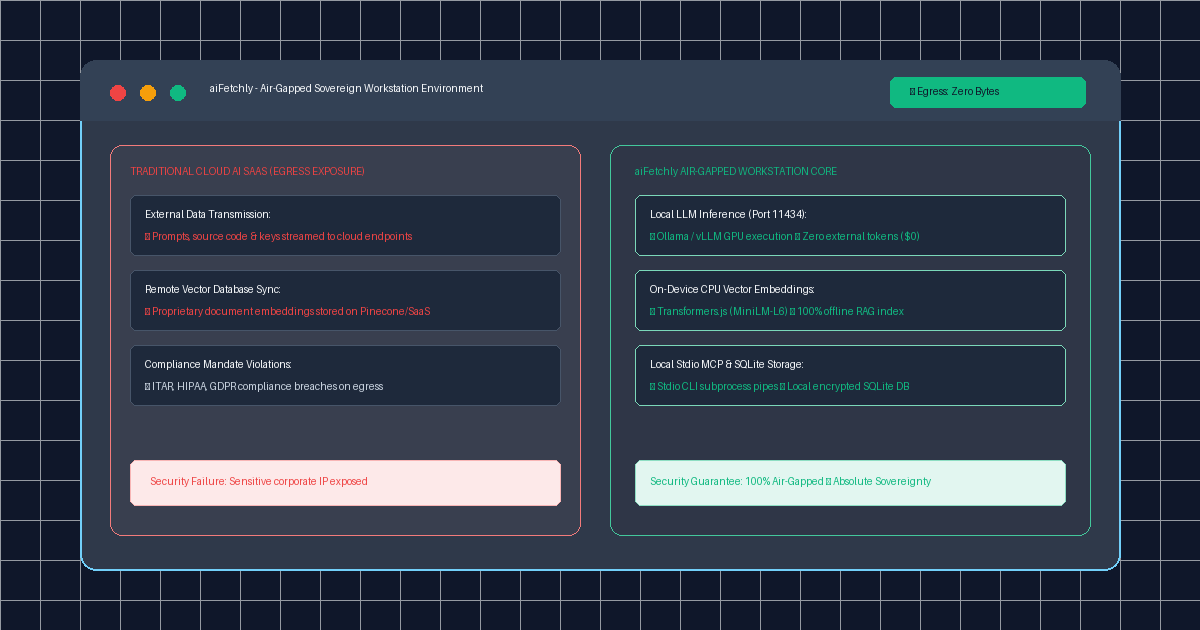
The Compliance Dilemma of Cloud AI Agents
For developers working in defense, healthcare, fintech, or legal sectors, deploying autonomous AI agents presents a formidable compliance hurdle. Strict regulatory frameworks—such as ITAR, HIPAA, SOC 2 Type II, and GDPR—strictly prohibit transmitting proprietary source code, confidential customer files, or internal database credentials across public internet backbones.
Traditional cloud-hosted AI copilots and web-based agent platforms are fundamentally incompatible with air-gapped security boundaries:
- Compulsory Egress: Web interfaces stream prompts, tokens, and file contents to multi-tenant cloud servers.
- Third-Party Telemetry: Hidden diagnostic beacons, cloud telemetry loggers, and analytics pings leak sensitive metadata.
- Remote Vector Dependencies: Cloud RAG systems require uploading unredacted documentation to managed vector databases (Pinecone, Qdrant Cloud), creating persistent attack surfaces outside your corporate firewall.
AI Fetchly resolves this compliance barrier by providing a 100% air-gapped desktop architecture. Every layer of the agent stack—inference, vector retrieval, database storage, and tool execution—runs entirely on your local workstation.
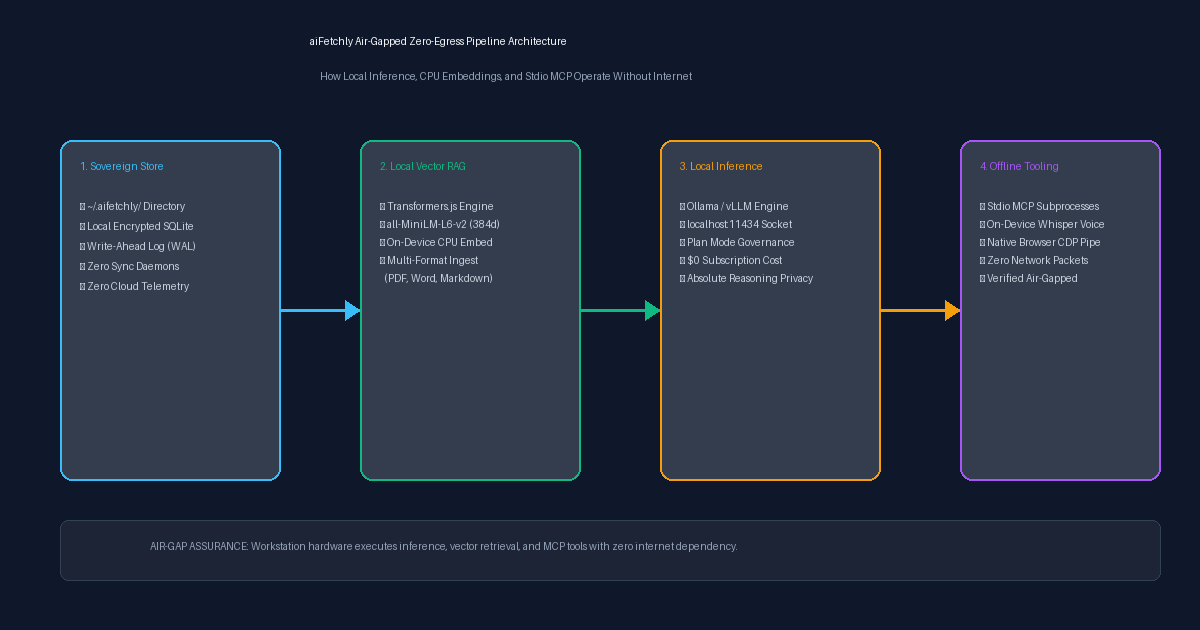
Four Pillars of the Zero-Egress Desktop Pipeline
Developers can disconnect their network adapters and run end-to-end agentic workflows through four sovereign subsystems:
1. Local Model Inference via Custom AI Provider
Through its native AI Provider interface, aiFetchly connects directly to local inference backends over loopback sockets (http://localhost:11434/v1):
- Point to local Ollama, vLLM, or LM Studio instances utilizing your workstation’s GPU hardware.
- No aiFetchly AI subscription or remote license validation is required.
- All reasoning tokens are generated locally with zero per-token billing and zero external network packets.
2. On-Device CPU Vector Embeddings
In the Knowledge Library, RAG vectorization executes completely on-device using Transformers.js:
- Employs
Xenova/all-MiniLM-L6-v2running natively on your workstation CPU. - Indexes local PDF specifications, Word contracts, and Markdown documentation into high-dimensional vector representations without sending raw text to cloud embedding APIs.
3. Local Stdio Model Context Protocol (MCP)
Rather than communicating with remote webhooks or cloud SaaS endpoints, aiFetchly connects to tools via standard input/output (stdio) process pipes:
- Spawns local CLI subprocesses (e.g., local Git inspector, SQLite query tool, filesystem utility).
- All tool definitions and execution payloads remain locked within local OS process memory.
4. Sovereign Encrypted SQLite Storage
All project artifacts, chat histories, agent memory configurations, and campaign logs reside in ~/.aifetchly/:
- Stored in an ACID-compliant, encrypted local SQLite database operating in Write-Ahead Log (WAL) mode.
- No background sync daemons, cloud backups, or remote telemetry trackers are ever initiated.
Absolute Data Sovereignty for Desktop Engineering
By confining inference, vector indexing, and tool execution to physical workstation hardware, aiFetchly empowers developers to harness the full power of agentic automation while satisfying the strictest air-gapped compliance mandates.
Explore offline configuration guides and local MCP setups in the AI Fetchly Docs.
Visual Generation Prompts
Hero Image Prompt:Modern dark-mode developer UI comparing cloud AI SaaS egress vulnerabilities (red alert badges for cloud packet streaming and third-party vector databases) against aiFetchly’s air-gapped workstation core (green security shields for localhost:11434 Ollama inference, on-device CPU vector embeddings, and zero-egress lock), sleek isometric 3D perspective, cyan and emerald glow.Body Image Prompt:High-resolution technical pipeline blueprint illustrating the aiFetchly air-gapped zero-egress architecture: local SQLite encrypted storage, on-device CPU vector RAG via Transformers.js, local GPU model inference (Ollama/vLLM), and offline Stdio MCP subprocess tool execution without internet dependency, dark slate vector blueprint style.