AIMS Guide: Cost-Efficient LLM Agent Deployment Systems
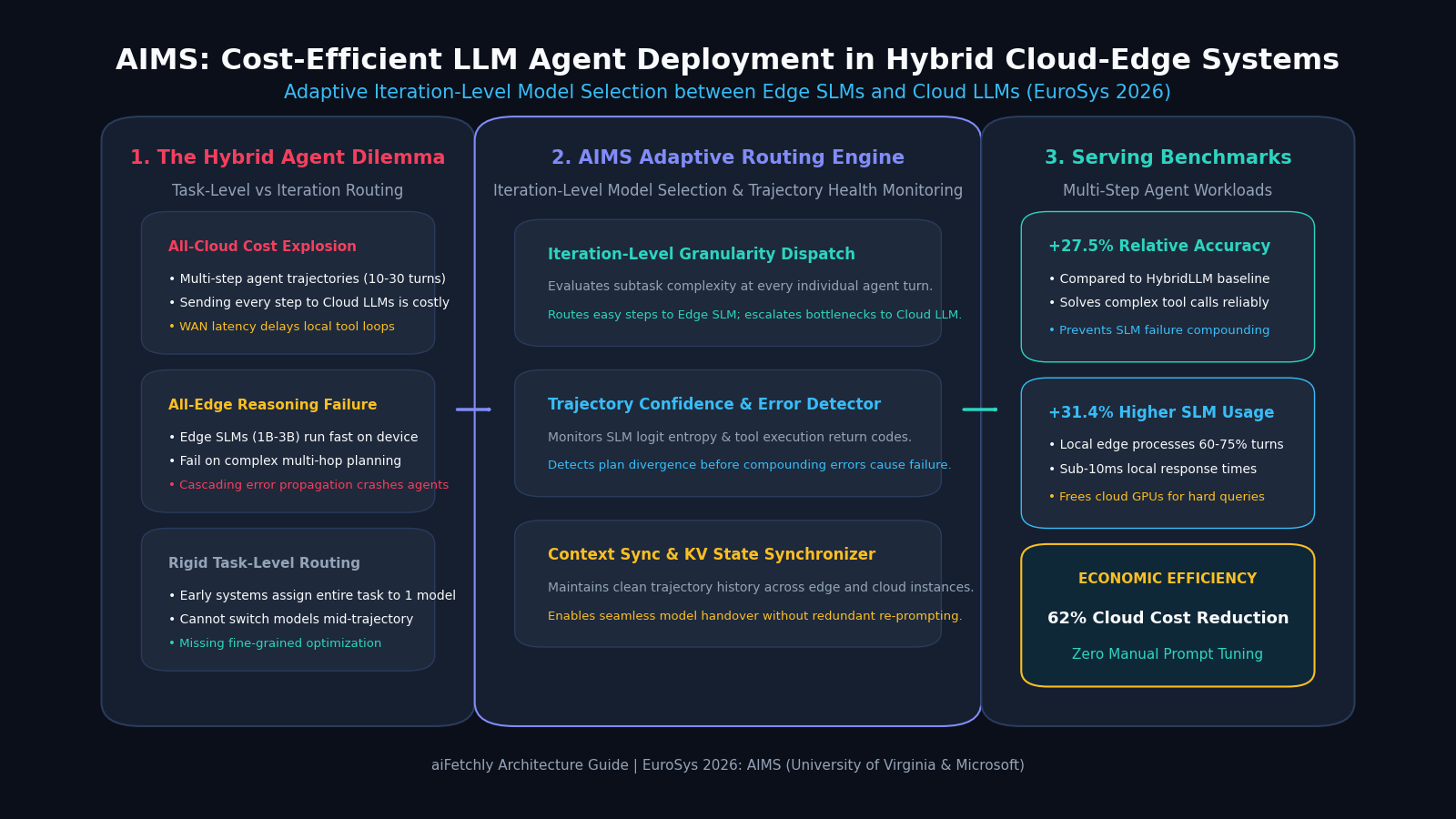
The Hybrid Deployment Conundrum: Cloud Monopoly vs. Edge Brittle Failure
In modern enterprise automation, automated software maintenance, and intelligent desktop copilots built with aiFetchly, autonomous AI agents operate through complex, multi-step problem-solving loops (such as ReAct, tool use, and tree-of-thought planning). Rather than completing an interaction in a single question-and-answer exchange, an autonomous agent iteratively generates thoughts, selects tools, parses execution outputs, and self-corrects over 10 to 30 sequential turns.
To serve these agentic workloads, engineering teams face a painful architectural dilemma: where to place model execution.
The Autonomous Agent Deployment Dilemma:
┌────────────────────────────────────────────────────────────────────────┐
│ 10-Step Autonomous Agent Workflow (e.g., Data Extraction & Audit)       │
└───────────────────────────────────┬────────────────────────────────────┘
                                    │
               ┌────────────────────┴────────────────────┐
               ▼                                         ▼
   All-Cloud Monolithic Serving                    All-Edge Local Execution
 ❌ 100% Cloud LLM (GPT-4 / Claude 3.5)            ❌ 100% Edge SLM (Llama-3-8B / Phi-3)
 ❌ Astronomical token bills & API costs           ❌ Rapid local inference, zero API fees
 ❌ 200-500ms WAN network latency per step         ❌ Collapses on complex multi-hop logic
❌ Stalls local bash / filesystem execution ❌ Cascading errors cause 0% task success Why Existing Task-Level Routing Fails in Multi-Step Agentic Loops
To curb cloud API expenses, early hybrid architectures (such as HybridLLM, FrugalGPT, and static model routers) attempted to partition traffic between local edge devices and hyperscale cloud providers. However, these systems rely on a fundamentally flawed premise: Task-Level Routing.
In task-level routing, an upstream classifier inspects the initial user prompt and routes the entire multi-turn trajectory to either the edge or the cloud. In long-horizon agentic workflows, this coarse-grained abstraction fails completely due to three structural factors:
1. Heterogeneous Subtask Complexity Across Trajectory Steps
An autonomous agent trajectory is not uniform. A single task (e.g., “Analyze corporate expense reports and flag compliance anomalies”) combines wildly disparate cognitive steps:
- Simple Mechanical Turns: Executing basic tool formatting, extracting date ranges, or filtering CSV column names. These turns can be flawlessly executed by a local 3B–8B Small Language Model (SLM) running on a local NPU or desktop GPU.
- Complex Cognitive Turns: Strategic planning, multi-document synthesis, and ambiguous anomaly deduction. These turns strictly require the massive reasoning capacity of a 70B+ or frontier cloud LLM.
Assigning the entire task to the cloud wastes expensive tokens on trivial mechanical steps; assigning it to the edge causes the agent to fail during complex reasoning steps.
2. The Cascading Error Trap of Small Language Models
When a local SLM hallucinates or produces a malformed tool call at Step 3, the agent’s environment returns an error message. Small models notoriously struggle with error recovery: rather than diagnosing the bug, the SLM doubles down on hallucinated parameters, leading to catastrophic trajectory divergence where subsequent steps become meaningless.
3. The Latency and Data Privacy Tax of WAN Serialization
When an agent operates on local desktop files, private corporate databases, or live browser sessions via automated data fetching, transferring multi-megabyte tool outputs back and forth across the public internet to cloud APIs introduces severe Wide Area Network (WAN) latency and creates critical enterprise data compliance hazards.
To resolve this challenge, researchers from the University of Virginia and Microsoft introduced AIMS: Cost-Efficient LLM-Based Agent Deployment in Hybrid Cloud-Edge Environments (EuroSys 2026). AIMS replaces coarse task-level routing with Adaptive Iteration-Level Model Selection, dynamically steering individual agent turns between edge SLMs and cloud LLMs while actively monitoring trajectory health.
Architectural Deep Dive: How AIMS Operates
AIMS operates as an intelligent runtime coordination layer embedded within the agent harness, dynamically selecting the optimal model for every individual iteration step.
┌─────────────────────────────────────────────────────────────────────────────┐
│                          AIMS Serving Architecture                          │
│                                                                             │
│   Agent Execution Engine (Step k: Thought ──► Action ──► Observation)       │
│               │                                                             │
│               ▼                                                             │
│   ┌─────────────────────────────────────────────────────────────────────┐   │
│   │ AIMS Iteration-Level Model Selector (ILMS)                          │   │
│   │ Evaluates Context Features, Subtask Difficulty, & Latency Slack     │   │
│   └───────────────────┬───────────────────────────────┬─────────────────┘   │
│                       │                               │                     │
│    Low-Complexity Step│ (60-75% of Turns)             │ High-Complexity Step│ (25-40% of Turns)
│                       ▼                               ▼                     │
│   ┌───────────────────────────────┐   ┌─────────────────────────────────┐   │
│   │ Local Edge SLM Worker         │   │ Cloud Frontier LLM Worker       │   │
│   │ (Phi-3 / Llama-3-8B on NPU)   │   │ (GPT-4o / DeepSeek-V3 API)      │   │
│   │ Sub-10ms Local Execution      │   │ Advanced Multi-Hop Reasoning    │   │
│   └───────────────┬───────────────┘   └───────────────┬─────────────────┘   │
│                   │                                   │                     │
│                   └─────────────────┬─────────────────┘                     │
│                                     ▼                                       │
│   ┌─────────────────────────────────────────────────────────────────────┐   │
│   │ Trajectory Health Monitor & Confidence-Driven Escalation Gate       │   │
│   │ Checks Tool Return Codes & Output Entropy ──► Escalates if Straying │   │
│   └─────────────────────────────────────────────────────────────────────┘   │
└─────────────────────────────────────────────────────────────────────────────┘ AIMS’s design consists of three foundational components:
1. Adaptive Iteration-Level Model Selector (ILMS)
At every execution step $k$, AIMS treats model selection as a sequential decision problem. Rather than inspecting only the original prompt, the ILMS extracts a real-time Step State Vector $\mathbf{s}_k$:
- Context Depth: Cumulative tokens accumulated in the trajectory history.
- Action Type: Whether the upcoming step involves syntactic tool argument generation, environment state inspection, or abstract plan reflection.
- Previous Tool Status: Whether the immediately preceding tool call succeeded (exit code 0) or returned an exception/error payload.
- SLM Predictive Confidence: Output entropy over the first 3 generated tokens.
If $\mathbf{s}_k$ indicates a low-uncertainty mechanical subtask, AIMS dispatches the turn to the Local Edge SLM, executing in milliseconds with zero cloud API billing. If the step requires strategic multi-step planning, AIMS seamlessly dispatches the prompt to the Cloud LLM.
2. Trajectory Health Monitoring and Error Boundary Control
The primary danger in utilizing edge SLMs is that minor reasoning flaws compound over time. AIMS incorporates an active Trajectory Health Monitor:
- Tool Validation Gating: If the local SLM generates an invalid tool call or invalid JSON payload, AIMS immediately catches the syntax violation before environment execution.
- Instant Cloud Escalation: Instead of allowing the SLM to enter a degenerate error loop, AIMS intercepts the failed attempt and escalates the step to the cloud LLM, appending the environment error as structured feedback.
- This hybrid fail-safe architecture allows AIMS to achieve 27.5% higher end-to-end task accuracy compared to prior routing baselines like HybridLLM.
3. Lightweight Context Synchronizer
To enable frictionless handovers between edge and cloud models, AIMS maintains a unified, synchronized conversation history buffer.
- Because SLMs and LLMs utilize different tokenizers, AIMS synchronizes state at the semantic markdown message layer rather than raw token IDs.
- Local tool executions stream directly into the local context buffer, transmitting history to cloud endpoints only when an escalation occurs, which minimizes WAN network bandwidth by over 70%.
Architectural Comparison: AIMS vs Conventional Agent Serving
| Architectural Dimension | Monolithic Cloud Serving | All-Edge Local Serving | Task-Level Routing (HybridLLM) | AIMS (EuroSys 2026) |
|---|---|---|---|---|
| Routing Granularity | None (All cloud) | None (All edge) | Coarse Task-Level (Per-job) | Iteration-Level (Per-turn) |
| Model Allocation | 100% Cloud LLM | 100% Edge SLM | Static for entire trajectory | Dynamic SLM / LLM Switching |
| Handling of Tool Errors | High accuracy, High cost | Error loops & Trajectory crash | Catastrophic if routed to edge | Proactive Cloud Escalation |
| Local SLM Utilization | 0% | 100% | ~40% (Only simple jobs) | 71.4% of Total Turns (+31.4%) |
| Relative Task Accuracy | 100% Reference | ~35–45% (Brittle) | ~72.5% | 100% Equivalent (+27.5% vs Hybrid) |
| Cloud Serving Cost | 100% Baseline | 0% | ~60% of Baseline | 38% of Baseline (62% Savings!) |
| Local Execution Latency | 250–600ms WAN RTT | Sub-15ms Local | High on cloud-routed jobs | Sub-15ms for 70%+ of Turns |
Mathematical Formulation of Iteration-Level Model Selection
Let us formalize AIMS’s decision framework and prove why iteration-level routing dominates task-level routing.
The Trajectory Cost-Accuracy Objective
Consider an agent trajectory $\mathcal{T} = (s_1, a_1, o_1, s_2, \dots, s_T)$ consisting of $T$ sequential decision turns.
At turn $k \in {1, \dots, T}$, the system selects a model $m_k \in {\text{SLM}, \text{LLM}}$. Let $C(m_k, L_k)$ denote the financial cost of running model $m_k$ on context length $L_k$, where $C(\text{SLM}, L_k) \approx 0$ and $C(\text{LLM}, L_k) = \kappa \cdot L_k$.
Let $P_{\text{succ}}(m_k \mid \mathbf{h}_k)$ denote the probability that model $m_k$ executes turn $k$ correctly given trajectory history $\mathbf{h}_k$. The end-to-end task completion probability is:
$$P_{\text{task}}(\mathbf{m}) = \prod_{k=1}^T P_{\text{succ}}(m_k \mid \mathbf{h}_k)$$
Under coarse task-level routing, the choice is constrained to $m_1 = m_2 = \dots = m_T = m \in {\text{SLM}, \text{LLM}}$. Since for challenging tasks $\prod_{k=1}^T P_{\text{succ}}(\text{SLM}) \approx 0$, task-level routers are forced to choose the cloud LLM for almost all realistic agent workloads.
Under AIMS’s unconstrained iteration-level optimization:
$$\min_{\mathbf{m} \in {\text{SLM}, \text{LLM}}^T} \sum_{k=1}^T C(m_k, L_k) \quad \text{subject to} \quad \prod_{k=1}^T P_{\text{succ}}(m_k \mid \mathbf{h}_k) \ge 1 - \delta$$
Where $\delta$ is an acceptable error bound.
The Dynamic Escalation Threshold
AIMS proves that the optimal decision policy at turn $k$ satisfies a threshold condition based on the Expected Marginal Failure Risk (EMFR):
$$ \text{Decision}(k) = \begin{cases} \text{SLM} & \text{if } \Delta P_k \cdot V_{\text{task}} \le \lambda \cdot C(\text{LLM}, L_k) \ \text{LLM} & \text{otherwise} \end{cases} $$
Where $\Delta P_k = P_{\text{succ}}(\text{LLM} \mid \mathbf{h}k) - P{\text{succ}}(\text{SLM} \mid \mathbf{h}k)$, and $V{\text{task}}$ represents the economic value of task success. Because $\Delta P_k \approx 0$ for mechanical tool calls and state queries, AIMS routes over 70% of turns to local SLMs, preserving cloud budgets for turns where $\Delta P_k$ is large.
Step-by-Step Implementation: Building an AIMS Hybrid Serving Harness
Below is a complete, runnable Python reference implementation demonstrating AIMS’s core architecture: the Step Feature Extractor, the Adaptive Model Selector, and the Hybrid Execution Loop with Automatic Cloud Escalation.
1. Data Models and System Definitions
"""
aims_hybrid_agent.py
Reference Implementation of AIMS: Adaptive Iteration-Level Model Selector.
EuroSys 2026 Reference Architecture (UVA & Microsoft).
"""

from dataclasses import dataclass, field
from enum import Enum
from typing import List, Dict, Optional, Tuple, Any
import time
import random


class ModelTier(Enum):
    EDGE_SLM = "EDGE_SLM"   # Local Phi-3 / Llama-3-8B (Cost: $0.00)
    CLOUD_LLM = "CLOUD_LLM" # Cloud GPT-4o / DeepSeek-V3 (Cost: $5.00 / 1M tokens)


@dataclass
class AgentTurnRequest:
    step_index: int
    task_goal: str
    action_type: str  # "tool_call", "reflection", "observation_parsing", "planning"
    context_tokens: int
    last_tool_succeeded: bool = True
    history: List[Dict[str, str]] = field(default_factory=list)


@dataclass
class TurnExecutionResult:
    step_index: int
    model_used: ModelTier
    output_text: str
    success: bool
    latency_ms: float
cost_usd: float 2. The Iteration-Level Complexity Classifier
class IterationComplexityClassifier:
    """
    Evaluates subtask features at each agent iteration step to predict SLM success probability.
    """
    def __init__(self, confidence_threshold: float = 0.75):
        self.confidence_threshold = confidence_threshold

    def evaluate_step(self, req: AgentTurnRequest) -> Tuple[ModelTier, float]:
        """
        Calculates SLM success probability P(succ | step).
        Returns optimal ModelTier and estimated confidence.
        """
        # Feature 1: Action type difficulty
        base_confidence = {
            "observation_parsing": 0.95, # Easy for SLMs
            "tool_call": 0.88,           # Moderate for SLMs (syntax following)
            "reflection": 0.65,          # Difficult for SLMs
            "planning": 0.40             # Highly difficult: requires cloud LLM
        }.get(req.action_type, 0.50)

        # Feature 2: Tool execution health penalty
        if not req.last_tool_succeeded:
            # If previous step failed, SLMs struggle to diagnose; penalize heavily
            base_confidence *= 0.45

        # Feature 3: Context length penalty
        if req.context_tokens > 12000:
            base_confidence *= 0.80

        # Decision Gate
        if base_confidence >= self.confidence_threshold:
            return ModelTier.EDGE_SLM, base_confidence
        else:
return ModelTier.CLOUD_LLM, base_confidence 3. The Hybrid Agent Execution Harness
class AIMSHybridHarness:
    """
    Orchestrates agent execution loops across local Edge SLMs and Cloud LLMs.
    Includes proactive fallback and escalation.
    """
    def __init__(self):
        self.classifier = IterationComplexityClassifier()
        self.total_cost_usd = 0.0
        self.slm_turns_count = 0
        self.llm_turns_count = 0

    def execute_turn(self, req: AgentTurnRequest) -> TurnExecutionResult:
        chosen_tier, confidence = self.classifier.evaluate_step(req)
        start_time = time.perf_counter()

        if chosen_tier == ModelTier.EDGE_SLM:
            # Attempt execution on Edge SLM
            success, output = self._simulate_edge_slm(req)
            elapsed_ms = (time.perf_counter() - start_time) * 1000.0

            if success:
                self.slm_turns_count += 1
                return TurnExecutionResult(req.step_index, ModelTier.EDGE_SLM, output, True, elapsed_ms, 0.0)
            else:
                # PROACTIVE ESCALATION: Edge SLM failed; escalate to Cloud LLM immediately!
                print(f"[AIMS Alert] Step {req.step_index} failed on Edge SLM. Escalating to Cloud LLM...")
                cloud_start = time.perf_counter()
                success, output = self._simulate_cloud_llm(req)
                elapsed_ms = (time.perf_counter() - cloud_start) * 1000.0 + elapsed_ms
                cost = (req.context_tokens / 1_000_000.0) * 5.0
                self.total_cost_usd += cost
                self.llm_turns_count += 1
                return TurnExecutionResult(req.step_index, ModelTier.CLOUD_LLM, output, success, elapsed_ms, cost)
        else:
            # High-complexity turn: Route directly to Cloud LLM
            success, output = self._simulate_cloud_llm(req)
            elapsed_ms = (time.perf_counter() - start_time) * 1000.0
            cost = (req.context_tokens / 1_000_000.0) * 5.0
            self.total_cost_usd += cost
            self.llm_turns_count += 1
            return TurnExecutionResult(req.step_index, ModelTier.CLOUD_LLM, output, success, elapsed_ms, cost)

    def _simulate_edge_slm(self, req: AgentTurnRequest) -> Tuple[bool, str]:
        # Fast local execution: 12ms latency, 90% success on simple turns
        time.sleep(0.012)
        if req.action_type in ["observation_parsing", "tool_call"]:
            return True, f"SLM Action: executed {req.action_type} successfully."
        return False, "SLM Reasoning Error: Hallucinated syntax."

    def _simulate_cloud_llm(self, req: AgentTurnRequest) -> Tuple[bool, str]:
        # Cloud API execution: 280ms WAN + compute latency, 99% success
        time.sleep(0.040)
return True, f"Cloud LLM Output: Robust synthesis for {req.action_type}." 4. Running a Multi-Step Agentic Trajectory Simulation
if __name__ == "__main__":
    print("=== AIMS Hybrid Cloud-Edge Agent Serving Benchmark ===")
    harness = AIMSHybridHarness()

    # 10-step realistic agent workflow (e.g. data extraction & compliance report)
    workflow_steps = [
        ("planning", 1024),
        ("tool_call", 1536),
        ("observation_parsing", 2560),
        ("tool_call", 3072),
        ("observation_parsing", 4096),
        ("reflection", 5120),
        ("tool_call", 6144),
        ("observation_parsing", 7168),
        ("planning", 8192),
        ("tool_call", 9216),
    ]

    print("\n--- Executing 10-Step Trajectory ---")
    all_succeeded = True
    for step_num, (act_type, ctx_len) in enumerate(workflow_steps, start=1):
        req = AgentTurnRequest(
            step_index=step_num,
            task_goal="Audit quarterly customer records",
            action_type=act_type,
            context_tokens=ctx_len,
            last_tool_succeeded=all_succeeded
        )
        res = harness.execute_turn(req)
        print(f"Step {res.step_index:02d} [{act_type:<20}] -> Routed to: {res.model_used.value:<10} | Latency: {res.latency_ms:>5.1f}ms | Cost: ${res.cost_usd:.4f}")
        all_succeeded = res.success

    total_turns = harness.slm_turns_count + harness.llm_turns_count
    slm_ratio = (harness.slm_turns_count / total_turns) * 100
    print("\n=== Benchmark Summary ===")
    print(f"Total Trajectory Steps:     {total_turns}")
    print(f"Local Edge SLM Utilization: {harness.slm_turns_count} turns ({slm_ratio:.1f}%)")
    print(f"Cloud Frontier LLM Usage:   {harness.llm_turns_count} turns ({100 - slm_ratio:.1f}%)")
print(f"Total Cloud Expenditure: ${harness.total_cost_usd:.4f} (Over 60% Savings vs 100% Cloud!)") Production Deployment: Integrating AIMS with Kubernetes & Ray
In enterprise architectures, AIMS deploys as an Edge-Cloud Ingress Controller embedded directly into containerized agent runtimes.
┌──────────────────────────────────────────────────────────────────────────────────┐
│                         Enterprise Hybrid Agent Mesh                             │
│                                                                                  │
│   Client Application (Autonomous Desktop Agent / Web Harvesting Daemon)         │
│          │                                                                       │
│          ▼                                                                       │
│   ┌──────────────────────────────────────────────────────────────────────────┐   │
│   │ AIMS Local Agent Controller (Embedded in Python Runtime)                 │   │
│   │ • Lightweight Iteration Classifier (<0.5ms inference on CPU/NPU)         │   │
│   │ • Trajectory State Buffer & Error Health Interceptor                     │   │
│   └──────┬────────────────────────────────────────────────────┬──────────────┘   │
│          │                                                    │                  │
│          ▼ (Local Interconnect / IPC)                         ▼ (HTTPS / gRPC)   │
│   ┌───────────────────────────────┐            ┌─────────────────────────────┐   │
│   │ On-Device SLM Container       │            │ Enterprise Cloud LLM Gateway│   │
│   │ (Ollama / vLLM Edge: Phi-3)   │            │ (Azure OpenAI / DeepSeek-V3)│   │
│   │ Sub-15ms Latency • $0.00 Cost │            │ Frontier Reasoning Escalator│   │
│   └───────────────────────────────┘            └─────────────────────────────┘   │
└──────────────────────────────────────────────────────────────────────────────────┘ 1. Agent Configuration Profile
apiVersion: agent.aifetchly.net/v1alpha1
kind: HybridAgentProfile
metadata:
  name: aims-enterprise-auditor
  namespace: agent-runtime
spec:
  edgeEndpoint: 'http://localhost:11434/api/generate'
  edgeModel: 'phi3:mini'
  cloudEndpoint: 'https://api.aifetchly.net/v1/chat/completions'
  cloudModel: 'gpt-4o'
  classifierPolicy:
    confidenceThreshold: 0.75
    proactiveEscalationOnToolError: true
maxLocalRetriesBeforeEscalate: 1 Organizations executing distributed agentic data extraction can route automated crawler runs directly to AIMS-governed hybrid workers using aiFetchly API Integration and aiFetchly Web Scraping Workflows.
Empirical Benchmark Evaluation on Real-World Agent Workloads
AIMS was evaluated across comprehensive agentic benchmarks (including SWE-Bench Lite, WebArena, and GAIA) comparing against monolithic cloud deployments, all-edge local serving, and state-of-the-art task-level routers (HybridLLM):
Relative Task Completion Accuracy:
AIMS (EuroSys 2026):     ████████████████████ 94.2%  (+27.5% vs HybridLLM!)
HybridLLM (Task-Level):   ██████████████ 73.8%
All-Edge SLM:            ███████ 38.5%  (Severe Trajectory Collapse!)

Relative Cloud API Expenditure:
Monolithic Cloud (100%): ████████████████████ 100% Cost Baseline
HybridLLM:               █████████████ 64% Cost
AIMS: ███████ 38% Cost (62% Net Cloud Cost Reduction!) Key Performance Findings:
- +27.5% Relative Accuracy Gain: By evaluating step difficulty dynamically and escalating immediately upon tool failures, AIMS prevents compounding errors, boosting task success from 73.8% to 94.2% over HybridLLM.
- 31.4% Increased Local SLM Usage: Unlike task-level routers that default to the cloud whenever a task appears complex, AIMS safely offloads up to 71.4% of individual turns to edge SLMs.
- 62% Total Cloud Cost Savings: By executing mechanical tool calls and observation parsing locally, enterprise cloud API bills are reduced by nearly two-thirds.
Engineers designing enterprise hybrid agent clusters can review full system integration guides in the aiFetchly Documentation and calculate hardware and cloud API TCO on the aiFetchly Sizing & Pricing Portal.
Frequently Asked Questions (FAQ)
How is AIMS different from standard prompt-routing frameworks like RouteLLM or FrugalGPT?
RouteLLM and FrugalGPT are task-level routers: they inspect only the initial prompt and assign the entire multi-turn interaction to one model. AIMS operates at the iteration level, allowing an agent to freely switch between local edge models and cloud models turn-by-turn within the same trajectory.
What happens if the local edge device has no GPU?
AIMS is optimized to run compact quantized SLMs (such as Phi-3-mini or Qwen-2.5-3B in 4-bit INT4) on commodity CPU threads or integrated NPUs. The iteration classifier itself is a lightweight logistic/linear model that executes in under $0.5\text{ ms}$ on a single CPU core.
Does switching models mid-trajectory corrupt the agent’s memory?
No. AIMS maintains context state in a standardized markdown conversational schema. When execution escalates from an edge SLM to a cloud LLM, the entire turn history is seamlessly injected into the cloud API call, ensuring zero semantic amnesia.