AI Web Scraping: Architecture & LLM Extraction Guide
The Problem: The Fragility of Selector-Based Web Scraping
For decades, automated web data extraction relied on deterministic DOM parsers such as BeautifulSoup, Cheerio, and Scrapy. Engineers inspected HTML source code, located class names or XPath strings, and wrote hard-coded query selectors:
// Traditional fragile scraping logic
const productPrice = document.querySelector(
  'div.product-card > span.price-tag__current',
)?.textContent; While deterministic scrapers work well on static, predictable websites, modern web architecture has made this approach increasingly brittle:
- Ephemeral and Obfuscated Class Names: Modern frontend toolchains (such as CSS Modules, Tailwind compilation, and styled-components) generate randomized, hashed CSS classes (e.g.,
.css-1x8b32) that shift with every single production deployment. - Client-Side Hydration and Shadow DOM: Content is no longer delivered as raw HTML strings. Heavy single-page applications (SPAs) dynamically inject elements via client-side JavaScript, WebSockets, and closed shadow roots that traditional HTTP scrapers fail to parse.
- Aggressive Anti-Bot Gatekeeping: Enterprise platforms deploy sophisticated anti-scraping defenses—including Cloudflare Turnstile, DataDome, and Akamai Bot Manager—that detect headless browser fingerprints, canvas anomalies, and abnormal cursor velocities.
- Maintenance Debt: Engineering teams spend up to 40% of their maintenance hours updating broken selectors whenever targeted platforms release minor UI redesigns.
The Solution: Semantic Extraction with LLMs and Browser Agents
To solve maintenance overhead and handle arbitrary web layouts, modern data engineering has evolved toward AI Web Scraping. Instead of relying on rigid DOM paths, AI scraping systems utilize multimodal foundation models and autonomous browser agents to understand web pages semantically—extracting information the way a human analyst reads a document.
Traditional Scrapers vs. AI-Powered Extraction
| Capability | Traditional Scrapers (Cheerio, Scrapy) | AI Web Scraping (LLM + Vision Agents) |
|---|---|---|
| Selector Dependency | Rigid CSS / XPath selectors | Zero selectors; semantic field matching |
| Handling Layout Redesigns | Fails immediately on HTML change | Adapts autonomously to UI modifications |
| Dynamic SPAs & Shadow DOM | Requires complex custom scripts | Handled natively via accessibility trees & vision |
| Output Normalization | Manual regex cleaning and string parsing | Enforced JSON schema via guided decoding |
| Maintenance Overhead | High (ongoing manual selector repairs) | Minimal (prompt & schema driven) |
The Core Architectural Pipeline
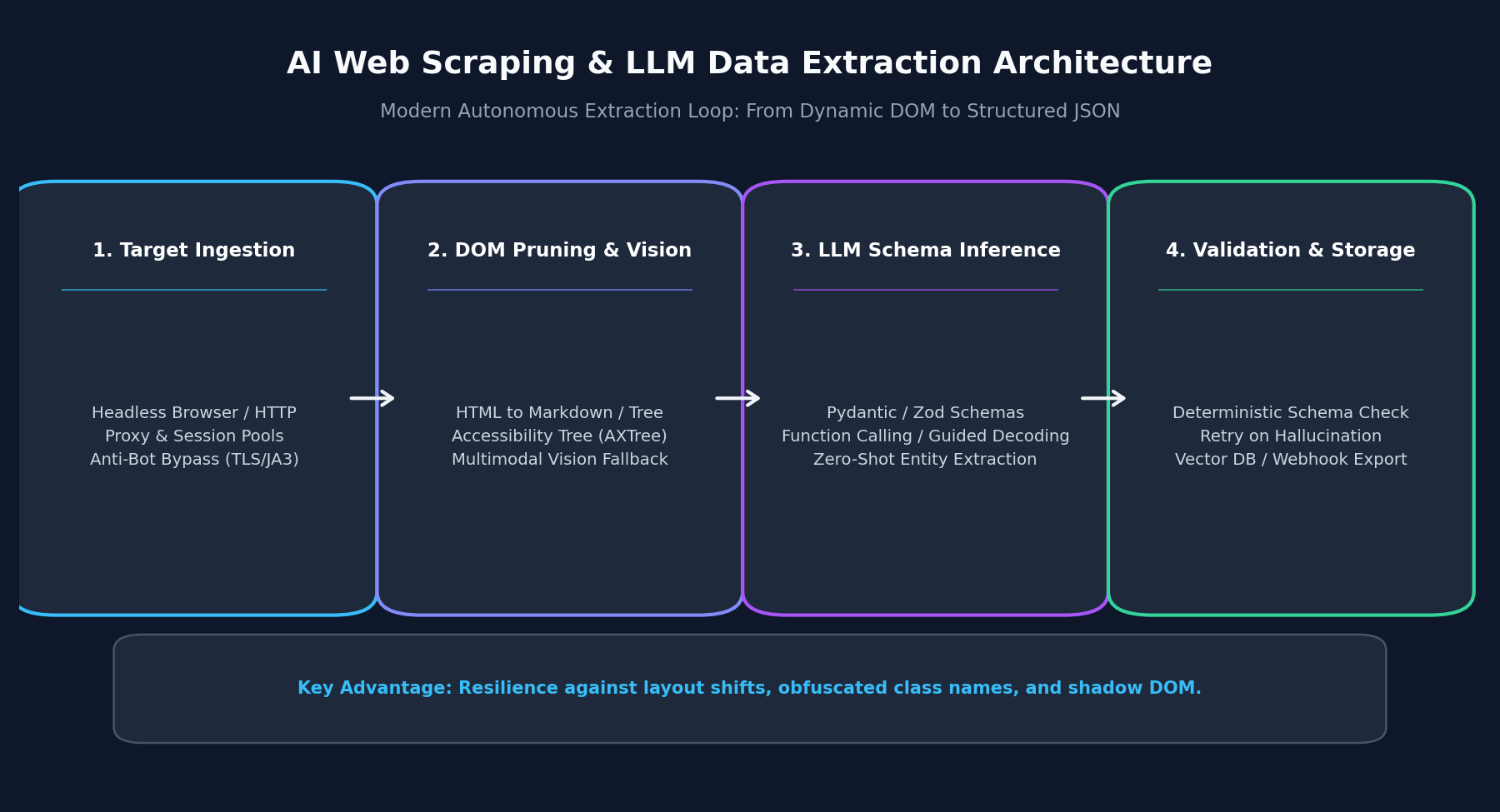
An enterprise-grade AI scraping pipeline consists of four sequential stages:
- Target Ingestion & Session Management: Navigating to the destination URL using automated browser pools equipped with TLS fingerprint masking, residential IP rotation, and CAPTCHA solving.
- DOM Pruning & Context Compression: Raw web pages often exceed 200,000 tokens of HTML. The pipeline strips SVG paths, base64 payloads, style blocks, and metadata tags—transforming the DOM into either clean semantic Markdown or an Accessibility Tree (AXTree).
- LLM Schema Inference: Passing the compressed text or page screenshot to an LLM paired with structured decoding (such as Pydantic in Python or Zod in TypeScript) to enforce strict type constraints.
- Deterministic Validation: Checking the extracted JSON against business rules, verifying missing fields, and executing automated retries if hallucinated values occur.
Implementation: Building a Resilient AI Web Scraping Pipeline
Let us build a complete, production-ready AI scraping pipeline in TypeScript using modern schema validation and structured tool extraction.
Step 1: Define the Structured Output Schema
Always define an explicit schema before passing data to the language model. Schema constraints prevent hallucinations and guarantee type safety in downstream databases.
import { z } from 'zod';

export const ProductExtractionSchema = z.object({
  title: z.string().min(1, 'Product title is required'),
  currentPrice: z.number().positive('Price must be positive'),
  currency: z.string().length(3, 'ISO 4217 currency code expected'),
  inStock: z.boolean(),
  specifications: z.record(z.string(), z.string()).optional(),
  summaryReview: z.string().min(10, 'Summary must be descriptive'),
});

export type ProductExtraction = z.infer<typeof ProductExtractionSchema>; Step 2: Extract Clean Semantic Markdown from the DOM
Rather than feeding raw HTML to the model, prune the page tree to maximize semantic density and minimize LLM inference costs:
import { JSDOM } from 'jsdom';

export function pruneHtmlToMarkdown(rawHtml: string): string {
  const dom = new JSDOM(rawHtml);
  const document = dom.window.document;

  // Remove scripts, stylesheets, and irrelevant UI noise
  const removeSelectors = ['script', 'style', 'noscript', 'svg', 'iframe', 'nav', 'footer'];
  removeSelectors.forEach((selector) => {
    document.querySelectorAll(selector).forEach((el) => el.remove());
  });

  // Extract core main body text
  const mainContent = document.querySelector('main, article, #content, body');
  return mainContent?.textContent?.replace(/\s+/g, ' ').trim() || '';
} Step 3: Execute Schema-Constrained LLM Extraction
With clean text and a structured schema, invoke the AI extraction model using guided JSON output:
import { generateObject } from 'ai';
import { openai } from '@ai-sdk/openai';
import { ProductExtractionSchema } from './schema';

export async function extractProductData(pageContent: string) {
  const { object } = await generateObject({
    model: openai('gpt-4o-mini'),
    schema: ProductExtractionSchema,
    prompt: `Extract structured product details from the following webpage content:\n\n${pageContent}`,
  });

  return object;
} Step 4: Production Considerations and Optimization
When deploying AI scraping to production workloads:
- Implement Dual-Pass Fallbacks: Use fast, lightweight heuristic extraction (such as OpenGraph meta tags and Schema.org microdata) first. If fields are missing, escalate to the LLM. This lowers operational API costs by over 70%.
- Multimodal Vision for Dynamic UIs: For heavily obfuscated web applications, render a viewport screenshot and pass the image directly to a vision-capable model. Vision bypasses DOM obfuscation entirely.
- Rate-Limiting & Governance: Respect robots.txt directives, enforce exponential backoff, and avoid overloading host servers with high concurrency.
Conclusion
AI web scraping transforms web data harvesting from a fragile, high-maintenance chore into a resilient, autonomous pipeline. By shifting from brittle CSS selectors to semantic understanding and schema-driven decoding, development teams can ingest complex web data reliably across ever-evolving digital landscapes.