Agno Guide: High-Performance Multi-Agent Architecture
The Problem: The Latency and Complexity Wall of Heavyweight Agent Frameworks
In enterprise automation, autonomous research copilots, and intelligent data extraction pipelines powered by AiFetchly, autonomous AI agents must execute complex multi-step workflows: querying live APIs, searching dense vector databases, synthesizing multi-page documents, and delegating sub-tasks across specialized teams.
As generative AI evolved from basic prompt-completion wrappers into agentic swarms, early development teams adopted first-generation agent libraries such as LangChain, AutoGen, and CrewAI. While these libraries popularized the concept of tool-calling loops and multi-agent roles, deploying them in high-throughput enterprise production revealed severe architectural bottlenecks.
The Traditional Multi-Agent Framework Dilemma:
┌─────────────────────────────────────────────────────────────────┐
│ 1. Heavy Runtime Overhead (10ms–50ms Framework Tax)             │
│ • Deep object inheritance trees and recursive Pydantic schemas  │
│ ❌ Wastes CPU cycles before network packets even leave the host │
├─────────────────────────────────────────────────────────────────┤
│ 2. The Directed Acyclic Graph (DAG) Boilerplate Trap            │
│ • Forcing developers to model simple interactions as graph nodes│
│ ❌ Hundreds of lines of edge routers, state keys, and reducers  │
├─────────────────────────────────────────────────────────────────┤
│ 3. Memory & State Fragmentation                                 │
│ • Naive chat history replay floods prompts with 20k+ tokens     │
│ ❌ Escalates token costs and triggers "Lost in the Middle" bugs │
├─────────────────────────────────────────────────────────────────┤
│ 4. Brittle Tool & Protocol Integration                          │
│ • Incompatible proprietary tool wrappers across model providers │
│ ❌ Painful refactoring when bridging with modern MCP servers   │
└─────────────────────────────────────────────────────────────────┘
Result: Production multi-agent swarms become sluggish, fragile, and difficult to maintain! 1. Framework Overhead and the Microsecond vs. Millisecond Tax
In production microservices handling thousands of requests per second, framework overhead directly impacts operational margins and response latency:
- Early agent libraries wrap every prompt, tool call, and memory lookup in dozens of abstraction layers, metaclasses, and deep validation validators.
- Instantiating a single agent or executing a single step can take 10 to 50 milliseconds of pure CPU compute, independent of the LLM provider’s Time-to-First-Token (TTFT).
- When a supervisor agent spawns ten dynamic sub-agents to inspect parallel document streams, CPU thread saturation and memory allocation delays throttle throughput.
2. The DAG Graph Complexity Trap
To introduce determinism into multi-agent systems, frameworks like LangGraph introduced state graphs:
- While graph state machines excel at complex cyclical loops, simple collaborative patterns (e.g., a researcher gathering data and passing findings to an editor) require defining rigid state dictionaries, TypedDict reducers, node functions, conditional edge functions, and compiled graphs.
- Debugging state transitions becomes a major development burden: intermediate variable changes are buried inside graph checkpoint dictionaries rather than transparent Python call stacks.
3. Context Window Explosion and Memory Amnesia
Most legacy agent frameworks lack native, multi-tiered memory systems:
- They either replay entire raw chat histories into the prompt (blowing up token costs and causing attention drift) or rely on naive semantic search over raw message strings.
- Real-world production agents require hierarchical memory scoping: persistent user preferences, task-level session memory, and isolated agent scratchpads.
The Solution: Agno’s Microsecond Multi-Agent Runtime
To solve the dual challenges of framework bloat and graph orchestration complexity, the open-source community created Agno (formerly known as Phidata).
Agno is a lightweight, full-stack framework and runtime designed specifically for high-performance multi-agent systems. Built with modern Python 3.10+ ergonomics, Agno prioritizes pure Pythonic composition, microsecond-scale execution, and production-grade enterprise features.
Agno Architectural Topology:
┌─────────────────────────────────────────────────────────────────┐
│ User Ingestion / aiFetchly Desktop Application                  │
└─────────────────────────────────────────────────────────────────┘
 │
 ▼
┌─────────────────────────────────────────────────────────────────┐
│ Agno Team Coordinator (from agno.team import Team)              │
│ • Autonomous task decomposition and intelligent delegation      │
│ • Shared in-memory team context with microsecond coordination   │
└─────────────────────────────────────────────────────────────────┘
 │
 ├──► Worker Agent 1: Research (Web Search / ArXiv / Exa)
 ├──► Worker Agent 2: Financial Analyst (SQL / SEC Filings / YFinance)
 └──► Worker Agent 3: Code Refactor (AST Parsing / Shell / Git)
 │
 ▼
┌─────────────────────────────────────────────────────────────────┐
│ Agno Enterprise Infrastructure Layer                            │
│ ├──► Multi-Tier Memory (User, Session, and Entity Stores)       │
│ ├──► Hybrid Vector Knowledge (Qdrant, PgVector, LanceDB)        │
│ ├──► Persistent State Storage (PostgreSQL, SQLite, Redis)       │
│ └──► FastMCP Protocol Bridge (Standardized JSON-RPC Tools)      │
└─────────────────────────────────────────────────────────────────┘ The Architectural Innovations of Agno
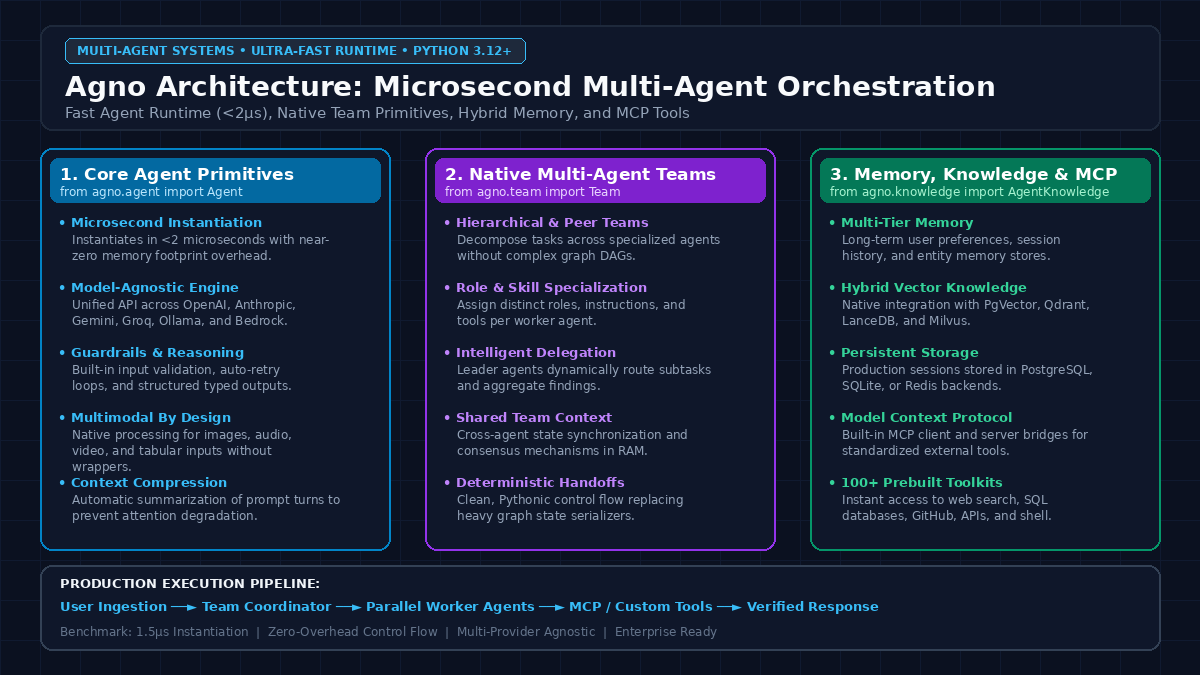
- Microsecond-Scale Instantiation: Agno agents instantiate in less than 2 microseconds (~1.5μs), compared to 10–50 milliseconds for legacy frameworks. Agents can be dynamically spawned, executed, and discarded on-the-fly without memory leaks.
- Native
TeamPrimitives: Multi-agent collaboration is modeled naturally through theTeamconstruct. Developers can configure hierarchical teams, peer-to-peer delegation, or round-robin consensus with simple Python lists of agents, completely bypassing complex DAG graph wiring. - Model-Agnostic Core: Agno natively supports over 20 foundation model providers—including OpenAI, Anthropic Claude, Google Gemini, Groq, Mistral, and local Ollama instances—allowing teams to swap models with a single line of code.
- Native MCP Support: Agno includes built-in Model Context Protocol (MCP) clients and servers, enabling seamless interoperability with tools built on FastMCP.
Comparing Multi-Agent Frameworks: LangGraph / CrewAI vs. Agno
The table below contrasts Agno against traditional agent orchestration frameworks:
Agent Framework Architecture Comparison:
┌───────────────────────────┬───────────────────────────────┬───────────────────────────────┐
│ Dimension                 │ Traditional Frameworks        │ Agno Framework                │
├───────────────────────────┼───────────────────────────────┼───────────────────────────────┤
│ Agent Instantiation Time  │ 10 ms – 50 ms                 │ < 2 μs (Microseconds)         │
│ Orchestration Paradigm    │ Heavy State Graphs / DAGs     │ Native Pythonic `Team` & `Agent`│
│ Memory Architecture       │ Flat chat replay / Add-on RAG │ Multi-tier (User, Session, DB)│
│ Boilerplate Code          │ High (Nodes, edges, reducers) │ Minimal (Direct class params) │
│ Protocol Support          │ Custom wrappers / Adapters    │ First-class MCP Client/Server │
│ Vector Database Storage   │ External custom glue code     │ Native `AgentKnowledge` RAG   │
│ Multimodal Capability     │ Text-only with plugin patches │ Native Vision, Audio, Video   │
│ Debuggability             │ Buried in graph checkpoints   │ Standard Python tracebacks    │
└───────────────────────────┴───────────────────────────────┴───────────────────────────────┘ Deep Dive into Agno Core Architecture & Primitives
Agno structures agentic applications through five modular, composable building blocks that work harmoniously across standalone desktop scripts and enterprise cloud clusters.
Agno Core Primitives:
Agno System Architecture
 ├──► 1. Agent: Core autonomous entity with prompt instructions and model bindings
 ├──► 2. Team: Orchestrator managing role delegation, shared context, and consensus
 ├──► 3. Memory: Multi-tier factual storage isolating user, session, and agent context
 ├──► 4. Knowledge: Dense & hybrid vector retrieval (Qdrant, PgVector, LanceDB)
└──► 5. Storage: Persistent session and state ledger (PostgreSQL, SQLite, Redis) 1. The Agent Primitive
The Agent is the fundamental execution unit in Agno. It encapsulates:
- Model Binding: Connects to any supported provider (
OpenAIChat,Claude,Gemini,Ollama). - Instructions & Guidelines: Preambles and runtime system prompts that govern behavior.
- Tool Registry: Standard Python functions or pre-built toolkits decorated for autonomous model invocation.
- Guardrails & Reasoning: Built-in validation loops that check outputs against structured schemas or security policies before returning responses to the user.
from agno.agent import Agent
from agno.models.openai import OpenAIChat

# Instantiates in <2 microseconds
research_agent = Agent(
    name="Market Analyst",
    model=OpenAIChat(id="gpt-4o"),
    instructions=[
        "Provide factual financial analysis with exact metrics.",
        "Always cite your sources and present comparisons in markdown tables."
    ],
    markdown=True
) 2. The Team Primitive: Native Multi-Agent Orchestration
Rather than requiring developers to construct directed graphs with nodes and edges, Agno introduces the Team class:
- Leader & Member Roles: A Team coordinates multiple specialized agents. The team leader analyzes incoming user tasks, determines which specialized members are best suited to execute specific components, and delegates sub-tasks.
- Shared Team Memory: Member agents share intermediate findings in-memory, allowing subsequent agents to build directly on earlier analysis without round-trip database serialization.
- Execution Modes: Teams support multiple operating modes, including hierarchical delegation, round-robin consensus, and direct response routing.
from agno.team import Team
from agno.agent import Agent

team = Team(
    name="Investment Research Team",
    members=[web_researcher, financial_analyst, risk_auditor],
    instructions=[
        "First, have the Web Researcher gather the latest quarterly earnings news.",
        "Next, have the Financial Analyst examine valuation multiples.",
        "Finally, synthesize findings with the Risk Auditor into a clear executive brief."
    ]
) 3. Multi-Tier Memory Architecture
Agno decouples conversational memory into three distinct operational layers:
- User Memory: Persists user-specific traits, preferences, and long-term facts across all sessions (e.g., “Prefers concise answers with Python code examples”).
- Session Memory: Retains the conversational context and tool results of the immediate task.
- Context Compression: When sessions grow long, Agno automatically condenses past turns into concise summaries, eliminating token bloat while preserving critical semantic details.
4. Hybrid Knowledge & Vector Storage
Through AgentKnowledge, Agno integrates Retrieval-Augmented Generation (RAG) directly into the agent lifecycle:
- Supports native vector databases like Qdrant, PgVector, and LanceDB.
- Executes hybrid search (combining dense semantic vectors with BM25 sparse keyword matching) to deliver high retrieval precision for technical manuals, legal contracts, and financial reports.
5. Native Model Context Protocol (MCP) Integration
Agno provides built-in client and server interfaces for Anthropic’s Model Context Protocol (MCP):
- An Agno agent can connect to external FastMCP microservices over standard
stdioor Server-Sent Events (SSE) transports. - Tool schemas and execution boundaries are dynamically negotiated, allowing enterprises to maintain modular, language-agnostic tool servers while running Agno orchestration.
Hands-On Implementation: Building a High-Performance Multi-Agent Team in Agno
Let’s build a complete, production-grade investment research team in Python using Agno. The team consists of a Web Research Agent (using DuckDuckGo) and a Financial Valuation Agent, coordinated by a Team Leader.
1. Environment Setup
Install Agno, the OpenAI SDK, and search tooling:
pip install agno openai duckduckgo-search 2. Complete Code Implementation (research_team.py)
import os
from agno.agent import Agent
from agno.team import Team
from agno.models.openai import OpenAIChat
from agno.tools.duckduckgo import DuckDuckGoTools
from agno.tools import tool

# 1. Ensure API Key is configured
if not os.getenv("OPENAI_API_KEY"):
    raise ValueError("OPENAI_API_KEY environment variable is required.")

# 2. Define a Custom Python Tool for Financial Calculations
@tool
def calculate_peg_ratio(pe_ratio: float, annual_growth_rate: float) -> str:
    """Calculates the Price/Earnings to Growth (PEG) ratio.

    Args:
        pe_ratio: The current Price-to-Earnings ratio.
        annual_growth_rate: The expected percentage EPS growth rate (e.g. 15.0 for 15%).
    """
    if annual_growth_rate <= 0:
        return "Growth rate must be greater than zero."
    peg = pe_ratio / annual_growth_rate
    return f"Calculated PEG Ratio: {peg:.2f} (PE: {pe_ratio}, Growth: {annual_growth_rate}%)"

# 3. Create the Web Research Agent
researcher = Agent(
    name="Web Researcher",
    role="Extract real-time market intelligence and corporate announcements",
    model=OpenAIChat(id="gpt-4o"),
    tools=[DuckDuckGoTools()],
    instructions=[
        "Search for the latest corporate earnings releases and product updates.",
        "Always extract the exact dates and verifiable quotes.",
        "Keep summaries concise and factual."
    ],
    markdown=True
)

# 4. Create the Financial Valuation Agent
analyst = Agent(
    name="Financial Analyst",
    role="Evaluate valuation multiples and balance sheet strength",
    model=OpenAIChat(id="gpt-4o"),
    tools=[calculate_peg_ratio],
    instructions=[
        "Analyze company valuation metrics, including P/E, PEG, and debt ratios.",
        "Use the calculate_peg_ratio tool whenever calculating growth valuations.",
        "Highlight financial risks and margin trajectories."
    ],
    markdown=True
)

# 5. Create the Coordinated Multi-Agent Team
investment_team = Team(
    name="Strategic Investment Team",
    members=[researcher, analyst],
    model=OpenAIChat(id="gpt-4o"),
    instructions=[
        "You are the executive coordinator of a high-performance investment analysis team.",
        "1. First, delegate to the Web Researcher to gather recent operational and product developments.",
        "2. Next, delegate to the Financial Analyst to compute valuation multiples.",
        "3. Synthesize the findings into an executive markdown briefing with clear investment takeaways."
    ],
    markdown=True,
    show_tool_calls=True
)

# 6. Execute the Team Workflow
if __name__ == "__main__":
    query = "Analyze Nvidia's recent Blackwell GPU demand and evaluate its valuation multiples."
    print(f"=== Dispatching Agno Multi-Agent Team: '{query}' ===\n")

    # Run and stream the collaborative response
investment_team.print_response(query, stream=True) 3. Execution Output Analysis
When running the script:
python research_team.py - Instant Initialization: The team and its member agents instantiate in microseconds with near-zero memory footprint.
- Autonomous Sub-Task Routing: The team leader decomposes the query, invoking the Web Researcher for live news and the Financial Analyst for valuation metrics.
- Zero Graph Boilerplate: The entire multi-agent coordination workflow executes cleanly within standard Python control structures, eliminating graph node setup and reducer functions.
Production Architecture & Best Practices for aiFetchly
Integrating Agno into high-throughput data extraction and desktop automation workflows in AiFetchly establishes a scalable, production-grade foundation.
aiFetchly Enterprise Agno Deployment:
┌─────────────────────────────────────────────────────────────────┐
│ aiFetchly Automation Platform & Desktop Runtime                 │
└─────────────────────────────────────────────────────────────────┘
 │
 ▼
┌─────────────────────────────────────────────────────────────────┐
│ Agno Multi-Agent Fleet                                          │
│ ├──► Microsecond Worker Pools (<2μs cold-starts)                │
│ ├──► Centralized PostgreSQL Storage (Sessions & Ledgers)        │
│ └──► PgVector / Qdrant Knowledge Base (Document RAG)            │
└─────────────────────────────────────────────────────────────────┘
 │
 ├──► FastMCP Server Pool (Local Python/Node tools over stdio/SSE)
└──► Hybrid Inference Gateway (Ollama local fallback + Cloud LLMs) 1. Centralizing Session State in PostgreSQL
In multi-user production environments:
- Use Agno’s
PostgresStorageto persist conversation history and agent state in PostgreSQL. - Eliminates memory leaks and ensures that multi-turn sessions remain recoverable across container restarts or horizontal auto-scaling events.
2. Connecting Agno with FastMCP Tool Servers
For teams maintaining a microservice architecture:
- Run domain-specific tools as standalone FastMCP servers.
- Use Agno’s native MCP client to bind tools dynamically, ensuring that tool updates do not require redeploying the core agent orchestration engine.
3. Context Window Compression & Cost Optimization
To prevent token bloat during extended agent workflows:
- Enable Agno’s automatic context compression to distill conversational turns into factual summaries.
- Combine frontier models (e.g., Claude 3.5 Sonnet or GPT-4o) for high-level coordination with compact models (e.g., local Phi-4 or Ollama instances) for high-frequency extraction sub-tasks, slashing API costs by up to 70%.
Summary: The Evolution of Lean Multi-Agent Systems
The evolution of artificial intelligence frameworks mirrors the history of distributed systems: early experimental frameworks accumulate abstraction layers, until leaner, high-performance engines emerge to redefine production standards.
By combining microsecond instantiation (<2μs), native Team collaboration primitives, multi-tier memory, and first-class Model Context Protocol (MCP) support, Agno eliminates the latency overhead and graph complexity of legacy agent frameworks. For autonomous research assistants, enterprise automation swarms, and data harvesting pipelines powered by AiFetchly, Agno provides the architectural clarity and raw speed necessary to build the next generation of scalable AI agents.