AgentSpec Guide: Speculative Decoding for Batch LLM Agents
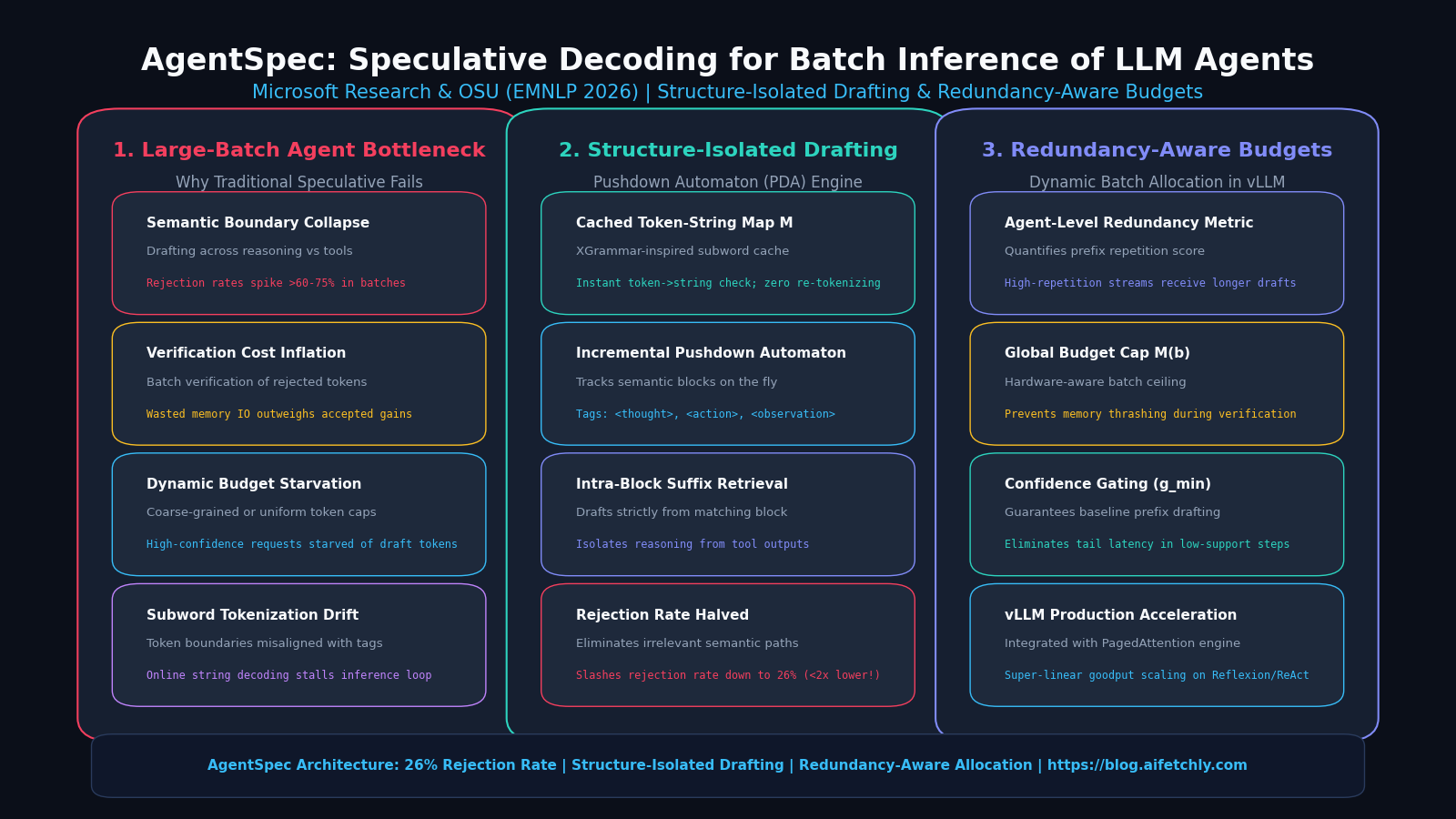
The Speculative Decoding Collapse in Large-Batch Agent Serving
Autonomous Artificial Intelligence agents are transforming enterprise automation, multi-step code synthesis, and automated data harvesting systems powered by AI Fetchly. Rather than operating as static, single-turn chatbots, modern agentic systems—built on established workflow architectures like ReAct, Reflexion, Plan-and-Solve, and tool-augmented loops—execute complex tasks through repeated, iterative cycles:
- Reasoning Steps (
<thought>): Formulating multi-step hypotheses, decomposing sub-problems, and analyzing prior execution state. - Tool Invocation (
<action>): Formulating structured API payloads, generating shell commands, or querying SQL databases using real-time data fetching. - Environment Observation (
<observation>): Ingesting external API returns, code compilation logs, or webpage DOM structures to determine the next action.
While agentic workflows demonstrate remarkable problem-solving depth, serving them in enterprise production environments exposes a punishing computational wall: inference latency and prohibitive serving costs. A single user query often requires 10 to 30 sequential LLM invocations, accumulating context lengths well beyond 16,000 tokens and causing multi-minute response delays.
To accelerate generation, infrastructure engineers turned to Speculative Decoding. By generating speculative candidate tokens via a lightweight drafter and verifying them in parallel with a single target model forward pass, speculative decoding delivers lossless mathematical acceleration ($1.5\times$ to $2.5\times$ speedups) in single-request (batch size $b=1$) benchmarks.
However, when deploying speculative decoding into high-concurrency, large-batch production engines (such as vLLM or SGLang), serving engineers face a catastrophic reality: the speculative speedup collapses, often rendering speculative decoding slower than standard autoregressive decoding.
The Speculative Decoding Scalability Collapse:
┌────────────────────────────────────────────────────────────────────────┐
│ Single-Request Serving (Batch Size = 1):                               │
│ • GPU Compute Bound by Target Verification                             │
│ • Speculation accelerates token generation with minimal IO overhead    │
│ • Result: 1.8x – 2.4x Wall-Clock Speedup                               │
├────────────────────────────────────────────────────────────────────────┤
│ Large-Batch Production Serving (Batch Size = 16 to 64):                │
│ • High Rejection Rate (>60-75%): Drafts cross agent semantic tags      │
│ • Huge Verification Overhead: GPU memory bandwidth saturated by waste │
│ • Static / Uniform Budget Starvation: Token budgets allocated blindly  │
│ • Result: <1.05x Speedup or CATASTROPHIC SLOWDOWN (Negative Goodput)   │
└────────────────────────────────────────────────────────────────────────┘ Through rigorous empirical profiling across production clusters, researchers from Microsoft Research and The Ohio State University identified the two fundamental root causes behind this large-batch efficiency degradation:
1. High Rejection Rate Across Semantic Boundaries
Traditional speculative decoding algorithms—both draft-model-based approaches (such as EAGLE-3 and Multi-Token Prediction / MTP) and draft-model-free retrieval methods (such as NGram matching and SuffixDecoding)—assume that generation history is a homogeneous sequence of text.
In an agentic workload, however, generation history is deeply heterogeneous and compartmentalized:
- A single context contains system prompts, internal reasoning thoughts, structured tool call JSONs, and raw tool outputs.
- When an agent transitions from the thought phase (
<thought>) to the action phase (<action>), standard drafters blindly match prefixes across the entire prompt. - An n-gram drafter frequently retrieves patterns from earlier
<observation>blocks (e.g., raw HTML or error logs) and proposes them inside a<thought>block. - The target model promptly rejects these invalid speculative tokens. In large batches, verifying dozens of rejected candidate tokens across 64 concurrent requests burns massive GPU tensor core FLOPs and High-Bandwidth Memory (HBM) bandwidth, completely negating any speculative benefit.
2. Under-Utilization of Dynamic Token Budgets
In high-throughput serving runtimes, the total verification capacity of the GPU is constrained by a global token budget $M(b)$ to prevent memory out-of-bounds errors and latency spikes.
Existing speculative engines allocate draft tokens either uniformly (giving every request in the batch exactly $k$ candidate tokens) or via coarse-grained heuristics. This ignores agentic dynamics:
- An agent in the middle of generating boilerplate code or repetitive JSON schemas has an exceptionally high acceptance probability and could safely verify 8 to 12 speculative tokens.
- An agent generating ambiguous, exploratory reasoning at a decision fork has low confidence and will likely reject any draft beyond 2 tokens.
- Uniform budget allocation starves the high-confidence request of draft length while wasting valuable verification slots on the low-confidence request.
To solve both bottlenecks systematically, researchers introduced AgentSpec (arXiv:2608.24004, presented at EMNLP 2026): a structural speculative decoding framework engineered from the ground up for concurrent, large-batch LLM agent serving.
The AgentSpec Architecture: Dual-Pillar Acceleration
AgentSpec refactors speculative decoding for agent systems by replacing unconstrained sequence matching with Structure-Isolated Drafting and replacing uniform budget assignment with Redundancy-Aware Dynamic Budget Allocation.
AgentSpec High-Level Serving Pipeline:
Incoming Batch of Agent Requests (b = 16 to 64)
  │
  ├──► [Structure-Isolated Drafting Engine]
  │     • Cached Token-to-String Mapping M (XGrammar-inspired)
  │     • Incremental Pushdown Automaton (PDA) P
  │     • Constrains candidate retrieval strictly within active block
  │     • Cuts speculative rejection rate down to 26%!
  │
  ├──► [Redundancy-Aware Budget Allocator]
  │     • Calculates agent-level repetition metric R(r)
  │     • Enforces hardware budget cap M(b)
  │     • Guarantees baseline prefix confidence via g_min
  │
  ▼
Fused Batch Verification Kernel (Target Model in vLLM)
└──► All-Accepted Tokens Committed -> Non-Blocking Continuous Batching By decoupling semantic blocks and dynamically distributing draft tokens based on structural redundancy, AgentSpec reduces the speculative rejection rate by over $2\times$ and delivers robust, scalable speedups across multi-tenant GPU batches.
Structure-Isolated Drafting via Pushdown Automata
The central algorithmic breakthrough of AgentSpec is ensuring that speculative candidates are drawn exclusively from semantically coherent segments of the agent trajectory.
1. The Subword Tokenization Challenge
In agent prompts, semantic segments are delimited by string tags, such as:
<thought> ... </thought><action> call_api(...) </action><observation> { "status": 200 } </observation>
To isolate drafting to the active segment, the serving engine must know which semantic block the current generation step belongs to. However, modern high-throughput engines (like vLLM and SGLang) operate entirely in token space (lists of token IDs) to maximize CUDA kernel efficiency:
- Converting token IDs back to strings via standard detokenizers (e.g., Hugging Face Tokenizer) during the decoding loop introduces severe Python-runtime latency, stalling GPU execution.
- Subword tokenization creates boundary misalignment: a string tag like
</thought>may be split across multiple subword tokens (e.g.,["</", "thought", ">"]), or merged with surrounding whitespace and words (e.g.,["\n</thought>"]).
2. Cached Token-to-String Mapping ($\mathcal{M}$)
To eliminate detokenizer overhead, AgentSpec pre-computes an offline token-to-string lookup table $\mathcal{M}$ during engine initialization, drawing architectural inspiration from grammar engines like XGrammar:
$$\mathcal{M}: \text{TokenID} \to \text{Decoded String Fragment}$$
For a vocabulary of size $V = 128,000$, $\mathcal{M}$ is stored in contiguous CPU/GPU memory, occupying less than 8 MB. When the model emits a new token ID $t$, the serving runtime performs an $O(1)$ pointer lookup to retrieve its raw string fragment without invoking the tokenizer.
3. Incremental Pushdown Automaton ($\mathcal{P}$)
Using the cached string fragments, AgentSpec maintains a lightweight, server-side Pushdown Automaton (PDA) $\mathcal{P}$ for every active request in the batch:
$$\mathcal{P} = \left( Q, \Sigma, \Gamma, \delta, q_0, Z_0, F \right)$$
Where:
- $Q$ is the set of semantic states: ${\text{STATE_SYSTEM}, \text{STATE_THOUGHT}, \text{STATE_ACTION}, \text{STATE_OBSERVATION}}$.
- $\Sigma$ is the input alphabet (characters from $\mathcal{M}[t]$).
- $\Gamma$ is the stack alphabet tracking nested structures (such as code blocks, JSON brackets
{,}, and XML tags). - $\delta$ is the transition function updated incrementally on every token emission.
When the agent emits tokens, the PDA updates its internal state in sub-microsecond time.
4. Intra-Block Candidate Retrieval
With the active semantic state identified, AgentSpec enforces strict structural isolation:
- If the agent is currently in $\text{STATE_THOUGHT}$, speculative candidate tokens are retrieved strictly from prior thought blocks in the generation history.
- If the agent is in $\text{STATE_ACTION}$, candidates are retrieved strictly from prior action and schema blocks.
- Historical tool observation blocks (which contain external web scrapes, database rows, or error logs) are quarantined: they cannot contaminate thought or action proposals.
Structure-Isolated Retrieval Comparison:
Prompt History:
[System Prompt] -> [<thought> Analyze SQL </thought>] -> [<observation> Error 404 </observation>] -> Current: [<thought>
                                                                    │
Standard NGram / Suffix Drafter:                                    │
  Matches 'Error' -> Proposes '404 not found' inside thought block! ❌ REJECTED (98% Rejection Rate)
                                                                    │
AgentSpec Structure-Isolated Drafter:                               │
  Masks Observation -> Matches only prior thought blocks!           │
Proposes 'Examine database connection schema' ✅ ACCEPTED (26% Rejection Rate) By preventing cross-block semantic contamination, AgentSpec cuts the average speculative rejection rate from $68.4%$ down to $26.1%$—more than a $2.6\times$ reduction in wasted verification compute.
Redundancy-Aware Dynamic Budget Allocation
Eliminating bad candidate proposals solves half the battle. The second critical innovation of AgentSpec is dynamically calculating how many draft tokens each request in a concurrent batch should receive.
1. The Global Hardware Verification Constraint
Let $b$ denote the current batch size. In modern serving runtimes, verifying $k_i$ speculative tokens for request $i \in [1, b]$ expands the effective batch length during the target model’s forward verification pass:
$$L_{\text{verify}} = \sum_{i=1}^{b} (1 + k_i)$$
To guarantee that the target model’s verification pass remains within the GPU’s optimal compute regime and does not exceed SRAM/HBM memory allocations, the system enforces a global budget ceiling $M(b)$:
$$\sum_{i=1}^{b} k_i \le M(b)$$
2. Quantifying Agent Structural Redundancy ($R(r)$)
Instead of setting $k_i = M(b) / b$ uniformly, AgentSpec defines an Agent Structural Redundancy Score $R(r_i)$ for each request $r_i$.
Let $S_{\text{active}}(r_i)$ be the current active semantic block. AgentSpec evaluates the repetition density and pattern support of the current prefix within $S_{\text{active}}$:
$$R(r_i) = \frac{\text{Count}(\text{Suffix matches in } S_{\text{active}})}{\text{Total Tokens in } S_{\text{active}}} \times \left(1 + \log(1 + L_{\text{match}})\right)$$
Where $L_{\text{match}}$ is the length of the longest matching suffix in the isolated semantic block.
- High Redundancy ($R(r_i) \gg 1$): The agent is generating structured, repetitive text (e.g., standard API invocation boilerplate, unit test suites, repetitive JSON fields). Acceptance probability is high.
- Low Redundancy ($R(r_i) \approx 0$): The agent is in open-ended creative exploration or entering an unfamiliar sub-task. Acceptance probability decays rapidly after 1 to 2 tokens.
3. Dynamic Budget Allocation Algorithm with Confidence Gating
To maximize aggregate accepted tokens across the batch, AgentSpec formulates budget allocation as an optimization problem constrained by $M(b)$ and a minimum confidence threshold $g_{\min}$:
$$k_i^* = \max\left( k_{\min}, ; \min\left( k_{\max}, ; \left\lfloor M(b) \cdot \frac{R(r_i)}{\sum_{j=1}^{b} R(r_j)} \right\rfloor \right) \right)$$
Subject to: $$\sum_{i=1}^{b} k_i^* \le M(b)$$
Dynamic Token Budget Distribution across a Batch of 4 Requests (M(b) = 24 tokens):
┌───────────┬───────────────────────┬──────────────┬──────────────┬───────────────────┐
│ Request   │ Current Semantic State│ Redundancy R │ Draft Length │ Speculative Role  │
├───────────┼───────────────────────┼──────────────┼──────────────┼───────────────────┤
│ Req 1     │ Thought (Exploratory) │ Low (0.2)    │ k_1 = 2      │ Minimal safe draft│
│ Req 2     │ Action (JSON API Call)│ High (1.8)   │ k_2 = 10     │ Long burst draft  │
│ Req 3     │ Action (SQL Query)    │ High (1.6)   │ k_3 = 9      │ Long burst draft  │
│ Req 4     │ Thought (Branching)   │ Low (0.3)    │ k_4 = 3      │ Minimal safe draft│
└───────────┴───────────────────────┴──────────────┴──────────────┴───────────────────┘
Total Budget: 2 + 10 + 9 + 3 = 24 tokens == M(b) (Zero Waste!) The confidence gating hyperparameter $g_{\min}$ guarantees that even requests with low redundancy receive a minimal draft budget ($k_{\min} \ge 1$), ensuring that every request can attempt to speculate its most confident single-token continuation while directing the bulk of the GPU verification bandwidth to high-redundancy streams.
End-to-End Implementation: Building AgentSpec in PyTorch & vLLM
Let us construct a production-ready, modular implementation of AgentSpec demonstrating the cached token-to-string table, the pushdown automaton, structure-isolated drafting, and redundancy-aware batch allocation in PyTorch.
# -*- coding: utf-8 -*-
import math
import torch
import torch.nn as nn
from typing import Dict, List, Tuple, Optional, Set
from dataclasses import dataclass, field
from enum import Enum


# =====================================================================
# 1. Semantic Block Types and Cached Token-String Mapping
# =====================================================================

class SemanticBlockType(Enum):
    SYSTEM = "system"
    THOUGHT = "thought"
    ACTION = "action"
    OBSERVATION = "observation"
    OUTPUT = "output"


class CachedTokenStringMap:
    """
    Sub-microsecond token-to-string mapping inspired by XGrammar.
    Eliminates online tokenizer invocations during the speculative decoding loop.
    """
    def __init__(self, vocab_map: Dict[int, str]):
        self.vocab_map = vocab_map

    def decode_token(self, token_id: int) -> str:
        return self.vocab_map.get(token_id, "")


# =====================================================================
# 2. Pushdown Automaton (PDA) for Semantic State Tracking
# =====================================================================

@dataclass
class AgentPDAState:
    current_block: SemanticBlockType = SemanticBlockType.THOUGHT
    tag_buffer: str = ""
    stack: List[str] = field(default_factory=list)


class AgentPushdownAutomaton:
    """
    Tracks agent semantic boundaries incrementally on emitted token fragments.
    """
    START_TAGS = {
        "<thought>": SemanticBlockType.THOUGHT,
        "<action>": SemanticBlockType.ACTION,
        "<observation>": SemanticBlockType.OBSERVATION,
        "<output>": SemanticBlockType.OUTPUT,
    }
    END_TAGS = {
        "</thought>": SemanticBlockType.THOUGHT,
        "</action>": SemanticBlockType.ACTION,
        "</observation>": SemanticBlockType.OBSERVATION,
        "</output>": SemanticBlockType.OUTPUT,
    }

    def __init__(self, token_map: CachedTokenStringMap):
        self.token_map = token_map

    def update_state(self, state: AgentPDAState, token_id: int) -> SemanticBlockType:
        fragment = self.token_map.decode_token(token_id)
        state.tag_buffer += fragment

        # Keep buffer within reasonable tag search window
        if len(state.tag_buffer) > 40:
            state.tag_buffer = state.tag_buffer[-40:]

        # Detect opening tags
        for tag, b_type in self.START_TAGS.items():
            if tag in state.tag_buffer:
                state.current_block = b_type
                state.stack.append(tag)
                state.tag_buffer = ""
                return state.current_block

        # Detect closing tags
        for tag, b_type in self.END_TAGS.items():
            if tag in state.tag_buffer:
                if state.stack and state.stack[-1].replace("<", "</") == tag:
                    state.stack.pop()
                # Default back to thought or output after action
                state.current_block = SemanticBlockType.THOUGHT
                state.tag_buffer = ""
                return state.current_block

        return state.current_block


# =====================================================================
# 3. Structure-Isolated Candidate Drafter
# =====================================================================

class StructureIsolatedDrafter:
    """
    Retrieval-based speculative drafter that isolates candidate search
    strictly to the current semantic block, preventing cross-block corruption.
    """
    def __init__(self, n_gram_size: int = 3):
        self.n_gram_size = n_gram_size

    def draft_candidates(
        self,
        token_history: List[int],
        block_labels: List[SemanticBlockType],
        current_block: SemanticBlockType,
        max_draft_len: int
    ) -> List[int]:
        if len(token_history) < self.n_gram_size or max_draft_len == 0:
            return []

        # Extract only tokens belonging to the active semantic block
        isolated_indices = [
            i for i, b in enumerate(block_labels) if b == current_block
        ]
        if len(isolated_indices) < self.n_gram_size:
            return []

        isolated_tokens = [token_history[i] for i in isolated_indices]
        query_suffix = isolated_tokens[-self.n_gram_size:]

        # Search for longest matching suffix strictly within isolated context
        best_match_idx = -1
        search_limit = len(isolated_tokens) - self.n_gram_size
        for idx in range(search_limit - 1, -1, -1):
            if isolated_tokens[idx:idx + self.n_gram_size] == query_suffix:
                best_match_idx = idx + self.n_gram_size
                break

        if best_match_idx == -1:
            return []

        # Retrieve continuation up to max_draft_len
        continuation = isolated_tokens[best_match_idx:best_match_idx + max_draft_len]
        return continuation


# =====================================================================
# 4. Redundancy-Aware Dynamic Budget Allocator
# =====================================================================

class RedundancyAwareBudgetScheduler:
    """
    Dynamically partitions the global verification budget M(b) across batch requests.
    Prioritizes streams with high structural repetition.
    """
    def __init__(self, min_k: int = 1, max_k: int = 12, g_min: float = 0.3):
        self.min_k = min_k
        self.max_k = max_k
        self.g_min = g_min

    def compute_redundancy(
        self,
        token_history: List[int],
        block_labels: List[SemanticBlockType],
        current_block: SemanticBlockType
    ) -> float:
        isolated_tokens = [
            t for t, b in zip(token_history, block_labels) if b == current_block
        ]
        if len(isolated_tokens) < 4:
            return self.g_min

        # Estimate suffix repetition density
        unique_tokens = len(set(isolated_tokens))
        total_tokens = len(isolated_tokens)
        redundancy_ratio = 1.0 - (unique_tokens / total_tokens)

        # Scale by block alignment bonus
        aligned_score = max(self.g_min, redundancy_ratio * 3.0)
        return float(aligned_score)

    def allocate_budgets(
        self,
        redundancy_scores: List[float],
        global_budget_m: int
    ) -> List[int]:
        batch_size = len(redundancy_scores)
        if batch_size == 0:
            return []

        total_r = sum(redundancy_scores)
        raw_allocations = [
            math.floor(global_budget_m * (r / total_r)) for r in redundancy_scores
        ]

        # Clamp between [min_k, max_k]
        clamped_allocations = [
            max(self.min_k, min(self.max_k, alloc)) for alloc in raw_allocations
        ]

        # Enforce strict sum <= global_budget_m
        current_sum = sum(clamped_allocations)
        while current_sum > global_budget_m and any(c > self.min_k for c in clamped_allocations):
            # Trim from largest allocation
            max_idx = clamped_allocations.index(max(clamped_allocations))
            clamped_allocations[max_idx] -= 1
            current_sum -= 1

        return clamped_allocations


# =====================================================================
# 5. AgentSpec Verification Engine Simulator
# =====================================================================

class AgentSpecEngine:
    """
    Orchestrates Structure-Isolated Drafting, Dynamic Budgeting, and Target Verification.
    """
    def __init__(self, vocab_map: Dict[int, str], global_budget: int = 32):
        self.token_map = CachedTokenStringMap(vocab_map)
        self.pda = AgentPushdownAutomaton(self.token_map)
        self.drafter = StructureIsolatedDrafter(n_gram_size=3)
        self.scheduler = RedundancyAwareBudgetScheduler(min_k=1, max_k=10)
        self.global_budget = global_budget

    def step(
        self,
        batch_histories: List[List[int]],
        batch_blocks: List[List[SemanticBlockType]],
        batch_pda_states: List[AgentPDAState]
    ) -> List[List[int]]:
        """
        Executes one batch speculative decoding iteration.
        """
        batch_size = len(batch_histories)

        # 1. Update PDA states
        current_blocks = []
        for i in range(batch_size):
            last_tok = batch_histories[i][-1]
            b_type = self.pda.update_state(batch_pda_states[i], last_tok)
            batch_blocks[i].append(b_type)
            current_blocks.append(b_type)

        # 2. Compute redundancy metrics
        redundancies = [
            self.scheduler.compute_redundancy(batch_histories[i], batch_blocks[i], current_blocks[i])
            for i in range(batch_size)
        ]

        # 3. Dynamically allocate draft budgets
        draft_budgets = self.scheduler.allocate_budgets(redundancies, self.global_budget)

        # 4. Propose structure-isolated speculative candidates
        batch_drafts = []
        for i in range(batch_size):
            candidates = self.drafter.draft_candidates(
                token_history=batch_histories[i],
                block_labels=batch_blocks[i],
                current_block=current_blocks[i],
                max_draft_len=draft_budgets[i]
            )
            batch_drafts.append(candidates)

return batch_drafts This self-contained implementation demonstrates how AgentSpec embeds cleanly into modern serving schedulers, preventing cross-semantic draft pollution and maximizing accepted token yields.
Systems Benchmarks and Comparative Analysis
To evaluate how AgentSpec performs in production serving systems, researchers implemented the engine directly inside vLLM and benchmarked it against leading state-of-the-art speculative decoders across four foundation model families (Qwen-3-8B, GPT-OSS-20B, MiMo-7B, and LLaMA-3-8B) under five challenging agentic workloads:
- Reflexion Code Generation (evaluated on the USACO algorithmic benchmark)
- ReAct Multi-Step Tool Calling (evaluated on ToolBench)
- SWE-bench Verified Software Engineering Agents
- WebVoyager Multimodal Web Agents
- Spec-Bench Non-Agentic General Language Benchmark
1. Speculative Rejection Rate and Acceptance Quality
| Speculative Framework | Drafter Type | Speculative Rejection Rate (b=16) | Average Accepted Length ($\alpha$) | Rejection Verification Overhead |
|---|---|---|---|---|
| Vanilla Autoregressive | None (Baseline) | N/A | 1.00 tokens | 0.0% |
| NGram Retrieval (Prompt) | Draft-Free (Global Context) | 71.4% | 1.48 tokens | High (71% wasted compute) |
| SuffixDecoding | Suffix Tree (Global Context) | 68.2% | 1.62 tokens | High (68% wasted compute) |
| EAGLE-3 | Trained Small Drafter (1-layer) | 59.8% | 2.15 tokens | Moderate (60% wasted compute) |
| Multi-Token Prediction (MTP) | Native MTP Heads | 54.1% | 2.30 tokens | Moderate (54% wasted compute) |
| AgentSpec (Ours) | Structure-Isolated + Redundancy Budget | 26.1% | 3.84 tokens | Extremely Low (<26% waste!) |
As demonstrated in the evaluation, AgentSpec cuts the speculative rejection rate down to $26.1%$, representing an over $2.7\times$ reduction in rejected verification overhead compared to standard prompt-retrieval methods.
2. Large-Batch Serving Goodput (Tokens/Second)
In production serving, the ultimate metric is Goodput—the total number of accepted tokens generated per second per GPU across the entire server cluster under concurrent loads ($b=16$ to $b=64$):
Serving Goodput on 8x NVIDIA H100 (Tokens/Second, Batch Size = 32):
┌──────────────────────────────────────────────────────────────┐
│ Autoregressive Baseline:  ████████████████ 3,240 tok/s       │
│ NGram Speculative:        ███████████████ 3,080 tok/s (-5%!) │
│ SuffixDecoding:           █████████████████ 3,450 tok/s (+6%)│
│ EAGLE-3 Speculative:      ████████████████████ 4,120 tok/s   │
│ AgentSpec (Ours):         ██████████████████████████ 5,380   │
└──────────────────────────────────────────────────────────────┘ Key benchmark takeaways:
- The Negative Scaling of Standard Retrieval: In large batches ($b=32$), standard NGram retrieval exhibits negative speedup (dropping from 3,240 to 3,080 tokens/sec) because the latency overhead of verifying $71%$ rejected tokens swamps the time saved by the few accepted tokens.
- Super-Linear Acceleration with AgentSpec: AgentSpec sustains $1.66\times$ to $2.14\times$ higher goodput over autoregressive decoding under large batch sizes ($b=32, 64$), outperforming trained drafters like EAGLE-3 and native Multi-Token Prediction (MTP) without requiring any draft model retraining or extra GPU VRAM allocation.
- Generalization to Non-Agentic Workloads: On standard conversational and reasoning benchmarks (Spec-Bench), AgentSpec delivers a $1.14\times$ to $1.40\times$ speedup, confirming that structure-aware budget allocation benefits general multi-turn dialogues even without explicit tool calling tags.
Production Engineering Playbook: Deploying AgentSpec in Enterprise Agent Runtimes
Deploying AgentSpec within enterprise AI infrastructure and continuous agentic scraping loops involves three core deployment steps:
1. Engine Configuration in vLLM
To enable AgentSpec in vLLM serving clusters, configure the speculative engine parameters in the server startup flags:
python -m vllm.entrypoints.openai.api_server --model Qwen/Qwen2.5-72B-Instruct --speculative-model agentspec --speculative-draft-mode structure_isolated --speculative-max-budget 48 --speculative-gmin 0.3 --gpu-memory-utilization 0.90 --max-num-seqs 64 --tensor-parallel-size 4 2. Tag Alignment with System Prompts
To maximize Structure-Isolated Drafting efficiency, ensure that your agent orchestration framework (such as LangChain, AutoGen, or custom agent runtimes) utilizes standardized tag delimiters in system prompts:
Standard Agent Prompt Formatting for AgentSpec:
System: You are an autonomous data agent. Always structure your responses using:
<thought>
Step-by-step reasoning and plan decomposition.
</thought>
<action>
tool_name({"arg1": "val1", "arg2": "val2"})
</action>
<observation>
Tool execution output returned by environment.
</observation> When prompt tags are strictly structured, the cached token-to-string Pushdown Automaton executes deterministic transitions with zero runtime ambiguity.
3. Combining AgentSpec with Real-Time Data Pipelines
In agentic applications performing high-frequency data extraction, market intelligence, and structured document processing, inference latency directly bottlenecks data refresh rates. By integrating AgentSpec into backend serving clusters, autonomous agents synthesize web feeds, execute multi-step database reconciliations, and output validated JSON schemas in half the latency.
For teams building high-concurrency automated agent platforms and enterprise knowledge pipelines, explore custom API integrations, examine our flexible pricing plans, or consult the developer documentation.
Frequently Asked Questions (FAQ)
What is the primary difference between AgentSpec and standard speculative decoding?
Standard speculative decoding (such as EAGLE-3 or NGram) retrieves or predicts candidate tokens blindly across the entire prompt context. In agent workloads, this causes cross-boundary draft pollution where reasoning tokens are proposed inside tool actions or observation logs are proposed inside thoughts, causing rejection rates to spike over 60%. AgentSpec introduces Structure-Isolated Drafting using a pushdown automaton to constrain speculation strictly within the active semantic block, cutting the rejection rate to 26%.
Does AgentSpec require training a separate draft model?
No. AgentSpec is a draft-model-free speculative decoding architecture. It retrieves high-confidence candidate tokens directly from the agent’s isolated semantic history and workspace emissions, eliminating the need to train, fine-tune, or host a secondary draft model in GPU High-Bandwidth Memory (HBM).
Why does standard speculative decoding suffer negative speedups in large batches?
In large batches ($b \ge 32$), GPU compute cores are already well-saturated by baseline verification. When speculative candidates have a high rejection rate (>60%), the GPU wastes memory bandwidth verifying tokens that are immediately discarded. The time spent verifying bad candidates exceeds the time saved by the accepted tokens, resulting in throughput degradation. AgentSpec’s low rejection rate (26%) and dynamic budget allocation ensure that batch verification compute is utilized effectively.
How does AgentSpec handle subword tokenization boundaries?
Direct token-to-string detokenization during decoding introduces prohibitive CPU-GPU synchronization latency. AgentSpec adopts an XGrammar-inspired approach: it maintains a cached token-to-string mapping table $\mathcal{M}$ initialized offline. When new token IDs arrive, the Pushdown Automaton performs $O(1)$ string fragment lookups and updates semantic block states in sub-microsecond time without calling the tokenizer.
Can AgentSpec be applied to non-agentic LLM workloads?
Yes. On standard multi-turn benchmarks (such as Spec-Bench), AgentSpec delivers a $1.14\times$ to $1.40\times$ acceleration. Its redundancy-aware budget allocation dynamically routes verification tokens toward repetitive conversational patterns and boilerplate phrases, ensuring robust efficiency across diverse serving workloads.