Agentless: Deterministic Software Engineering LLM Guide
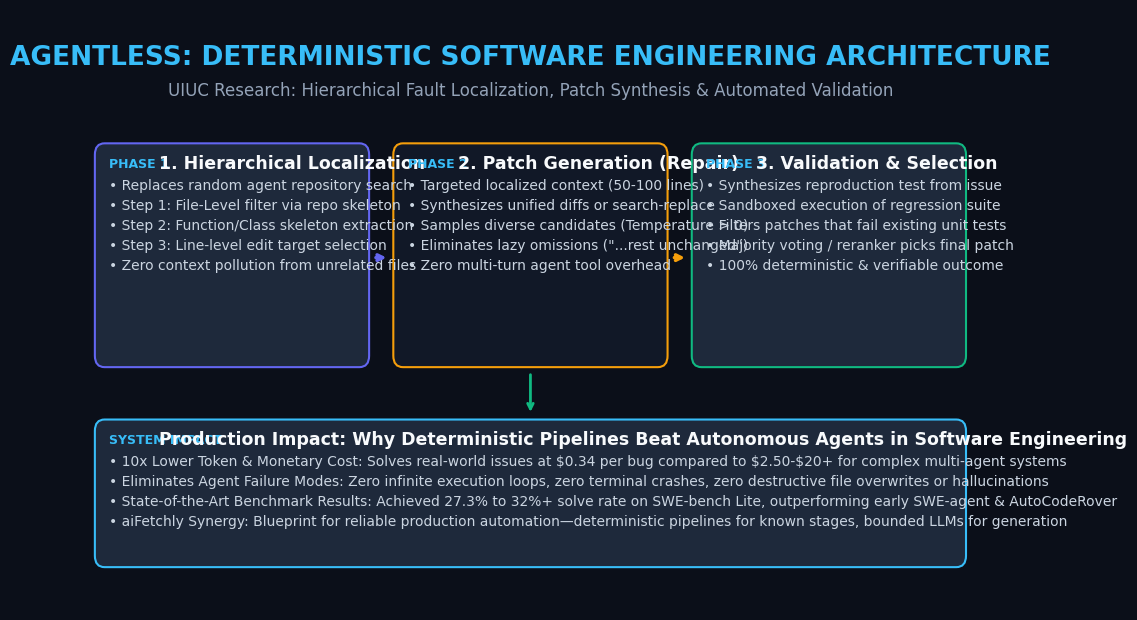
The Problem: The Fragility and Astronomical Cost of Autonomous Coding Agents
In modern automated software development, enterprise refactoring, and data integration platforms powered by AiFetchly, deploying foundation models to resolve complex bugs across large-scale software repositories is a primary objective.
Following the release of SWE-bench (a rigorous benchmark of real-world GitHub issues from repositories like Django, SymPy, and scikit-learn), the software industry rushed to build autonomous multi-turn coding agents (such as early SWE-agent, AutoCodeRover, and various commercial copilots). These agents granted the Large Language Model (LLM) full autonomy inside a while-loop: executing bash commands, running searches, viewing file slices, writing code, and deciding when the issue was resolved.
However, operationalizing autonomous while-loop agents in production revealed three severe systemic failure modes:
The Autonomous Agent Breakdown on Repository Tasks:
GitHub Issue: "Fix KeyError when parsing nested schema in validator.py"
  │
  ▼ [Autonomous Multi-Turn Agent Loop: while not done:]
┌────────────────────────────────────────────────────────┐
│ Turn 1: find_files("validator") ──► 24 matches         │
│ Turn 2: read_file("validator.py", 1, 100) ──► Snippet  │
│ Turn 3: grep("KeyError") ──► 180 hits across tests     │
│ Turn 4: edit_file("validator.py") ──► Syntax error!    │
│ Turn 5: bash("pytest") ──► 14 unrelated test failures  │
│ Turn 6: edit_file("tests/test_other.py") ──► Off-track!│
│ ... (Repeats for 35 turns!)                           │
└────────────────────────────────────────────────────────┘
  │
  ├──► Failure 1: Code Wandering & Scope Creep
  │    ❌ Agent edits unrelated files and breaks existing test suites!
  │
  ├──► Failure 2: Infinite Tool Loops & Terminal Stalls
  │    ❌ Model repeats failing grep or sed commands without progress!
  │
  └──► Failure 3: Astronomical Token Expenditure
❌ Burns $4.00 to $20.00+ per issue with sub-20% success rates! 1. The Autonomous Agent Delusion: Infinite Loops and Code Wandering
When an LLM is placed in an open-ended autonomous loop with dozens of tool capabilities:
- Code Wandering: Unable to localize the exact bug boundary, agents wander aimlessly through directory trees, modifying peripheral files, refactoring unrelated helper functions, or deleting critical comments.
- Runaway Loops: When a command fails (e.g., a regex search returns empty output or a test command hangs), autonomous agents frequently repeat identical failing tool calls, burning compute cycles until hitting hard turn limits.
- Destructive Edits: Lacking strict architectural boundaries, agents attempt broad rewrites that break existing passing tests, leaving the repository in a corrupted, unrecoverable state.
2. Context Window Pollution and Tool Hallucination Cascades
Autonomous agents accumulate observations in a single expanding conversational thread:
- Terminal logs, verbose grep outputs, stack traces, and full-file dumps flood the context window.
- When context reaches 50,000+ tokens, models suffer from severe attention dilution (“Lost in the Middle”), forgetting the original user problem description and hallucinating non-existent library methods.
3. The Astronomical Token Cost Tax on SWE-bench
Autonomous agents execute between 20 and 50 sequential reasoning steps per bug:
- Re-transmitting tens of thousands of tokens of accumulated shell logs at every turn costs $2.50 to $15.00+ in API tokens per issue.
- Despite this immense cost, early autonomous agent systems resolved less than 15% to 20% of SWE-bench Lite problems.
The Solution: Agentless Deterministic Three-Stage Pipeline
To challenge the dogma that autonomous multi-turn agents are necessary for software engineering, researchers at the University of Illinois Urbana-Champaign (UIUC) (Chunqiu Steven Xia, Yinlin Deng, Soren Dunn, and Lingming Zhang) introduced Agentless (arXiv:2407.01489).
Agentless deliberately strips away the autonomous while-loop, the open-ended action space, and autonomous decision-making. Instead, it solves complex GitHub issues through a deterministic, multi-stage pipeline:
The Agentless Pipeline Topology:
                        ┌────────────────────────┐
                        │ Issue & Repo Metadata  │
                        └───────────┬────────────┘
                                    │
                                    ▼
┌────────────────────────────────────────────────────────────────────────┐
│ STAGE 1: HIERARCHICAL FAULT LOCALIZATION                               │
│ • Step 1.1: File-Level Localization (Filters candidate files via repo) │
│ • Step 1.2: Class/Function Localization (Inspects skeleton signatures) │
│ • Step 1.3: Edit Location Identification (Pinpoints line targets)      │
└───────────────────────────────────┬────────────────────────────────────┘
                                    │
                                    ▼
┌────────────────────────────────────────────────────────────────────────┐
│ STAGE 2: CANDIDATE PATCH REPAIR & SYNTHESIS                            │
│ • Assembles minimal, targeted code context (50-100 lines)              │
│ • Generates diverse patch completions via temperature sampling         │
│ • Emits clean search-replace blocks or standard unified diffs          │
└───────────────────────────────────┬────────────────────────────────────┘
                                    │
                                    ▼
┌────────────────────────────────────────────────────────────────────────┐
│ STAGE 3: AUTOMATED PATCH VALIDATION & SELECTION                        │
│ • Synthesizes reproduction test case from issue description            │
│ • Executes regression test suite in isolated container                 │
│ • Filters broken patches; selects final patch via majority voting      │
└───────────────────────────────────┬────────────────────────────────────┘
                                    │
                                    ▼
                        ┌────────────────────────┐
                        │ Verified Git Patch     │
└────────────────────────┘ 1. Stage 1: Hierarchical Fault Localization
Rather than letting an agent wander through the repository, Agentless employs a coarse-to-fine hierarchical search:
- File-Level Filter: Ingests the issue description alongside a lightweight repository skeleton (file paths without contents), prompting the model to identify the top 1 to 5 candidate files.
- Function/Class-Level Filter: Extracts the structural skeleton (class names, function signatures, and docstrings) of the candidate files, prompting the model to identify the exact functions or classes containing the defect.
- Edit Location Pinpointing: Pulls only the localized code blocks and prompts the model to highlight the exact lines requiring modification.
2. Stage 2: Candidate Patch Generation (Repair)
Once the defect location is precisely bounded:
- Agentless constructs a concise, highly focused prompt containing only the bug report and the relevant localized code snippet (typically under 1,500 tokens).
- The model generates candidate code modifications using standardized search-and-replace blocks or unified diffs.
- To maximize the chance of discovering the correct solution, Agentless samples multiple candidate completions (e.g., $N=5$ to $N=10$ candidate patches) across moderate temperatures.
3. Stage 3: Automated Patch Validation and Selection
Rather than trusting the model’s first output, Agentless applies rigorous software testing:
- Reproduction Test Synthesis: The LLM generates a minimal Python test script that reproduces the bug based on the issue description.
- Isolated Execution: Each candidate patch is applied to a clean git checkout inside an isolated Docker sandbox.
- Test Filtering: Agentless executes both the reproduction test and the existing repository regression suite. Any patch that fails existing tests or fails to resolve the reproduction test is immediately discarded.
- Selection: The remaining passing patches are ranked and selected via majority voting.
Deep Dive: How Hierarchical Fault Localization Solves Repository Blindness
The foundation of Agentless is its ability to locate buggy code in codebases spanning hundreds of thousands of lines without exceeding token budgets or diluting model attention.
Hierarchical Fault Localization Mechanics:
┌────────────────────────────────────────────────────────────────┐
│ Repository: 250,000 Lines of Code across 800 Files             │
└───────────────────────────────┬────────────────────────────────┘
                                │
                                ▼ [Step 1: File-Level Filter]
┌────────────────────────────────────────────────────────────────┐
│ Input: Issue text + File tree paths (e.g., "src/auth/token.py") │
│ LLM Output: Top-3 Candidate Files (~5,000 Lines of Code)       │
└───────────────────────────────┬────────────────────────────────┘
                                │
                                ▼ [Step 2: Class/Function Filter]
┌────────────────────────────────────────────────────────────────┐
│ Input: Python Skeletons (def / class signatures only, no bodies)│
│ LLM Output: Target Function (e.g., "verify_jwt_signature()")   │
└───────────────────────────────┬────────────────────────────────┘
                                │
                                ▼ [Step 3: Edit Location Target]
┌────────────────────────────────────────────────────────────────┐
│ Input: Target function body with line numbers (50 lines)       │
│ LLM Output: Edit location: Lines 42-48                         │
└────────────────────────────────────────────────────────────────┘
Result: 99.98% of irrelevant repository context discarded cleanly! 1. File-Level Skeleton Filtering and Surface Area Reduction
Instead of attempting to ingest full files into a vector database or massive context window:
- Agentless generates a compact directory tree listing all relevant source files.
- The model analyzes the issue report against the file tree to select candidate files.
- By pruning 99% of the repository upfront, the remaining pipeline operates with near-zero noise.
2. Function and Class Signature Localization
For each candidate file:
- Agentless parses the code using Python’s
ast(Abstract Syntax Tree) module, removing function bodies and retaining only class definitions, function signatures, argument types, and docstrings. - This skeleton representation preserves the full structural architecture of the file in less than 10% of the token footprint.
- The model identifies which specific methods or classes correlate with the stack trace or defect description.
3. Fine-Grained Edit Target Pinpointing
Finally, Agentless retrieves the raw implementation of the selected functions:
- It annotates the code with line numbers and asks the LLM to identify the exact line interval where the fix should be applied.
- This produces bounded, surgical contexts, preventing the model from hallucinating edits in unrelated areas of the codebase.
Benchmark & Economics Comparison: Agentless vs. Autonomous Coding Agents
On the standardized SWE-bench Lite benchmark (300 real-world GitHub issues), Agentless fundamentally outperformed complex autonomous agents in both accuracy and operational economics:
| Metric / Attribute | Baseline ReAct Agent | AutoCodeRover | SWE-agent (Princeton) | Agentless (UIUC) |
|---|---|---|---|---|
| Orchestration Model | Autonomous while-loop | AST search + Agent | Custom ACI + Agent loop | Deterministic 3-Stage Pipeline |
| SWE-bench Lite Solve Rate | 12.47% | 19.00% | 18.00% | 27.33% (32%+ with GPT-4o) |
| Average Cost per Issue | $3.50 – $5.20 | $0.85 – $1.50 | $2.50 – $4.00 | $0.34 (10x Cheaper!) |
| Average Execution Time | 15 – 30 minutes | 5 – 10 minutes | 10 – 20 minutes | ~1.5 minutes |
| Runaway Loop Risk | High (infinite loops) | Moderate | Moderate | Zero (Strict linear stages) |
| Reproduction Test Synthesis | Ad-hoc / Rare | No | Manual command | Automated in validation stage |
| Deterministic Reproducibility | Poor (stochastic paths) | Moderate | Low | High (Auditable pipeline) |
Practical Implementation: Building an Agentless Software Repair Pipeline
Let us implement a streamlined, production-ready Agentless pipeline in Python that extracts repository skeletons, localizes defects, synthesizes candidate patches, and validates changes.
Step 1: Generating the Repository Tree Skeleton
Create skeleton_extractor.py to extract structural Python definitions using the native ast module:
import ast
import os

def extract_file_skeleton(file_path: str) -> str:
    """Extract class and function signatures without implementation bodies."""
    with open(file_path, "r", encoding="utf-8") as f:
        source = f.read()

    try:
        tree = ast.parse(source)
    except SyntaxError:
        return f"# Syntax error parsing {file_path}"

    skeleton_lines = []
    for node in tree.body:
        if isinstance(node, ast.ClassDef):
            skeleton_lines.append(f"class {node.name}:")
            for item in node.body:
                if isinstance(item, ast.FunctionDef):
                    args = [arg.arg for arg in item.args.args]
                    skeleton_lines.append(f"    def {item.name}({', '.join(args)}): ...")
        elif isinstance(node, ast.FunctionDef):
            args = [arg.arg for arg in node.args.args]
            skeleton_lines.append(f"def {node.name}({', '.join(args)}): ...")

    return "\n".join(skeleton_lines)

if __name__ == "__main__":
    sample_file = "sample_service.py"
    with open(sample_file, "w") as f:
        f.write(
            "class PaymentGateway:\n"
            "    def __init__(self, api_key):\n"
            "        self.api_key = api_key\n\n"
            "    def charge_card(self, amount, token):\n"
            "        if amount <= 0:\n"
            "            raise ValueError('Invalid amount')\n"
            "        return {'status': 'success'}\n"
        )
    print("--- Extracted Python Skeleton ---")
print(extract_file_skeleton(sample_file)) Step 2: Running Hierarchical Localization with Structured Prompting
Create agentless_pipeline.py to coordinate localization and patch generation:
import os
from openai import OpenAI

client = OpenAI()

def localize_and_repair(issue_description: str, file_path: str, code_content: str) -> str:
    print(f"Step 1: Localizing defect in {file_path}...")

    # Stage 1: Fine-grained localization prompt
    loc_prompt = (
        f"You are an expert software engineer.\n"
        f"Problem description: {issue_description}\n\n"
        f"Code file content with line numbers:\n"
        + "\n".join(f"{i+1}: {line}" for i, line in enumerate(code_content.splitlines()))
        + "\n\nIdentify the exact line numbers where the defect should be fixed."
    )

    loc_response = client.chat.completions.create(
        model="gpt-4o",
        messages=[{"role": "user", "content": loc_prompt}],
        temperature=0.0
    )
    localized_lines = loc_response.choices[0].message.content
    print(f"Localized targets:\n{localized_lines[:200]}...\n")

    print("Step 2: Synthesizing candidate patch...")
    # Stage 2: Patch generation prompt using Search-and-Replace
    repair_prompt = (
        f"You are an expert bug-fixing tool.\n"
        f"Problem description: {issue_description}\n"
        f"Target file: {file_path}\n"
        f"Original code:\n{code_content}\n\n"
        f"Generate a minimal search-and-replace patch in this format:\n"
        f"<<<<<<< SEARCH\n"
        f"[exact original lines]\n"
        f"=======\n"
        f"[modified replacement lines]\n"
        f">>>>>>> REPLACE"
    )

    repair_response = client.chat.completions.create(
        model="gpt-4o",
        messages=[{"role": "user", "content": repair_prompt}],
        temperature=0.2
    )

    patch = repair_response.choices[0].message.content
    return patch

if __name__ == "__main__":
    sample_issue = "charge_card crashes with UnboundLocalError when amount is zero instead of raising ValueError"
    sample_code = (
        "class PaymentGateway:\n"
        "    def charge_card(self, amount, token):\n"
        "        if amount < 0:\n"
        "            raise ValueError('Invalid amount')\n"
        "        return {'status': 'success'}\n"
    )

    result_patch = localize_and_repair(sample_issue, "sample_service.py", sample_code)
    print("\n--- Generated Agentless Patch ---")
print(result_patch) Step 3: Candidate Patch Generation and Isolated Test Validation
In Stage 3, the pipeline:
- Generates an isolated test:
test_reproduce_issue.py. - Applies the generated diff using standard
patchor string replacement. - Spawns
pytest -qinside an unprivileged Docker container. - Checks return codes: If exit code is
0, the patch is accepted and committed to git; if non-zero, the next candidate patch in the sample pool is evaluated.
Production Architecture Best Practices: Integrating Agentless in aiFetchly
When architecting production software engineering workflows, continuous integration bots, and intelligent extraction pipelines in AiFetchly, adhere to these operational principles:
1. Deterministic Control Flow for Mission-Critical Engineering
Reserve open-ended while-loop agents (like ReAct or Magentic-One) for open web exploratory research. For code maintenance and repository repairs:
- Always prefer deterministic, multi-stage pipelines over autonomous agent loops.
- Enforce linear stage transitions: Localization $\rightarrow$ Generation $\rightarrow$ Validation.
- This guarantees bounded execution times, predictable token budgets, and eliminates the risk of code wandering.
2. Ephemeral Sandbox Execution and Regression Safeguards
Never execute generated tests or patches directly on developer host machines:
- Run validation passes inside short-lived, isolated Docker containers with no internet egress.
- Mount the git repository read-only, except for an ephemeral working volume.
- Automatically discard any patch that breaks pre-existing passing tests.
3. Caching and Batching Localization Embeddings
To maximize throughput and minimize latency:
- Pre-extract and cache AST repository skeletons for every active branch or git commit.
- Pair Agentless localization calls with high-performance inference caching (such as LMCache or RadixAttention) to reuse shared repository prompts across dozens of concurrent bug fixes.