Agentic RAG: Architecture & Dynamic Multi-Hop Guide
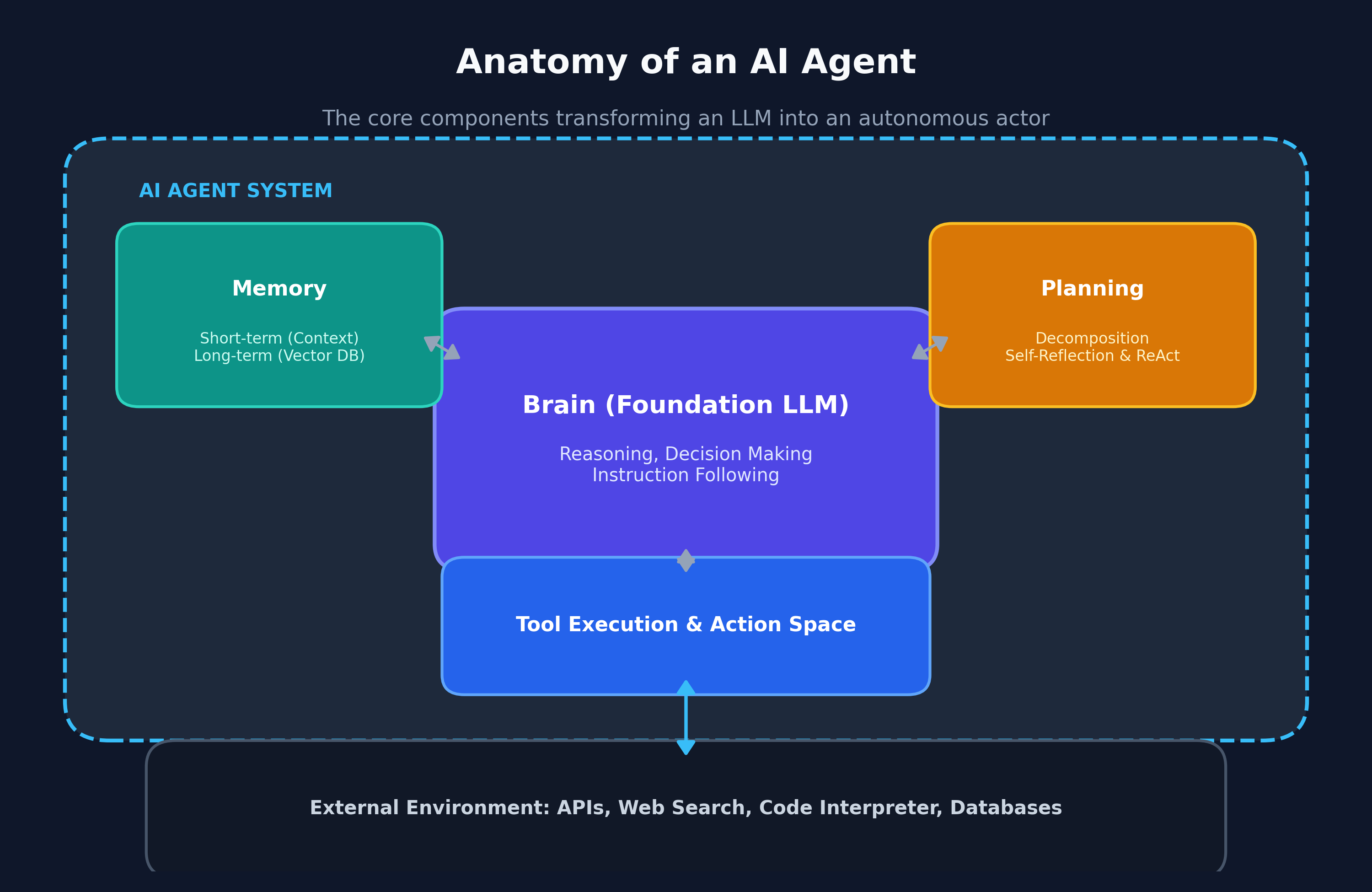
The Problem: Why Naive RAG Fails in Production
Retrieval-Augmented Generation (RAG) fundamentally changed how software developers ground Large Language Models (LLMs) in private enterprise knowledge. However, the industry’s early baseline—often termed Naive RAG—relies on a rigid, single-shot execution pattern: take a user prompt, compute its vector embedding, fetch the top-$k$ nearest chunks from a vector database, and inject them into a fixed generation prompt.
While Naive RAG performs adequately for basic factual lookups against clean static documentation, production enterprise systems encounter catastrophic failure modes when facing complex real-world queries:
- Semantic Mismatch & Query Brittleness: A user’s natural query rarely aligns cleanly with the specific wording of reference documents. A vector search for “Why did Q3 cloud infrastructure costs spike?” fails to retrieve documents discussing “Kubernetes cluster over-provisioning in September” if the vector space lacks dense overlap.
- Inability to Perform Multi-Hop Reasoning: Complex enterprise questions frequently require synthesizing facts spread across multiple disparate documents. For example, answering “Compare the pricing tier of our top competitor with our internal margin targets” requires two distinct retrieval steps: first fetching competitor pricing, and second fetching internal margin thresholds. Naive RAG attempts this in a single shot, retrieving incomplete context and hallucinating the comparison.
- Retrieval Blindness (Garbage In, Garbage Out): Traditional pipelines have no mechanism to evaluate whether retrieved chunks are actually relevant or sufficient. When retrieval returns low-quality or irrelevant noise, the generator model either incorporates the irrelevant information or hallucinates plausible falsehoods.
- Static Source Siloing: Traditional RAG treats the vector database as the sole source of truth, remaining blind to live APIs, relational SQL databases, and real-time web changes.
The Solution: Autonomous Multi-Hop Agentic RAG
To overcome the architectural ceiling of single-shot retrieval, modern AI infrastructure has shifted to Agentic RAG. Rather than treating retrieval as an immutable pre-processing step, Agentic RAG embeds the retrieval mechanism inside an active reasoning and tool-execution loop.
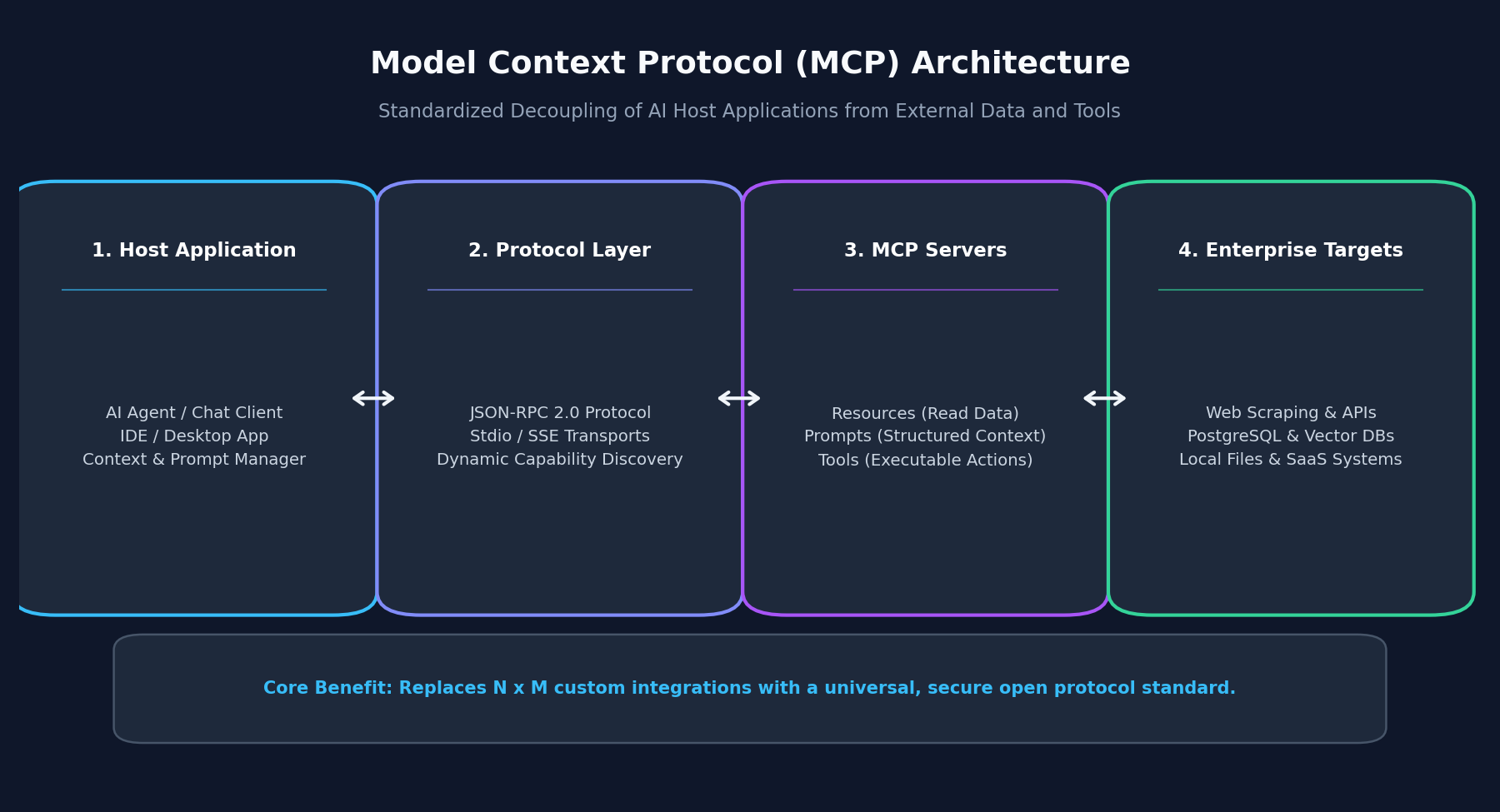
In an Agentic RAG architecture, an autonomous orchestrator evaluates incoming queries, formulates a multi-step retrieval strategy, dynamically routes requests across specialized data tools (e.g., vector stores, SQL engines, live AiFetchly Web Scraping tools), inspects retrieved evidence, and self-corrects if the retrieved context is insufficient.
Architectural Evolution: Naive vs. Advanced vs. Agentic RAG
| Capability | Naive RAG (2023) | Advanced / Modular RAG (2024–2025) | Agentic RAG (2026) |
|---|---|---|---|
| Retrieval Strategy | Single-shot vector lookup | Pre/post-retrieval reranking & hybrid search | Autonomous planning & multi-step iteration |
| Query Handling | Raw user string | Sub-query decomposition & HyDE | Dynamic query rewriting & adaptive routing |
| Multi-Hop Synthesis | Unsupported (fails multi-doc joins) | Static sequential pipelines | Iterative hops guided by intermediate findings |
| Relevance Verification | None (assumes top-$k$ is correct) | Cross-encoder rerank score cutoff | Self-reflective grading (CRAG / Self-RAG) |
| Data Tool Integration | Single vector store only | Multi-index vector databases | Vector DBs, SQL engines, and live AiFetchly Data Fetching APIs |
| Failure Recovery | Halts with hallucination | Returns empty or fallback message | Reformulates query and attempts alternative tools |
The Four Pillars of Agentic RAG
A resilient Agentic RAG implementation relies on four core architectural capabilities:
- Intelligent Query Routing: The agent acts as an adaptive dispatcher. It classifies user intent and routes specific sub-questions to the most appropriate context source—querying relational SQL for tabular aggregations, vector embeddings for unstructured policy guides, and live web extraction for real-time market data.
- Query Reformulation & Decomposition: When a query spans multiple entities or dependencies, the agent decomposes it into an ordered execution graph, resolving prerequisites step-by-step.
- Corrective Document Grading (CRAG): Before synthesizing an answer, a fast, lightweight evaluator model grades retrieved documents. If chunks are deemed irrelevant or contradictory, the agent triggers automated query expansion or falls back to live web search.
- Self-Reflective Hallucination Checks (Self-RAG): After drafting the response, the agent verifies whether every assertion is strictly grounded in the retrieved citations, eliminating unsupported claims before final delivery.
Implementation: Building a Self-Reflective Agentic RAG Pipeline
Let us implement a production-ready Agentic RAG pipeline in TypeScript. This implementation demonstrates query routing, iterative multi-hop retrieval, and automated document evaluation loops.
Step 1: Define Schemas for Routing and Document Grading
Establish explicit type contracts using Zod to ensure deterministic decision-making within the agent graph:
import { z } from 'zod';

// Schema for routing user queries to the optimal data source
export const RouteQuerySchema = z.object({
  datasource: z.enum(['vectorstore', 'sql_database', 'live_web']),
  subQueries: z.array(z.string()).min(1, 'At least one sub-query required'),
  reasoning: z.string(),
});

export type RouteQuery = z.infer<typeof RouteQuerySchema>;

// Schema for grading the relevance of retrieved documents
export const GradeDocumentsSchema = z.object({
  binaryScore: z.enum(['yes', 'no']),
  explanation: z.string(),
  missingAspects: z.array(z.string()).optional(),
});

export type GradeDocuments = z.infer<typeof GradeDocumentsSchema>; Step 2: Implement the Corrective Document Evaluator
Implement the evaluation node that determines whether retrieved context satisfies the question or requires query reformulation:
import { generateObject } from 'ai';
import { openai } from '@ai-sdk/openai';
import { GradeDocumentsSchema, type GradeDocuments } from './schemas';

export async function gradeDocumentRelevance(
  question: string,
  documentContent: string,
): Promise<GradeDocuments> {
  const { object } = await generateObject({
    model: openai('gpt-4o-mini'),
    schema: GradeDocumentsSchema,
    prompt: `You are an expert evaluator grading the relevance of a retrieved document to a user question.
Question: "${question}"
Document:
"${documentContent}"

Carefully evaluate if the document contains relevant facts that help answer the question. Grade as 'yes' or 'no'.`,
  });

  return object;
} Step 3: Implement the Multi-Hop Retrieval Orchestrator
Build the core agentic loop that executes iterative retrieval hops until sufficient evidence is assembled:
export interface RetrievalState {
  originalQuery: string;
  accumulatedContext: string[];
  currentHop: number;
  maxHops: number;
  isComplete: boolean;
}

export class AgenticRAGOrchestrator {
  private maxHops: number;

  constructor(maxHops = 3) {
    this.maxHops = maxHops;
  }

  public async executeMultiHop(query: string): Promise<{ context: string[]; iterations: number }> {
    const state: RetrievalState = {
      originalQuery: query,
      accumulatedContext: [],
      currentHop: 0,
      maxHops: this.maxHops,
      isComplete: false,
    };

    let activeSubQuery = query;

    while (!state.isComplete && state.currentHop < state.maxHops) {
      state.currentHop++;
      console.log(
        `[Agentic RAG] Executing Hop ${state.currentHop} for sub-query: "${activeSubQuery}"`,
      );

      // Mock retrieval from hybrid search / external API
      const retrievedChunks = await this.mockFetchChunks(activeSubQuery);

      // Evaluate retrieved chunks
      const validChunks: string[] = [];
      for (const chunk of retrievedChunks) {
        const grade = await gradeDocumentRelevance(activeSubQuery, chunk);
        if (grade.binaryScore === 'yes') {
          validChunks.push(chunk);
        }
      }

      state.accumulatedContext.push(...validChunks);

      // Determine if more context is needed
      if (validChunks.length > 0 && state.currentHop >= 2) {
        state.isComplete = true;
      } else {
        // Formulate next targeted hop query based on current findings
        activeSubQuery = `Specific details regarding: ${query} (focus on missing verification)`;
      }
    }

    return {
      context: state.accumulatedContext,
      iterations: state.currentHop,
    };
  }

  private async mockFetchChunks(subQuery: string): Promise<string[]> {
    return [
      `Relevant technical documentation snippet addressing: ${subQuery}`,
      `Secondary contextual data supporting: ${subQuery}`,
    ];
  }
} Step 4: Production Engineering Considerations
Deploying Agentic RAG in mission-critical applications requires balancing reasoning autonomy with strict operational boundaries:
- Configuring Hop Watermarks & Cost Guardrails: Autonomous loops can trigger multiple downstream embedding lookups and LLM evaluations. Always enforce a hard cap on retrieval hops (typically 2 to 4 hops) and implement per-request token budgets.
- Latency Optimization via Parallel Fan-Out: When a query decomposes into independent sub-questions, execute vector searches and web data fetching across sub-queries concurrently rather than sequentially.
- Semantic Caching: Cache deterministic query routings and document evaluation scores in an edge store or local database to eliminate redundant inference on recurring domain questions.
Conclusion
Agentic RAG bridges the critical gap between static document retrieval and human-grade research workflows. By elevating retrieval from a passive vector lookup into an active, self-correcting reasoning loop, engineering teams can build knowledge systems that handle ambiguity, synthesize multi-document evidence, and provide verifiably grounded answers across complex enterprise domains.