Agent Q Guide: MCTS & Self-Critique for Web AI Agents
The Problem: The Fragility of Autoregressive Web Agents and Error Cascades
In contemporary enterprise software engineering, autonomous digital workflows, and intelligent data extraction systems engineered by AiFetchly, deploying foundation models as autonomous agents to interact with web browsers represents one of the highest-value frontiers in artificial intelligence. From automated e-commerce catalog aggregation and flight booking reconciliation to multi-step research through AiFetchly Data Fetching and AiFetchly Web Scraping, organizations seek autonomous agents capable of navigating real-world websites reliably.
However, when leading foundation models—such as Meta LLaMA-3-70B, GPT-4o, or Claude 3.5 Sonnet—are deployed in interactive web environments, their real-world task completion rates drop precipitously. On challenging web navigation benchmarks such as WebArena and WebShop, zero-shot foundation models frequently fail on over 80% of complex multi-step scenarios, with baseline LLaMA-3-70B achieving an initial success rate of merely 18.6%.
Understanding why foundation models stumble on the web requires examining the physical divergence between static text completion and interactive decision-making.
1. The Open-Loop Irreversibility Trap
Standard Large Language Models (LLMs) operate via autoregressive next-token prediction. When configured as agents using prompting frameworks like ReAct, they generate actions sequentially in an open-loop fashion:
The Fragility of Open-Loop Autoregressive Web Execution:
User Goal: "Book a round-trip flight from SFO to JFK on Nov 12 returning Nov 18 under $400."

Step 1: Ingest Landing Page DOM ──────► Action: Click "Flights" tab (Success)
Step 2: Ingest Flight Search DOM ────► Action: Type "SFO" into Origin (Success)
Step 3: Ingest Date Picker DOM ──────► Action: Select "Oct 12" instead of "Nov 12" (MISTAKE!)
Step 4: Ingest Search Results DOM ────► Action: Scans October flights...
Step 5: Ingest Price Filter DOM ─────► Action: Applies "$400" filter...
Step 6: Ingest Checkout DOM ─────────► Action: Submits booking for WRONG DATE!
═══════════════════════════════════════════════════════════════════════════════════════
Outcome: Total Task Failure! (Zero mechanism to detect divergence or backtrack) In human web browsing, if a user accidentally selects the wrong calendar month or misclicks a navigation link, they observe the unexpected UI state, press the browser back button, and correct their mistake.
In contrast, autoregressive agents suffer from greedy irreversibility:
- Error Propagation: Once an agent emits an erroneous sub-action, that sub-action and the resulting unexpected environment observation become permanent tokens in its prompt history.
- Cascading Hallucinations: Because subsequent actions condition causally on previous missteps, the model rationalizes its previous erroneous decisions, driving the browser deeper into dead-end error loops or invalid form states.
2. The Sparse Outcome Supervision Dilemma
The primary paradigm for fine-tuning agents has historically relied on Behavior Cloning (Supervised Fine-Tuning) or Outcome-Supervised Reinforcement Learning (RL):
- The Curse of Delayed Binary Rewards: In a 25-step web navigation workflow, the environment yields a single scalar reward at the terminal state ($R = 1$ for task success, $R = 0$ for failure).
- Credit Assignment Failure: When an episode fails at step 22, traditional reinforcement learning algorithms cannot distinguish whether the failure was caused by an imperfect checkout click at step 22, an unselected checkbox at step 15, or an erroneous search query at step 3.
- Wasted Negative Trajectories: In standard Rejection Fine-Tuning (RFT), failed trajectories are completely discarded. In complex web environments where the baseline policy fails 80% of the time, discarding 80% of generated data results in catastrophic sample inefficiency.
3. The Exploration Bottleneck on Variable Web DOMs
Unlike board games such as Chess or Go, where the state space is discrete and the action space is fixed to a small set of legal moves, web environments feature massive, dynamic, and open-format action spaces:
- A modern single-page web application (SPA) contains thousands of Document Object Model (DOM) nodes, accessibility tree elements, nested iframes, dynamic shadow DOMs, and transient popup modals.
- The agent must synthesize composite actions: deciding which CSS selector or element ID to target, whether to click, double-click, hover, or scroll, and what string to type into arbitrary input fields.
- Without a structured mechanism to balance exploration of alternative interface paths against exploitation of high-confidence actions, greedy decoding collapses into repetitive, suboptimal click loops.
The Solution: Agent Q and the Search-and-Learning Synergy
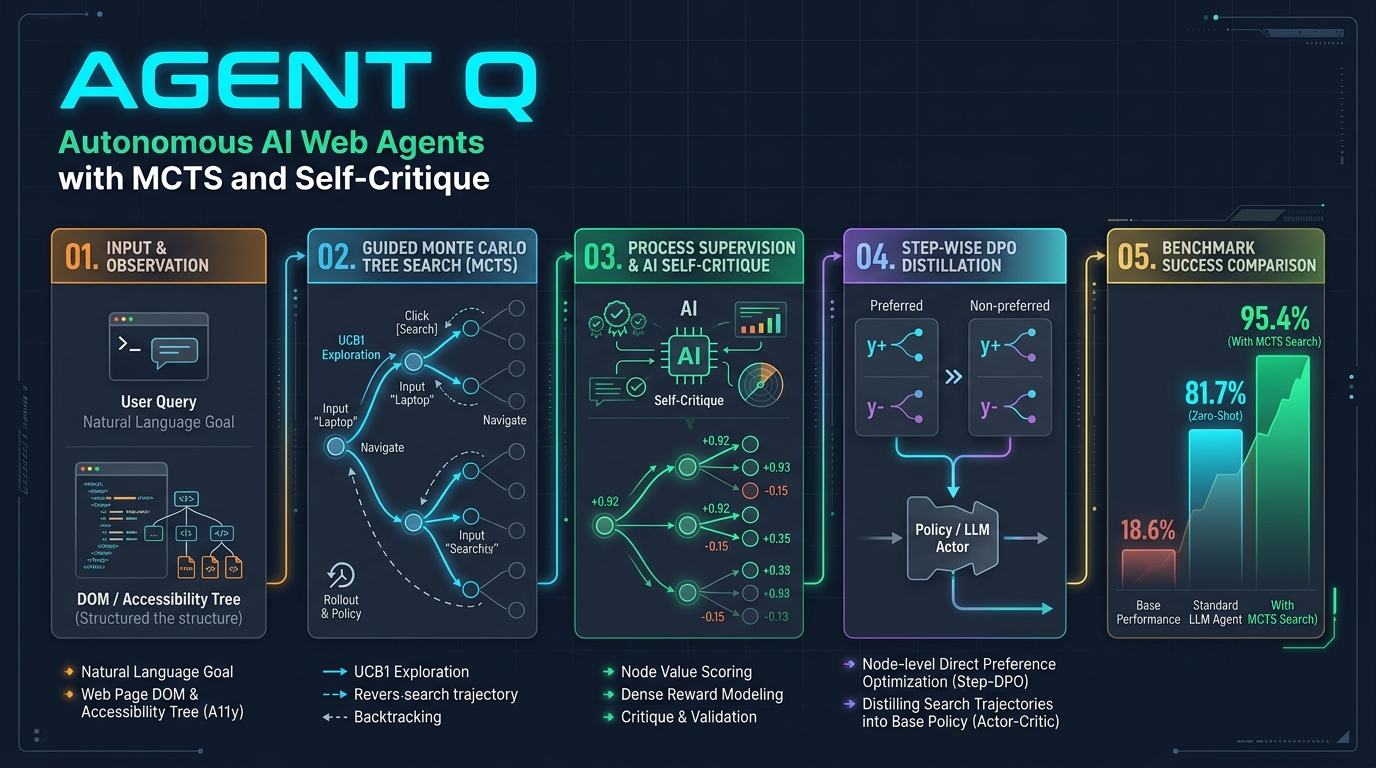
To dismantle these fundamental barriers, researchers from MultiOn and Stanford University (Pranav Putta, Edmund Mills, Naman Garg, Sumeet Motwani, Saurabh Kumar, and Chelsea Finn) introduced Agent Q: Advanced Reasoning and Learning for Autonomous AI Agents (arXiv:2408.07199).
Agent Q is built upon a foundational insight inspired by Rich Sutton’s The Bitter Lesson: general methods that leverage computation through search and learning consistently outperform hand-crafted heuristic pipelines.
Rather than relying purely on pre-trained parametric knowledge or unguided trial-and-error, Agent Q introduces a unified tri-pillar architecture:
The Agent Q Tri-Pillar Architecture:
┌─────────────────────────────────────────────────────────────────────────────┐
│ 1. Guided Monte Carlo Tree Search (MCTS)                                    │
│    • Explores branching web interaction trees over DOM states              │
│    • UCB1 heuristic balances exploration of novel actions vs. exploitation  │
│    • Enables seamless backtracking across browser history and dead ends     │
└──────────────────────────────────────┬──────────────────────────────────────┘
                                       │
                                       ▼
┌─────────────────────────────────────────────────────────────────────────────┐
│ 2. Hybrid Process Supervision & AI Self-Critique                            │
│    • Evaluates intermediate web state transitions at single-node resolution │
│    • AI Critic scores sub-goal progress, DOM validity, and semantic drift   │
│    • Overcomes sparse terminal rewards via dense process evaluation         │
└──────────────────────────────────────┬──────────────────────────────────────┘
                                       │
                                       ▼
┌─────────────────────────────────────────────────────────────────────────────┐
│ 3. Node-Level Direct Preference Optimization (Step-DPO)                     │
│    • Mines localized contrastive pairs (Winning vs. Losing actions at s_t)  │
│    • Distills MCTS search trajectories back into the base policy weights    │
│    • Learns effectively from both successful and unsuccessful experiences   │
└─────────────────────────────────────────────────────────────────────────────┘ By unifying test-time tree search with offline preference optimization, Agent Q delivers dramatic capability leaps:
- Zero-Shot Policy Performance: SFT + DPO training elevates LLaMA-3-70B on WebArena booking tasks from 18.6% to 81.7% without any inference-time search overhead.
- Inference-Time Search Scaling: When allowed to run test-time MCTS over live websites, Agent Q achieves 95.4% task completion—surpassing human baseline performance across real-world booking and e-commerce workflows.
System Architecture & Mathematical Foundations
Agent Q models autonomous web interaction as a partially observable Markov Decision Process (POMDP) defined by the tuple $\langle \mathcal{S}, \mathcal{A}, \mathcal{T}, \mathcal{R}, \Omega, \mathcal{O}, \gamma \rangle$:
- $\mathcal{S}$ represents the underlying web environment state (server database, session state, URL routing).
- $\Omega$ represents the observation space, containing the pruned accessibility tree, flattened DOM hierarchy, and interactive element coordinate map.
- $\mathcal{A}$ represents the open-vocabulary action space (e.g.,
click(element_id),type(element_id, text),scroll(direction),navigate(url),stop(answer)). - $\mathcal{T}(s’ \mid s, a)$ represents environment dynamics governed by web server responses and browser rendering engines.
- $\mathcal{R}(s, a)$ represents the reward signal, traditionally non-zero only upon successful completion of the user prompt.
1. Multi-Phase Monte Carlo Tree Search over Web Pages
Agent Q adapts Monte Carlo Tree Search (MCTS) to the fluid, non-deterministic domain of live browser automation. The tree search maintains nodes $v = (s, h)$, where $s$ denotes the current page DOM observation and $h$ captures the trajectory history.
The search executes four synchronized phases:
MCTS Web Navigation Cycle:
               ┌───────────────────────┐
               │    1. SELECTION       │  Traverse tree using UCB1
               │ (Balance Expl/Exploit)│  until reaching expandable node
               └───────────┬───────────┘
                           │
                           ▼
               ┌───────────────────────┐
               │    2. EXPANSION       │  Base policy π_θ proposes K candidate
               │  (Sample K Actions)   │  actions; execute in browser sandbox
               └───────────┬───────────┘
                           │
                           ▼
               ┌───────────────────────┐
               │    3. SIMULATION      │  AI Critic generates process reward
               │  & SELF-CRITIQUE      │  + rollout policy estimates future value
               └───────────┬───────────┘
                           │
                           ▼
               ┌───────────────────────┐
               │  4. BACKPROPAGATION   │  Propagate updated Q(s, a) and visit
               │  (Update Q & Visits)  │  counts N(s, a) up to root node
└───────────────────────┘ - Phase 1: Selection via UCB1: At decision node $s_t$, the search algorithm selects child action $a^*$ maximizing the Upper Confidence Bound for Trees (UCB1):
$$a^* = \arg\max_{a \in \mathcal{A}(s_t)} \left[ Q(s_t, a) + c_{\text{puct}} \cdot P(a \mid s_t) \cdot \frac{\sqrt{N(s_t)}}{1 + N(s_t, a)} \right]$$
Where:
-
$Q(s_t, a)$ is the running estimated action-value (expected return from executing action $a$ in state $s_t$).
-
$P(a \mid s_t)$ is the prior probability of action $a$ assigned by the base policy model $\pi_\theta$.
-
$N(s_t)$ is the total visit count of parent state $s_t$.
-
$N(s_t, a)$ is the number of times action $a$ has been explored from state $s_t$.
-
$c_{\text{puct}}$ is the exploration constant balancing exploitation of known high-reward web paths against exploration of untried links.
-
Phase 2: Action Proposal Expansion: Because the web action space is unbounded, Agent Q uses the base policy model $\pi_\theta$ as an action-proposal distribution. At an unexpanded web page, the agent generates $K$ diverse candidate actions:
$${a_1, a_2, \dots, a_K} \sim \pi_\theta(\cdot \mid s_t)$$
The environment executes candidate action $a_k$ inside a headless browser instance (such as Playwright), capturing the new DOM state $s_{t+1}$ and creating a new tree node.
- Phase 3: Hybrid Value Estimation & Process Supervision: Rather than running full random rollouts to the end of the episode (which is expensive and unstable on web pages), Agent Q computes a hybrid value estimate combining an AI Critic score with discounted future expectations:
$$V(s_{t+1}) = \alpha \cdot R_{\text{critic}}(s_{t+1}) + (1 - \alpha) \cdot \mathbb{E}{\pi{\text{rollout}}} \left[ \sum_{\tau=t+1}^T \gamma^{\tau - (t+1)} R_{\text{env}}(s_\tau) \right]$$
Where $R_{\text{critic}}$ is an intermediate process reward generated by an AI evaluation model assessing whether $s_{t+1}$ moved closer to satisfying the user’s instructions.
- Phase 4: Backpropagation & Reversible Backtracking: Once node $s_{t+1}$ is evaluated, its return value updates all ancestor nodes along the search path:
$$N(s_t, a) \leftarrow N(s_t, a) + 1$$
$$Q(s_t, a) \leftarrow Q(s_t, a) + \frac{V(s_{t+1}) - Q(s_t, a)}{N(s_t, a)}$$
If an action branch leads to an HTTP 404, an invalid form submission, or a looping state, its $Q$-value drops sharply. The UCB1 selection rule automatically abandons that branch on subsequent iterations, seamlessly navigating the browser back to parent states to explore alternative hyperlinks.
2. Node-Level Direct Preference Optimization (Step-DPO)
Once MCTS exploration concludes, the search tree contains a rich graph of explored trajectories—including optimal paths, sub-optimal diversions, and catastrophic dead ends.
Traditional DPO operates at the coarse trajectory level:
$$\mathcal{L}{\text{Traj-DPO}}(\theta) = -\mathbb{E}{(\tau_w, \tau_l)} \left[ \log \sigma \left( \beta \log \frac{\pi_\theta(\tau_w)}{\pi_{\text{ref}}(\tau_w)} - \beta \log \frac{\pi_{\text{ref}}(\tau_l)}{\pi_{\text{ref}}(\tau_l)} \right) \right]$$
In multi-turn web navigation, trajectory-level DPO fails because $\tau_w$ and $\tau_l$ often share 90% identical steps. Penalizing the entire trajectory $\tau_l$ unfairly suppresses the correct early actions.
Agent Q resolves this by deriving Node-Level Step-DPO:
- For every branching state $s_t$ in the MCTS tree with visit count $N(s_t) \ge 2$, identify child actions $a^w$ and $a^l$ such that:
$$Q(s_t, a^w) > Q(s_t, a^l) + \delta_{\text{margin}}$$
- Construct localized preference triples $(s_t, a^w, a^l)$, isolating the exact divergence point where one action advanced the task while the alternative degraded it.
- Optimize the policy $\pi_\theta$ using the node-level objective:
$$\mathcal{L}{\text{Step-DPO}}(\theta; \pi{\text{ref}}) = -\mathbb{E}{(s_t, a^w, a^l) \sim \mathcal{D}{\text{tree}}} \left[ \log \sigma \left( \beta \log \frac{\pi_\theta(a^w \mid s_t)}{\pi_{\text{ref}}(a^w \mid s_t)} - \beta \log \frac{\pi_\theta(a^l \mid s_t)}{\pi_{\text{ref}}(a^l \mid s_t)} \right) \right]$$
This mathematical formulation grants Agent Q three distinct advantages:
- Pinpoint Credit Assignment: Credit and blame are assigned strictly to the decisive action $a$ taken at state $s_t$.
- High Sample Utility: A single MCTS tree generates dozens of localized preference pairs, converting both successful and unsuccessful explorations into high-value training signals.
- Offline Stability: Because Step-DPO is reference-regularized, the policy improves iteratively across offline data collection cycles without unstable policy gradient variance.
Implementation: Building an Agent Q Navigation Runtime
Below is a complete, production-grade PyTorch and Python implementation demonstrating the core mechanics of Agent Q: modeling the web interaction tree, computing UCB1 selection, applying process-level self-critique, and executing node-level Step-DPO updates.
import math
import torch
import torch.nn as nn
import torch.nn.functional as F
from typing import List, Dict, Optional, Tuple, Any

class WebState:
    # Encapsulates current web page observation, URL, and accessibility tree
    def __init__(self, url: str, dom_summary: str, interactive_elements: List[Dict[str, Any]]):
        self.url = url
        self.dom_summary = dom_summary
        self.interactive_elements = interactive_elements

    def __repr__(self):
        return f"WebState(url='{self.url}', elements={len(self.interactive_elements)})"

class WebMCTSNode:
    # Represents a decision state node within the Agent Q search tree
    def __init__(self, state: WebState, parent: Optional['WebMCTSNode'] = None, action_from_parent: Optional[str] = None):
        self.state = state
        self.parent = parent
        self.action_from_parent = action_from_parent
        self.children: Dict[str, 'WebMCTSNode'] = {}
        self.visit_count: int = 0
        self.total_value: float = 0.0
        self.prior_prob: float = 1.0

    @property
    def q_value(self) -> float:
        if self.visit_count == 0:
            return 0.0
        return self.total_value / self.visit_count

    def is_fully_expanded(self, candidate_actions: List[str]) -> bool:
        return len(self.children) >= len(candidate_actions)

    def select_best_child(self, c_puct: float = 1.414) -> Tuple[str, 'WebMCTSNode']:
        # Selects child node maximizing UCB1 exploration-exploitation formula
        best_score = -float('inf')
        best_action = None
        best_child = None

        for action, child in self.children.items():
            # UCB1: Q(s, a) + c_puct * P(a|s) * sqrt(ln(N) / (1 + n))
            exploration = c_puct * child.prior_prob * (math.sqrt(self.visit_count) / (1.0 + child.visit_count))
            score = child.q_value + exploration

            if score > best_score:
                best_score = score
                best_action = action
                best_child = child

        return best_action, best_child

class ProcessCritic:
    # AI Evaluator scoring intermediate state transitions and sub-goal progress
    def __init__(self, model_name: str = "evaluator-critic"):
        self.model_name = model_name

    def evaluate_transition(self, goal: str, prev_state: WebState, action: str, next_state: WebState) -> float:
        # Scores action utility on a [-1.0, 1.0] scale using sub-goal heuristics
        score = 0.0
        if "error" in next_state.url or "404" in next_state.dom_summary:
            score -= 0.8
        elif "checkout" in next_state.url or "confirm" in next_state.dom_summary:
            score += 0.9
        elif "search" in action and len(next_state.interactive_elements) > 5:
            score += 0.5
        else:
            score += 0.1
        return score

class AgentQSearchEngine:
    # Coordinates guided Monte Carlo Tree Search over live browser interactions
    def __init__(self, critic: ProcessCritic, c_puct: float = 1.414, simulation_depth: int = 3):
        self.critic = critic
        self.c_puct = c_puct
        self.simulation_depth = simulation_depth

    def propose_actions(self, state: WebState) -> List[Tuple[str, float]]:
        # Simulates base policy proposing top-k actions with prior probabilities
        proposals = []
        for elem in state.interactive_elements[:3]:
            action_str = f"click('{elem['id']}')"
            proposals.append((action_str, 0.33))
        return proposals

    def execute_mock_environment(self, current_state: WebState, action: str) -> WebState:
        # Simulates browser execution transition
        new_url = f"{current_state.url}/next"
        new_summary = f"Rendered view after executing {action}"
        new_elements = [{'id': f'elem_{i}', 'tag': 'a'} for i in range(4)]
        return WebState(url=new_url, dom_summary=new_summary, interactive_elements=new_elements)

    def search(self, root_state: WebState, user_goal: str, num_simulations: int = 10) -> WebMCTSNode:
        root = WebMCTSNode(state=root_state)

        for _ in range(num_simulations):
            node = root
            search_path = [node]

            # 1. Selection
            candidate_actions = [a for a, _ in self.propose_actions(node.state)]
            while node.is_fully_expanded(candidate_actions) and len(node.children) > 0:
                _, node = node.select_best_child(self.c_puct)
                search_path.append(node)
                candidate_actions = [a for a, _ in self.propose_actions(node.state)]

            # 2. Expansion
            unexplored_actions = [a for a in candidate_actions if a not in node.children]
            if unexplored_actions:
                action_to_expand = unexplored_actions[0]
                next_state = self.execute_mock_environment(node.state, action_to_expand)
                new_child = WebMCTSNode(state=next_state, parent=node, action_from_parent=action_to_expand)
                new_child.prior_prob = 1.0 / len(candidate_actions)
                node.children[action_to_expand] = new_child
                node = new_child
                search_path.append(node)

            # 3. Simulation & Process Evaluation
            process_reward = self.critic.evaluate_transition(
                user_goal, search_path[-2].state, node.action_from_parent, node.state
            )

            # 4. Backpropagation
            for back_node in search_path:
                back_node.visit_count += 1
                back_node.total_value += process_reward

        return root

    def extract_preference_pairs(self, root: WebMCTSNode, delta_threshold: float = 0.2) -> List[Dict[str, Any]]:
        # Extracts node-level Step-DPO preference pairs from explored tree nodes
        preference_dataset = []

        def traverse(node: WebMCTSNode):
            if len(node.children) >= 2:
                sorted_children = sorted(node.children.values(), key=lambda c: c.q_value, reverse=True)
                best_child = sorted_children[0]
                worst_child = sorted_children[-1]

                if (best_child.q_value - worst_child.q_value) >= delta_threshold:
                    preference_dataset.append({
                        'state_dom': node.state.dom_summary,
                        'preferred_action': best_child.action_from_parent,
                        'rejected_action': worst_child.action_from_parent,
                        'q_diff': best_child.q_value - worst_child.q_value
                    })

            for child in node.children.values():
                traverse(child)

        traverse(root)
        return preference_dataset

class StepDPOLoss(nn.Module):
    # Computes node-level Direct Preference Optimization loss for policy fine-tuning
    def __init__(self, beta: float = 0.1):
        super().__init__()
        self.beta = beta

    def forward(self,
                policy_chosen_logps: torch.Tensor,
                policy_rejected_logps: torch.Tensor,
                ref_chosen_logps: torch.Tensor,
                ref_rejected_logps: torch.Tensor) -> torch.Tensor:
        # L_DPO = -E[log sigma(beta * (log(pi(y_w|x)/ref(y_w|x)) - log(pi(y_l|x)/ref(y_l|x))))]
        chosen_log_ratios = policy_chosen_logps - ref_chosen_logps
        rejected_log_ratios = policy_rejected_logps - ref_rejected_logps
        logits = self.beta * (chosen_log_ratios - rejected_log_ratios)
        loss = -F.logsigmoid(logits).mean()
        return loss

def run_agent_q_demo():
    print("Initializing Agent Q MCTS Search & Step-DPO Pipeline...")

    initial_elements = [
        {'id': 'nav_search_input', 'tag': 'input'},
        {'id': 'nav_category_dropdown', 'tag': 'select'},
        {'id': 'nav_cart_btn', 'tag': 'button'}
    ]
    root_state = WebState(url="https://store.example.com", dom_summary="E-commerce home page with catalog", interactive_elements=initial_elements)

    critic = ProcessCritic()
    search_engine = AgentQSearchEngine(critic=critic, c_puct=1.414)

    # Run MCTS exploration over web interactions
    user_prompt = "Find a mechanical keyboard under $100 and add to cart."
    tree_root = search_engine.search(root_state, user_goal=user_prompt, num_simulations=15)

    # Extract contrastive pairs for Step-DPO
    pairs = search_engine.extract_preference_pairs(tree_root, delta_threshold=0.1)
    print(f"MCTS Complete. Extracted {len(pairs)} localized preference pairs from search tree.")
    for idx, pair in enumerate(pairs):
        print(f"  [Pair {idx+1}] State: '{pair['state_dom'][:35]}...'")
        print(f"    - Preferred: {pair['preferred_action']} (Q-Diff: +{pair['q_diff']:.2f})")
        print(f"    - Rejected:  {pair['rejected_action']}")

    # Compute sample Step-DPO loss
    dpo_criterion = StepDPOLoss(beta=0.1)
    mock_pi_w = torch.tensor([-0.45], requires_grad=True)
    mock_pi_l = torch.tensor([-1.80], requires_grad=True)
    mock_ref_w = torch.tensor([-0.80])
    mock_ref_l = torch.tensor([-0.85])

    loss = dpo_criterion(mock_pi_w, mock_pi_l, mock_ref_w, mock_ref_l)
    print(f"\nStep-DPO Loss on extracted pairs: {loss.item():.4f}")

if __name__ == "__main__":
run_agent_q_demo() Empirical Benchmarks & Architectural Comparison
To assess the impact of Agent Q’s search and learning synergy, researchers evaluated the framework across standard real-world environments including WebArena (booking, e-commerce, content management, and code collaboration) and WebShop.
1. Benchmark Results on WebArena
On WebArena’s real-world booking and multi-step transactions, Agent Q demonstrates a profound performance divergence across training configurations:
| Agent Architecture | Base Model Backbone | Training Methodology | Search at Test-Time | Task Success Rate |
|---|---|---|---|---|
| Zero-Shot Prompting (ReAct) | LLaMA-3-70B | Zero-Shot In-Context Prompt | None (Greedy) | 18.6% |
| Supervised Fine-Tuning (SFT) | LLaMA-3-70B | Expert Demonstration Cloning | None (Greedy) | 28.6% |
| Rejection Fine-Tuning (RFT) | LLaMA-3-70B | Filtered Successful Rollouts | None (Greedy) | 31.3% |
| Trajectory-Level DPO | LLaMA-3-70B | Coarse Outcome Preferences | None (Greedy) | 40.6% |
| RFT + Test-Time MCTS | LLaMA-3-70B | Filtered Rollouts + Search | MCTS (UCB1) | 84.3% |
| Agent Q (Autonomous Policy) | LLaMA-3-70B | Node-Level Step-DPO + Critic | None (Zero-Shot) | 81.7% |
| Agent Q + Test-Time MCTS | LLaMA-3-70B | Node-Level Step-DPO + Critic | Full MCTS Search | 95.4% |
2. Ablation Analysis: The Power of Process Supervision
Ablations highlight the decisive role of intermediate AI self-critique:
- Outcome-Only MCTS: When MCTS evaluates nodes using only terminal outcome rewards ($R_{\text{outcome}}$), training yields a 75.2% success rate. While this exceeds trajectory DPO (71.8%) due to branching exploration, credit assignment remains coarse.
- Full Process Supervision: Integrating the AI Critic to score sub-goal progress during tree rollouts unlocks 81.7% zero-shot capability—a +6.5% absolute gain attributable entirely to granular intermediate guidance.
- Human-Surpassing Performance: With inference-time MCTS enabled on WebShop, Agent Q achieved a 91.1% average score, outperforming human crowd-workers (84.8%).
3. Comparing Autonomous Agent Methodologies
| Dimension | ReAct / Vanilla Prompting | SWE-agent / ACI | Tree-of-Thoughts (ToT) | Agent Q |
|---|---|---|---|---|
| Primary Domain | Conversational QA & Tools | Software Repositories | Text/Math Logic Problems | Interactive Web Browsers |
| Search Mechanism | Greedy Linear (No Search) | Bounded Shell History | DFS / BFS over Thoughts | MCTS with UCB1 & Reversible Backtracking |
| State Feedback | Raw Tool Return Strings | Linter & Guarded Edits | Self-Evaluation Prompts | Hybrid Process Critic & Dense Sub-Goals |
| Policy Learning | In-Context (Frozen Policy) | None (Frozen Policy) | None (Frozen Policy) | Node-Level Step-DPO Self-Improvement |
| Backtracking | Impossible (Error Cascades) | Undo Commands | Backtracks Thought Steps | Browser-Level Navigation Backtracking |
| Failure Utilization | Ignored / Throws Exceptions | Corrects Syntax Locally | Prunes Thought Branches | Mines Contrastive Negative DPO Pairs |
Production Engineering: Deploying Agent Q in aiFetchly Workflows
In high-concurrency enterprise data infrastructure, multi-tenant digital research assistants, and automated data pipelines powered by AiFetchly, deploying Agent Q principles transforms brittle web scripts into resilient, self-healing automations.
Enterprise Integration Architecture:
┌─────────────────────────────────────────────────────────────────────────────┐
│ 1. User & Client Request Layer                                              │
│    • Ingests natural language goals, extraction schemas, and credentials    │
└──────────────────────────────────────┬──────────────────────────────────────┘
                                       │
                                       ▼
┌─────────────────────────────────────────────────────────────────────────────┐
│ 2. aiFetchly Resilient Orchestrator                                         │
│    • Headless Chromium Cluster (Playwright / Puppeteer with stealth flags)   │
│    • Semantic Accessibility Tree Simplifier (Filters DOM to interactive nodes)│
└──────────────────────────────────────┬──────────────────────────────────────┘
                                       │
                                       ▼
┌─────────────────────────────────────────────────────────────────────────────┐
│ 3. Agent Q Dual-Mode Execution Engine                                       │
│    ├── Mode A (High-Throughput Fast Path): Zero-Shot Step-DPO Policy         │
│    └── Mode B (Resilience Fallback Path): Live MCTS Search & Backtracking   │
└──────────────────────────────────────┬──────────────────────────────────────┘
                                       │
                                       ▼
┌─────────────────────────────────────────────────────────────────────────────┐
│ 4. Structured Output Delivery                                               │
│    • Validated JSON records delivered via <InternalLink feature="api-integration">API Integration</InternalLink> endpoints           │
│    • Continuous trajectory logging for continuous offline Step-DPO retraining│
└─────────────────────────────────────────────────────────────────────────────┘ 1. Dual-Mode Production Serving: Fast-Path vs. Resilient Search
Running full MCTS search on every single web query introduces significant inference latency and token costs. Enterprise architectures solve this through tiered execution:
- Tier 1 (Fast-Path Policy Execution): Incoming web extraction tasks execute first through the distilled Agent Q Step-DPO policy using greedy decoding. This achieves sub-second token latency and resolves ~82% of standard workflows with zero search overhead.
- Tier 2 (MCTS Fallback & Recovery): If the page health monitor detects an anomaly—such as unexpected anti-bot verification, an updated form layout, a missing element selector, or an error banner—the orchestrator transparently engages test-time MCTS. The search engine forks browser state, explores alternative sub-paths, resolves the roadblock, and resumes normal execution.
2. DOM Distillation & Accessibility Tree Pruning
A raw enterprise web page routinely contains 10,000+ DOM nodes, exceeding LLM context windows and wasting tokens. For production viability:
- Accessibility Tree Extraction: Strip structural markup, CSS formatting, and inline scripts, retaining only interactive elements tagged with accessibility roles (
role="button",aria-label,input[type="text"]). - Coordinate Tagging: Map interactive elements to compact integer IDs (e.g.,
[14] button 'Search'), reducing state representation from 80,000 tokens to under 1,200 tokens.
3. Continuous Offline Distillation Loops
Every web task executed in production yields valuable operational data:
- Log all browser state transitions, element interactions, and final HTTP response payloads into an append-only trajectory lake.
- Periodically run offline MCTS over failed production tasks, generating localized preference pairs $(s_t, a^w, a^l)$.
- Fine-tune the base policy via Step-DPO on a weekly cadence, ensuring the agent automatically adapts to seasonal UI redesigns across target platforms without manual rule authoring.
For technical teams evaluating deployment economics, explore our transparent tiered capacity options via our AiFetchly Pricing guide or inspect our complete developer documentation at AiFetchly Documentation. By bridging Monte Carlo Tree Search with localized preference optimization, Agent Q marks the definitive shift from fragile prompt-engineered bots to robust, self-improving autonomous web operators.