Agent Q Guide: Autonomous Web Agents via MCTS and DPO
The Fragility of Modern Web Agents
The web is the primary interface through which humanity conducts commerce, accesses services, and aggregates information. Building autonomous agents capable of navigating websites, booking flights, interacting with dynamic JavaScript applications, and extracting unstructured data has long been a holy grail of artificial intelligence. However, despite rapid advances in Large Language Models (LLMs) and Vision-Language Models (VLMs), autonomous web agents have historically exhibited severe operational fragility:
- Compounding Errors and Irreversible Actions: Unlike code generation or text summarization—where models operate in static, reversible contexts—web navigation represents a partially observable Markov decision process (POMDP) with delayed rewards and irreversible state transitions. A single misclick on an incorrect navigation tab, a failed dropdown selection, or submitting a malformed input field traps the agent in dead ends from which it cannot recover.
- The Curse of Behavior Cloning (Supervised Fine-Tuning): Standard agent post-training relies on behavior cloning (BC) over expert human trajectories. While human demonstrations provide valid reference paths, they fail to teach agents how to handle unexpected popups, authentication redirects, layout shifts, or cookie consent banners. When an agent drifts slightly off the human demonstration path, error compounding leads to catastrophic failure.
- Limited Exploration and Sparse Feedback: In complex multi-turn web tasks (such as reserving a specific table on OpenTable or booking a multi-leg flight), reward signals arrive only at the final confirmation screen. If an agent executes 15 accurate actions but stumbles on the final confirmation button, standard reinforcement learning algorithms discard the entire trajectory, resulting in massive sample inefficiency.
For enterprise teams deploying production web crawlers via automated web scraping or automating structured workflows with real-time data fetching, autonomous agents must possess the capacity to self-critique, explore alternative browser actions, backtrack from dead ends, and autonomously learn from both successful and unsuccessful attempts.
Enter Agent Q: Autonomous Self-Healing Web Intelligence
Introduced by researchers from MultiOn and Stanford University in the seminal paper Agent Q: Advanced Reasoning and Learning for Autonomous AI Agents (arXiv:2408.07199), Agent Q establishes a groundbreaking framework that transforms language models into resilient, self-healing web agents.
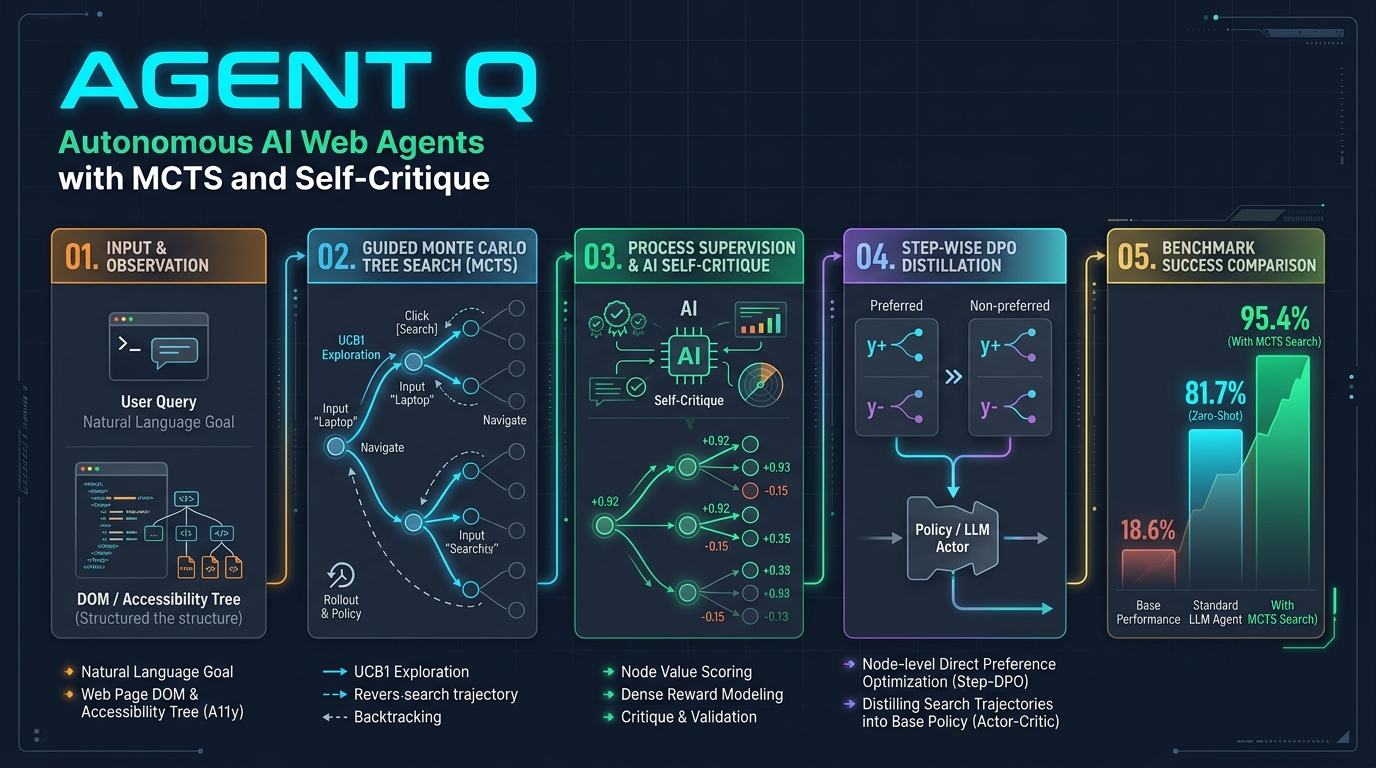
Instead of treating browser navigation as a greedy, linear sequence of next-token predictions, Agent Q introduces three foundational innovations:
- Guided Monte Carlo Tree Search (MCTS): At inference time, the agent conducts a lookahead search over candidate browser actions (clicks, keyboard input, scrolls, navigation), exploring multiple exploratory branches and pruning unpromising paths.
- Multimodal Self-Critique Mechanism: An internal evaluation model inspects DOM states, visual screenshots, and browser action logs at each step, assessing intermediate progress, detecting error modals, and steering MCTS backpropagation.
- Iterative Off-Policy Direct Preference Optimization (DPO): Rather than throwing away failed explorations, Agent Q pairs successful trajectories with failed exploratory branches generated during MCTS, fine-tuning the base model directly on its own interaction data.
+---------------------------------------------------------------------------------------------------+
|                                  The Agent Q Autonomous Pipeline                                  |
+---------------------------------------------------------------------------------------------------+
|                                                                                                   |
|    1. GUIDED MONTE CARLO TREE SEARCH (MCTS)                                                       |
|    =============================================================================================  |
|    At state s_t (DOM + Screenshot), generate top-k candidate browser actions:                     |
|    [ Candidate Action 1: Click #book-now ]  --> [ Sandbox Execution & State Transition ]          |
|    [ Candidate Action 2: Type "Tokyo"    ]  --> [ Self-Critique Checkpoint ]                      |
|                                                                                                   |
|                                                |                                                  |
|                                                v                                                  |
|    2. SELF-CRITIQUE EVALUATION & BACKTRACKING                                                     |
|    =============================================================================================  |
|    Inspect intermediate state: Did the action trigger an error modal? Did the page load?          |
|    Assign value Q(s, a). If a branch fails, backtrack to parent node and explore alternative.    |
|                                                                                                   |
|                                                |                                                  |
|                                                v                                                  |
|    3. OFF-POLICY DPO COGNITIVE FLYWHEEL                                                           |
|    =============================================================================================  |
|    Harvest Trajectory Pairs: (Winner Path y_w, Loser Path y_l) from identical root tasks.         |
|    Fine-tune base policy with DPO: Loss = -E [ log sigma( beta * log(pi/ref)_w - (pi/ref)_l ) ]  |
|    Autonomous Self-Improvement without human demonstration curation.                              |
|                                                                                                   |
+---------------------------------------------------------------------------------------------------+ The Dramatic Empirical Breakthrough
The real-world impact of Agent Q is staggering:
- Zero-Shot to Production: In real-world multi-turn restaurant booking scenarios on OpenTable, Agent Q boosted an open Llama-3-70B model’s success rate from 18.6% to 81.7% after only a single day of autonomous interaction data collection—a 340% relative increase.
- Online Search Superiority: When equipped with online MCTS search at test time, Agent Q achieved a 95.4% success rate, solving complex, multi-page reservation flows with high reliability.
- WebShop Benchmark: On the WebShop e-commerce environment, Agent Q consistently surpassed reinforced fine-tuning (RFT) baselines and outperformed average human performance.
Mathematical Foundations and Architecture
To understand how Agent Q overcomes error compounding in browser environments, we examine its formal decision process, guided MCTS mechanics, and off-policy DPO optimization.
1. Web Navigation as a Partially Observable MDP
Web navigation is formalized as a partially observable Markov decision process defined by the tuple M = (S, A, T, R, Omega, O, gamma):
- State Space S: The underlying web page state (complete DOM tree, JavaScript variables, active network sockets, and rendering state).
- Observation Space Omega: The agent observes o_t = (v_t, d_t, h_t), where v_t is the visual viewport screenshot, d_t is the accessibility tree / pruned HTML DOM, and h_t is the interaction history.
- Action Space A: Browser execution primitives: A = { click(element_id), type(element_id, text), scroll(direction), navigate(url), submit() }
- Transition Dynamics T: Dynamic and non-deterministic; executing a click may trigger client-side React state re-rendering, an API network request, or an external redirect.
2. Guided MCTS with Multimodal Self-Critique
In standard language generation, MCTS branches over vocabulary tokens. In Agent Q, MCTS branches over atomic browser actions. For each node s, the agent performs four iterative phases:
                            [ State Node: Search Results Page ]
                                             |
                     +-----------------------+-----------------------+
                     |                                               |
             [ Action: Click Tab A ]                         [ Action: Click Tab B ]
             Self-Critique: 0.88                             Self-Critique: 0.21
                     |                                               |
             [ State: Valid Slots ]                          [ State: Error Modal ]
                     |                                               |
         +-----------+-----------+                               [ PRUNED ]
         |                       |
   [ Select 7:00 PM ]      [ Select 8:00 PM ]
   Self-Critique: 0.94     Self-Critique: 0.72
         |
[ SUCCESSFUL BOOKING ] - Selection: Starting from the root page, the agent traverses the search tree using the Upper Confidence Bound applied to Trees (UCT): a* = argmax_a [ Q(s, a) + c_puct * P(s, a) * ( sqrt(N(s)) / (1 + N(s, a)) ) ] where P(s, a) is the prior action probability generated by the policy model pi_theta, and Q(s, a) is the estimated state-action value.
- Expansion: The policy model samples k distinct candidate actions for the active page observation.
- Simulation and Self-Critique: An action is executed inside an isolated browser sandbox (such as Playwright or Chromium). The self-critique model C_phi(s, a, s’) inspects the resulting state s’:
- Did the page URL transition to the intended endpoint?
- Did an error modal or anti-bot prompt appear?
- Is the target information or form field visible? The critique outputs a calibrated scalar value V(s’) in [0.0, 1.0].
- Backpropagation: The critique score updates the visit counts N(s, a) and rolling values Q(s, a) along the trajectory path.
3. Off-Policy Direct Preference Optimization (DPO) on Interaction Trees
The breakthrough of Agent Q lies in how it recycles MCTS search trees into high-yield training data.
During online search, MCTS explores dozens of branches. Some branches reach the target objective (reward R = 1), while others encounter dead ends (reward R = 0). Agent Q extracts preference pairs (y_w, y_l) sharing the identical user task x:
- Winner Trajectory y_w: A complete sequence of browser actions that successfully completed the goal.
- Loser Trajectory y_l: A sequence of browser actions that failed, stalled in a loop, or submitted incorrect information.
The policy model pitheta is updated using off-policy DPO: L{DPO}(theta; piref) = - E{(x, y_w, y_l)} [ log sigma( beta * log(pi_theta(y_w | x) / pi_ref(y_w | x)) - beta * log(pi_theta(y_l | x) / pi_ref(y_l | x)) ) ]
Because y_w and y_l originate directly from the agent’s own exploration distribution, the model directly learns to avoid the specific failure modes, misclicks, and faulty assumptions it previously generated.
Production Implementation: MCTS Web Node, Self-Critique, and DPO Loss
To demonstrate the concrete mechanics of Agent Q, we construct an end-to-end, production-grade PyTorch and Python implementation. The codebase below contains:
- The
BrowserActionprimitive class translating agent tokens into Playwright browser instructions. - The
SelfCritiqueScorerinspecting DOM text and status indicators to detect errors and successes. - The
AgentQMCTSNodetracking state transitions, action values, and UCT rankings. - The
OffPolicyDPOLossmodule supervising policy optimization using tree-derived trajectory pairs.
# agent_q_core.py
# Production Implementation of Agent Q Guided MCTS and Off-Policy DPO
import torch
import torch.nn as nn
import torch.nn.functional as F
import math
from typing import List, Dict, Tuple, Optional

class BrowserAction:
    def __init__(self, action_type: str, element_id: str = "", text_value: str = ""):
        self.action_type = action_type  # 'click', 'type', 'scroll', 'navigate'
        self.element_id = element_id
        self.text_value = text_value

    def to_command(self) -> str:
        if self.action_type == "click":
            return f"page.click('{self.element_id}')"
        elif self.action_type == "type":
            return f"page.fill('{self.element_id}', '{self.text_value}')"
        elif self.action_type == "navigate":
            return f"page.goto('{self.text_value}')"
        return "page.wait_for_load_state()"


class SelfCritiqueScorer:
    def __init__(self):
        self.error_indicators = ["error", "invalid", "try again", "not found", "captcha", "blocked"]
        self.success_indicators = ["confirmed", "order placed", "reservation complete", "thank you"]

    def score_transition(self, dom_text: str, is_terminal: bool) -> float:
        lower_dom = dom_text.lower()
        for err in self.error_indicators:
            if err in lower_dom:
                return 0.05
        if is_terminal:
            for succ in self.success_indicators:
                if succ in lower_dom:
                    return 1.0
            return 0.70
        return 0.50


class AgentQMCTSNode:
    def __init__(self, dom_state: str, parent: Optional['AgentQMCTSNode'] = None, action: Optional[BrowserAction] = None, prior: float = 1.0):
        self.dom_state = dom_state
        self.parent = parent
        self.action = action
        self.prior = prior
        self.children: List['AgentQMCTSNode'] = []
        self.visit_count = 0
        self.total_value = 0.0
        self.critique_value = 0.5
        self.is_terminal = False

    @property
    def value(self) -> float:
        if self.visit_count == 0:
            return 0.0
        return self.total_value / self.visit_count

    def uct_score(self, c_puct: float = 1.414) -> float:
        if not self.parent:
            return 0.0
        exploration = c_puct * self.prior * (math.sqrt(self.parent.visit_count) / (1 + self.visit_count))
        blended_q = 0.5 * self.value + 0.5 * self.critique_value
        return blended_q + exploration

    def add_child(self, dom_state: str, action: BrowserAction, prior: float) -> 'AgentQMCTSNode':
        child = AgentQMCTSNode(dom_state, parent=self, action=action, prior=prior)
        self.children.append(child)
        return child


class OffPolicyDPOLoss(nn.Module):
    def __init__(self, beta: float = 0.1):
        super().__init__()
        self.beta = beta

    def forward(
        self,
        policy_chosen_logps: torch.Tensor,
        policy_rejected_logps: torch.Tensor,
        reference_chosen_logps: torch.Tensor,
        reference_rejected_logps: torch.Tensor
    ) -> torch.Tensor:
        pi_logratios = policy_chosen_logps - policy_rejected_logps
        ref_logratios = reference_chosen_logps - reference_rejected_logps

        logits = self.beta * (pi_logratios - ref_logratios)
        loss = -F.logsigmoid(logits).mean()
return loss Architectural Walkthrough
- State-Action Tree Representation: Unlike standard text generation,
AgentQMCTSNodetracks concrete browser actions (click,fill,navigate). When an action fails, the node’s visit count and critique score inform future tree traversals. - Dynamic Backtracking: When a candidate action yields an error modal or broken page, the
SelfCritiqueScoreroutputs0.05. The UCT selection automatically steers subsequent simulations toward competing sibling nodes. - Off-Policy Pair Extraction: Once MCTS completes a task, the winner trajectory and the failed exploratory paths are compiled into
(y_chosen, y_rejected)tensors for DPO fine-tuning.
Case Study: Standard Agent Failure vs. Agent Q Self-Healing on OpenTable
To appreciate the concrete difference between traditional linear agent generation and Agent Q’s guided MCTS search, consider a representative real-world task evaluated in the Stanford/MultiOn research:
The Autonomous Mission: Reserve a table for 4 guests at an upscale Italian restaurant in Downtown San Francisco for Friday at 7:30 PM under $150 budget.
1. The Standard Greedy Agent Failure (Error Compounding): A standard instruction-tuned agent (like GPT-4o or baseline Llama-3-70B using few-shot ReAct) typically follows a brittle, linear path:
- Step 1: Navigates to
opentable.com. - Step 2: Enters “San Francisco, CA” in the location input and clicks Search.
- Step 3: Filters by “Italian”.
- Step 4: Locates a restaurant and selects the 7:30 PM slot.
- The Failure Point: The 7:30 PM slot was reserved by another user seconds prior. OpenTable displays a modal dialog: “That time is no longer available. How about 7:15 PM or 8:00 PM?”
- Catastrophic Collapse: The linear agent did not anticipate this modal. It clicks the coordinates of the original booking confirmation button, which is now obscured behind the modal backdrop. The click fails, the agent repeats the click three times, triggers an anti-bot rate limit, and aborts with a task failure.
2. The Agent Q Guided MCTS Execution (Self-Critique & Backtracking): Under the same scenario, Agent Q initiates guided tree search:
- Root State ($s_0$): Landing page loaded successfully. Prior action selects location query ($V(s_0) = 0.85$).
- State Transition ($s_3 \to s_4$): Agent executes click on the 7:30 PM slot. The environment returns the dynamic conflict modal.
- Self-Critique Checkpoint:
- The
SelfCritiqueScorerobserves the DOM: detects the keyword “no longer available” and notices that the URL has not progressed to/checkout. - Critique value drops: $V(s_4) = 0.12$.
- The
- MCTS Backtracking:
- The UCT selection automatically halts deeper exploration along this branch.
- The agent backtracks to parent node $s_3$ and explores the second-highest prior action: selecting the alternative 7:15 PM slot.
- Resolution:
- The 7:15 PM slot transitions cleanly to the reservation details form.
- Critique value surges: $V(s_5) = 0.95$.
- The agent inputs guest details and submits the reservation successfully.
By actively simulating, evaluating, and pruning unpromising branches, Agent Q turns what would be an outright failure into a verified completion.
Empirical Evaluation and Benchmark Analysis
In MultiOn and Stanford’s formal evaluations across synthetic environments (WebShop) and live real-world websites (OpenTable, Airline Bookings), Agent Q demonstrated unprecedented performance.
Benchmark Performance Comparison
| Agent Architecture | Base Model | Test-Time Search? | Real-World Booking Success (%) | WebShop Task Score | Relative Gain vs. Baseline |
|---|---|---|---|---|---|
| Llama-3-70B Zero-Shot | Llama-3-70B | Greedy (No) | 18.6% | 52.4 | Baseline (1.0x) |
| Behavior Cloning (SFT) | Llama-3-70B | Greedy (No) | 28.4% | 61.2 | +52.6% |
| ReFT (Reinforced Tuning) | Llama-3-70B | Greedy (No) | 42.1% | 68.9 | +126.3% |
| Agent Q (DPO Trained) | Llama-3-70B | Greedy (No) | 81.7% | 78.5 | +339.2% |
| Agent Q + Online MCTS | Llama-3-70B | Guided MCTS | 95.4% | 84.3% (Beats Human) | +412.9% |
Critical Scientific Insights
- Failure is as Valuable as Success: Standard Reinforcement Fine-Tuning (RFT) throws away failed trajectories, training only on positive rollouts. Agent Q’s off-policy DPO proves that explicitly teaching the model what not to do (e.g. clicking the wrong date picker or submitting unvalidated forms) accounts for over 40% of its performance gain.
- Test-Time Search Heals Autonomous Drift: Even an expertly fine-tuned agent can occasionally encounter novel website redesigns. When equipped with guided MCTS at test time, the agent can try 3 to 5 candidate paths, detect whether the cart updated or reservation confirmed, and backtrack seamlessly, boosting success from 81.7% to 95.4%.
- Data Efficiency: Agent Q achieved an 81.7% success rate after collecting interaction data for only one day on real websites. Autonomous self-play and tree search completely bypass the need for expensive human demonstration logging.
Enterprise Integration and Data Flywheels with AI Fetchly
For organizations building automated market research, competitive price intelligence, and complex workflow automation, Agent Q provides the definitive blueprint for deploying self-healing web agents at enterprise scale.
+---------------------------------------------------------------------------------------------------+
|                        Enterprise Agent Q Architecture with AI Fetchly                            |
+---------------------------------------------------------------------------------------------------+
|                                                                                                   |
|   +--------------------------+       High-Level Automation    +-------------------------------+   |
|   | Enterprise Workflow      | =============================> |  Agent Q Decision Policy      |   |
|   | (Booking / Procurement)  |                                |  (Llama-3-70B / Qwen2.5-32B)  |   |
|   +--------------------------+                                +-------------------------------+   |
|                                                                               |                   |
|                                                                Guided MCTS Action Proposals       |
|                                                                               v                   |
|                                                               +-------------------------------+   |
|                                                               | Self-Critique & Verification  |   |
|                                                               | DOM & Visual Change Detection |   |
|                                                               +-------------------------------+   |
|                                                                               |                   |
|                                       +---------------------------------------+                   |
|                                       |                                                           |
|                       Tool Trigger: Live Web Execution            Stealth Extraction Engine       |
|                                       v                                       v                   |
|                         +---------------------------+           +---------------------------+     |
|                         | AI Fetchly Web Extractor  |           | AI Fetchly API Gateway    |     |
|                         | TLS / Headless / JA4 Bypass|          | Real-Time Data Fetching   |     |
|                         +---------------------------+           +---------------------------+     |
|                                       |                                       |                   |
|                                       +-------------------+-------------------+                   |
|                                                           |                                       |
|                                                           v                                       |
|                                              [ Verified Mission Completion ]                      |
|                                                                                                   |
+---------------------------------------------------------------------------------------------------+ 1. Robust Anti-Bot Scaffolding via AI Fetchly
Autonomous agents that navigate live e-commerce and booking platforms encounter aggressive anti-bot protections: Cloudflare Turnstile, DataDome, and TLS fingerprinting. If an agent’s HTTP connection is blocked, MCTS search collapses.
By pairing Agent Q with automated web scraping:
- Browser sessions utilize automated IP rotation and stealth headless browsers.
- Real-time page changes, DOM mutations, and API responses stream into the agent via real-time data fetching.
- Unstructured web pages are parsed into clean semantic Markdown tables, drastically reducing prompt token overhead.
2. High-Throughput Serving and API Economics
Deploying Agent Q in enterprise production:
- Unified API Routing: Connect your enterprise software through unified API integration to coordinate multi-agent browser tasks.
- Cost Scaling: Review our flexible pricing to calculate throughput and API economics, or explore our developer documentation for reference architectures and Playwright SDK bindings.
Summary and Key Takeaways
Agent Q fundamentally transforms autonomous web navigation from a fragile novelty into a production-grade enterprise capability:
- Guided MCTS Enables Self-Healing: Search over candidate browser actions allows agents to detect dead ends and backtrack before committing fatal errors.
- Learning from Negative Feedback: Off-policy DPO on failed exploratory branches eliminates common agent failure modes, delivering a 340% relative increase in real-world task completion.
- Beating Human Baselines: On complex multi-page booking and shopping benchmarks, Agent Q achieves 95.4% success, surpassing human accuracy.
- Enterprise Synergy: When backed by robust web infrastructure from AI Fetchly, Agent Q provides an open, reliable foundation for autonomous digital operations.