Agent-Gym Guide: Training Autonomous LLM Agents via RL
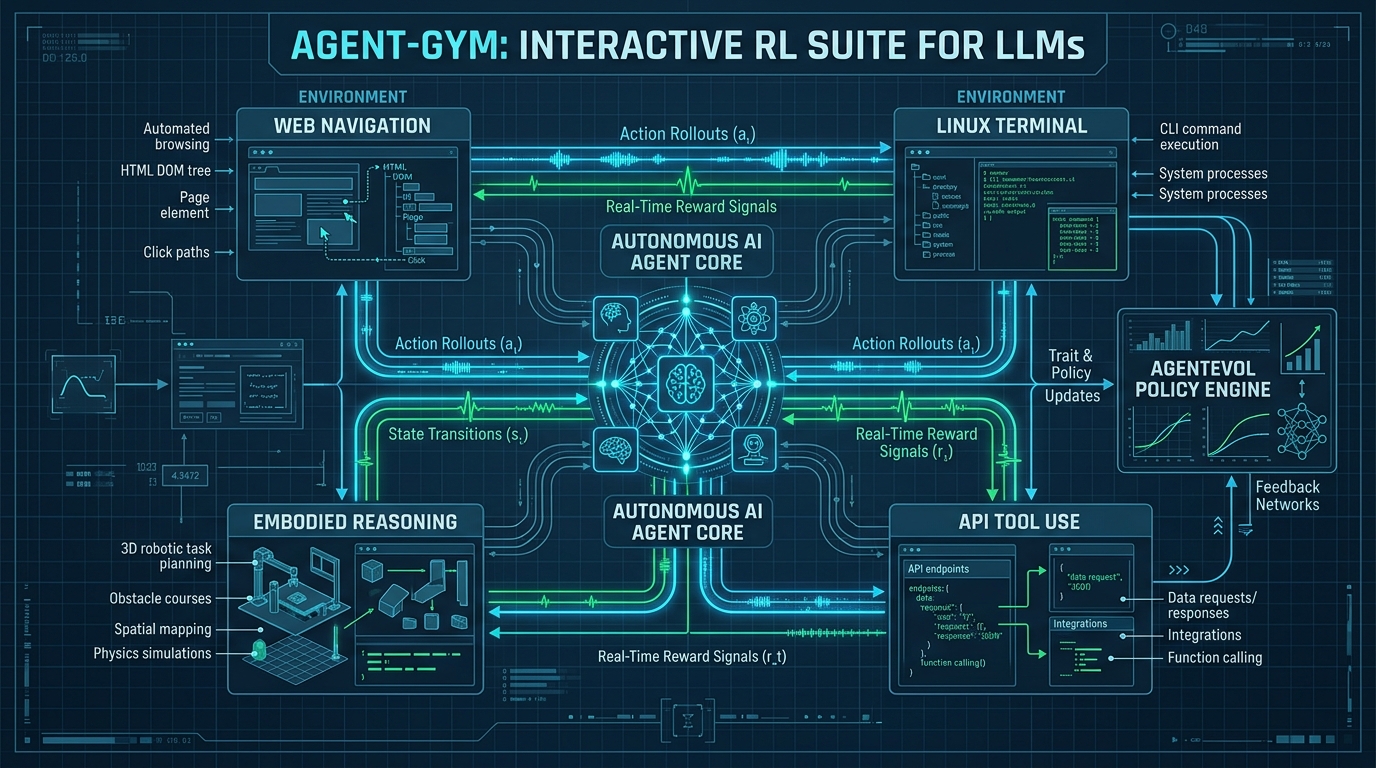
Problem: The Static SFT Ceiling and Exposure Bias in LLM Agents
In modern enterprise automation, automated data extraction, and multi-step cognitive copilots orchestrated by AI Fetchly, deploying foundation models as autonomous agents requires solving sequential decision-making problems. Whether an intelligent agent is navigating dynamic e-commerce catalogs via automated data fetching or orchestrating resilient browser automation across live web pages with intelligent web scraping, an agent cannot succeed simply by emitting a single eloquent paragraph. It must interact with an external environment: observing real-time states, executing API actions, interpreting error codes, backtracking from unexpected dead ends, and planning multi-step trajectories toward a distant goal.
Historically, the dominant methodology for training LLM agents has been Supervised Fine-Tuning (SFT) on static demonstration datasets (often called Behavioral Cloning). Machine learning teams collect thousands of successful human or GPT-4 trajectories, serialize the sequences into prompt-response pairs, and train the model using standard next-token cross-entropy loss.
However, when behavioral-cloned agents are deployed into dynamic production environments, they encounter severe systemic failure modes:
The Supervised Fine-Tuning (SFT) Agent Dilemma:
Training Phase: Perfect Human Trajectory (Teacher Forcing)
State 0 ──► Action 0 ──► State 1 ──► Action 1 ──► State 2 ──► Success!
(Model only learns what to do when everything goes 100% right)
 │
 ▼ Deployment in Live Production Environment
State 0 ──► Action 0 ──► State 1 ──► Slight Drift (Action 1*)
                                            │
                                            ▼ Unseen Error State (404 / Syntax Error)
                                     ┌────────────────────────────────────────┐
                                     │ Exposure Bias Trap:                    │
                                     │ Model has NEVER seen an error state!   │
                                     │ ❌ Cascading hallucinations            │
                                     │ ❌ Infinite retry loops                │
                                     │ ❌ Premature task abandonment          │
                                     └────────────────────────────────────────┘
Result: Agent collapses on the first environmental surprise! 1. The Exposure Bias Wall in Multi-Turn Decision Making
In classical supervised fine-tuning, models operate under Teacher Forcing: during every step of training, the model is provided with the ground-truth historical prefix.
When deployed into an interactive environment:
- Compounding Distribution Drift: The agent must feed its own generated actions back into the environment. If the agent takes a slightly suboptimal action at Step 3, the environment transitions into a state that never existed in the training dataset.
- The Fragility of Behavioral Cloning: Because static SFT never penalizes mistakes or teaches error recovery, the model has zero experiential knowledge of how to escape failure states. A single 404 HTTP error or an unexpected modal dialog causes the agent’s reasoning chain to unravel catastrophically.
- Lack of Exploration: SFT rewards the model exclusively for matching the exact token choices of the training trajectories. It provides no incentive to explore alternative, more efficient action paths.
2. Environment Fragmentation Across Disparate Agent Benchmarks
Prior to recent advances, evaluating and training interactive agents was severely hampered by benchmarking fragmentation:
- Siloed Environments: Researchers built isolated, incompatible simulators: WebShop for e-commerce, InterCode for bash shells, SWE-bench for GitHub issues, ScienceWorld for text-based science simulations, and BabyAI for grid-world navigation.
- Incompatible Observation and Action Formats: Each environment utilized disparate API conventions, idiosyncratic observation wrappers, and custom reward structures.
- The Overfitting Trap: Agents trained on an isolated web-browsing dataset overfit to specific DOM layouts and failed completely when tested on terminal execution or API tool calling.
3. The Lack of Interactive Feedback in Static Demonstration Datasets
Human developers and operators do not become proficient by reading frozen logs; they become proficient by interacting with systems, making errors, observing runtime feedback, and updating their internal mental models:
- Absence of Scalar Reward Signals: Static datasets contain no notion of environment reward. The model treats a sequence that achieved a successful checkout identically to a sequence that failed, as long as both sequences are formatted cleanly.
- Credit Assignment Failure: When an agent executes a 20-step workflow, static cross-entropy loss cannot distinguish which specific action was the critical breakthrough and which actions were redundant noise.
Solution: The Agent-Gym Interactive Environment Suite
To bridge the gap between static imitation and interactive learning, researchers from Salesforce Research, Stanford University, and TU Darmstadt introduced Agent-Gym: A Benchmark and Environment for Training LLM Agents (arXiv:2406.04151, Liu et al.).
Agent-Gym is an open-source, multi-task interactive environment suite designed specifically to evaluate and train foundation models through interactive exploration and multi-turn Reinforcement Learning (RL).
The Agent-Gym Architecture:
┌────────────────────────────────────────────────────────┐
│ Unified Interactive Environment Manager (14 Domains)   │
│ ┌──────────────┐ ┌──────────────┐ ┌──────────────────┐ │
│ │ WebShop      │ │ InterCode    │ │ ToolBench        │ │
│ │ (E-commerce) │ │ (Bash / SQL) │ │ (REST APIs)      │ │
│ └──────────────┘ └──────────────┘ └──────────────────┘ │
│ ┌──────────────┐ ┌──────────────┐ ┌──────────────────┐ │
│ │ SWE-bench    │ │ ScienceWorld │ │ BabyAI           │ │
│ │ (Software)   │ │ (Simulation) │ │ (Embodied)       │ │
│ └──────────────┘ └──────────────┘ └──────────────────┘ │
└──────────────────────────┬─────────────────────────────┘
                           │ Standardized Gym Step(Action) -> (Obs, Reward, Done)
                           ▼
┌────────────────────────────────────────────────────────┐
│ AgentEvol: Continuous Self-Evolution Framework        │
│ 1. Autonomous Trajectory Rollout & Exploration         │
│ 2. Environmental Reward Feedback (Delayed & Dense)     │
│ 3. Trajectory Filtering & Rejection Sampling           │
│ 4. Policy Gradient Optimization (PPO / DPO)            │
└──────────────────────────┬─────────────────────────────┘
                           │
                           ▼ Superior Generalization
┌────────────────────────────────────────────────────────┐
│ Empirical Performance Outcome:                         │
│ • Task Success Rate: +30% higher than static SFT       │
│ • Zero-shot transfer to unseen web & API environments  │
│ • Proven self-healing from unexpected runtime failures │
└────────────────────────────────────────────────────────┘ The primary innovations of Agent-Gym comprise:
- Unified Observation-Action Interface: A standardized OpenAI Gym-like interface spanning 14 diverse interactive benchmarks, enabling language models to interact with websites, databases, shells, and games through a consistent textual protocol.
- The AgentEvol Learning Framework: A continuous exploration and policy optimization algorithm that enables base LLMs to self-evolve by rolling out trajectories, collecting delayed environment feedback, and optimizing decision policies via reinforcement learning.
- Cross-Environment Generalization: Demonstrating that multi-environment interactive training breaks the exposure bias wall, producing generalist agents that transfer effectively to unseen commercial websites, proprietary APIs, and complex software tasks.
1. Unified Observation-Action Spaces Across 14 Interactive Domains
Agent-Gym harmonizes 14 historically fragmented environments under a single standardized protocol:
- Web Navigation: WebShop (e-commerce product search, option selection, and purchasing).
- Code & Operating Systems: InterCode-Bash, InterCode-SQL, and SWE-bench (terminal execution, database querying, and repository bug fixing).
- Tool & API Use: ToolBench and Movie (calling external REST endpoints and structured API parameter passing).
- Embodied Reasoning & Games: ScienceWorld, BabyAI, TextCraft, and ALFWorld (spatial navigation, household physics, and multi-step recipe crafting).
Across all 14 domains, the environment exposes a clean, synchronous execution contract:
$$\text{Observation}, \text{Reward}, \text{Done}, \text{Info} = \text{env.step}(\text{Action})$$
2. The AgentEvol Interactive Exploration and RL Framework
To move beyond the limitations of human demonstrations, Agent-Gym incorporates AgentEvol, an algorithm for autonomous agent self-training:
- Exploration via Temperature Sampling: Starting from a base instruction-tuned model, AgentEvol rolls out multiple candidate trajectories across training tasks.
- Environmental Outcome Verifiers: Rather than relying on fuzzy LLM judges, Agent-Gym uses deterministic environment verifiers (e.g., Did the shopping cart contain the correct item? Did the SQL query return the expected rows? Did the unit test pass?).
- Autonomous Error Recovery: When an action fails, the environment returns a concrete error message (e.g.,
Command not found,Invalid element index), forcing the agent to explore alternative action paths to reach the objective.
3. Cross-Environment Generalization Beyond Behavioral Cloning
A central finding of the Agent-Gym paper is that interactive multi-task training builds fundamental cognitive decision skills:
- Sub-Goal Planning: Agents learn to decompose abstract commands into verifiable intermediate sub-goals.
- Robustness to Noise: When exposed to messy HTML trees or verbose terminal tracebacks, agents trained via AgentEvol learn to filter out non-essential boilerplate and locate critical interactive targets.
- 30%+ Accuracy Leap: Across held-out, unseen interactive tasks, agents trained with AgentEvol achieved a 30% to 35% higher task success rate than models fine-tuned purely on static demonstrations.
Architecture: Inside the Agent-Gym Framework & AgentEvol Algorithm
Agent-Gym models interactive decision-making under the formal framework of a Partially Observable Markov Decision Process (POMDP).
The POMDP Decision Loop in Agent-Gym:
Time Step t:
┌────────────────────────────────────────────────────────┐
│ Environment State s_t (DOM tree, DB state, OS memory)  │
└──────────────────────────┬─────────────────────────────┘
                           │ Emits Partial Observation o_t
                           ▼
┌────────────────────────────────────────────────────────┐
│ Agent Working Context: Prompt = (Goal, Trajectory H_t) │
│ H_t = (o_0, a_0, r_0, o_1, a_1, r_1, ..., o_t)        │
└──────────────────────────┬─────────────────────────────┘
                           │ Policy π_θ(a_t | H_t)
                           ▼
┌────────────────────────────────────────────────────────┐
│ Executable Action a_t: "click [button_14]" or "ls -la" │
└──────────────────────────┬─────────────────────────────┘
                           │ Dispatched to Environment
                           ▼
┌────────────────────────────────────────────────────────┐
│ State Transition s_{t+1} ~ P(s_{t+1} | s_t, a_t)       │
│ Environmental Reward r_t ~ R(s_t, a_t)                 │
└────────────────────────────────────────────────────────┘ 1. The MDP Formulation: State Observation, Discrete Actions, and Delayed Rewards
Every interactive episode in Agent-Gym is defined by a 5-tuple $\langle \mathcal{S}, \mathcal{O}, \mathcal{A}, \mathcal{P}, \mathcal{R} \rangle$:
- Observation Space ($\mathcal{O}$): The textual representation of the environment state emitted to the agent at step $t$. In web tasks, $o_t$ is a pruned accessibility tree; in operating systems, $o_t$ is the terminal
stdout/stderr. - Action Space ($\mathcal{A}$): The set of valid text commands the agent can emit. Actions are structured as high-level semantic calls:
click [element],type [id] [text],scroll [down], orexecute [bash command]. - Reward Function ($\mathcal{R}$): Environmental feedback. While some tasks provide dense step-wise rewards (e.g., distance to target), most real-world tasks provide sparse, delayed rewards ($r_T = 1.0$ if the final goal was achieved, $r_T = 0.0$ otherwise).
2. The Exploration-Exploitation Dynamics in AgentEvol
AgentEvol trains language models across iterative learning epochs:
- Stage 1: Exploration Rollout: The active policy $\pi_\theta$ samples $K$ distinct trajectories for each goal:
$$\tau_k = (o_0, a_0, r_0, o_1, a_1, r_1, \dots, o_{T_k}, a_{T_k}, r_{T_k})$$
- Stage 2: Trajectory Evaluation & Filtering: Trajectories are scored based on cumulative return $R(\tau) = \sum_{t=0}^T \gamma^t r_t$. Unsuccessful trajectories that experienced unrecoverable loops are discarded or partitioned into negative contrastive sets.
- Stage 3: Contrastive Preference Pair Construction: For each goal $g$, AgentEvol pairs a successful trajectory $\tau_w$ with a failed or suboptimal trajectory $\tau_l$, creating preference pairs $(\tau_w, \tau_l)$.
3. Trajectory Filtering and Policy Optimization via PPO and DPO
AgentEvol supports two primary optimization strategies:
- Optimization Path A (Offline Trajectory DPO): Applying Direct Preference Optimization directly across tokenized action sequences:
$$\mathcal{L}{\text{DPO}}(\theta) = -\mathbb{E}{(\tau_w, \tau_l)} \left[ \log \sigma \left( \beta \sum_{t=0}^{|\tau_w|} \log \frac{\pi_\theta(a_t^w \mid H_t^w)}{\pi_{\text{ref}}(a_t^w \mid H_t^w)} - \beta \sum_{t=0}^{|\tau_l|} \log \frac{\pi_\theta(a_t^l \mid H_t^l)}{\pi_{\text{ref}}(a_t^l \mid H_t^l)} \right) \right]$$
- Optimization Path B (Online Reinforcement Learning - PPO/GRPO): For tasks with dense environment evaluators, AgentEvol computes generalized advantage estimation (GAE) across policy rollout groups, optimizing token generation probabilities using clipped surrogate objectives.
Implementation: Building an Interactive Gym Environment for LLM Agents
To understand how Agent-Gym standardizes interactive agent training, we construct a functional Python simulation of an interactive web extraction environment.
This prototype includes:
- The Interactive Web Extraction Gym: Implementing standard
reset()andstep(action)methods with stateful DOM navigation. - The Autonomous Agent Loop: An agent that observes environment state, emits structured actions, and handles runtime error codes.
- The Trajectory Logger and Reward Engine: Recording interaction histories and computing delayed environment rewards for RL training.
"""
Agent-Gym Interactive Environment Prototype
Demonstrates standardized Gym interface (reset/step), stateful multi-turn
interaction, delayed reward feedback, and trajectory collection for LLM agents.
"""

from dataclasses import dataclass, field
from typing import Dict, List, Tuple, Optional, Any
import json
import re

@dataclass
class StepResult:
    observation: str
    reward: float
    done: bool
    info: Dict[str, Any]

@dataclass
class InteractionStep:
    turn: int
    observation: str
    action: str
    reward: float

class WebExtractionGymEnvironment:
    """
    Simulated interactive web extraction environment mirroring Agent-Gym conventions.
    """
    def __init__(self):
        self.target_data = {"product_title": "Enterprise Cloud Server X1", "price_usd": 4200.0}
        self.current_page = "homepage"
        self.cart = []
        self.step_count = 0
        self.max_steps = 6

    def reset(self) -> str:
        self.current_page = "homepage"
        self.cart = []
        self.step_count = 0
        return (
            "[Environment: aiFetchly Store - Homepage]\n"
            "Elements on page:\n"
            "  [button_1] Navigate to Catalog\n"
            "  [button_2] View Enterprise Pricing\n"
            "  [input_3] Search Products\n"
            "Current Goal: Extract pricing and add 'Enterprise Cloud Server X1' to cart."
        )

    def step(self, action: str) -> StepResult:
        self.step_count += 1
        action_clean = action.strip()

        # Check maximum step truncation
        if self.step_count >= self.max_steps:
            return StepResult(
                observation="[Error: Maximum episode steps exceeded. Task failed.]",
                reward=0.0,
                done=True,
                info={"status": "timeout"}
            )

        # Parse actions
        if self.current_page == "homepage":
            if action_clean == "click [button_1]":
                self.current_page = "catalog"
                obs = (
                    "[Environment: Catalog Page]\n"
                    "Elements on page:\n"
                    "  [item_101] Enterprise Cloud Server X1 - $4,200.00\n"
                    "  [button_102] Add Server X1 to Cart\n"
                    "  [item_103] Standard Rack Switch - $850.00\n"
                    "  [button_104] Add Switch to Cart\n"
                    "  [button_105] Return to Homepage"
                )
                return StepResult(obs, reward=0.1, done=False, info={"page": "catalog"})

            elif action_clean == "click [button_2]":
                self.current_page = "pricing"
                obs = "[Environment: Pricing Page]\nNo physical items available here. [button_201] Back"
                return StepResult(obs, reward=0.0, done=False, info={"page": "pricing"})

            else:
                return StepResult(f"[Error: Invalid action '{action_clean}' on homepage]", -0.05, False, {})

        elif self.current_page == "catalog":
            if action_clean == "click [button_102]":
                self.cart.append("Enterprise Cloud Server X1")
                self.current_page = "checkout"
                obs = (
                    "[Environment: Checkout Page]\n"
                    "Cart Contents: 1x Enterprise Cloud Server X1 ($4,200.00)\n"
                    "Elements:\n"
                    "  [button_301] Confirm and Submit Order\n"
                    "  [button_302] Empty Cart"
                )
                return StepResult(obs, reward=0.4, done=False, info={"cart": self.cart})

            elif action_clean == "click [button_105]":
                self.current_page = "homepage"
                return StepResult("[Environment: Returned to Homepage]", 0.0, False, {})

            else:
                return StepResult(f"[Error: Unknown action '{action_clean}']", -0.05, False, {})

        elif self.current_page == "checkout":
            if action_clean == "click [button_301]":
                # Final Goal Achieved!
                obs = "[Success: Order confirmed! Task completed successfully.]"
                return StepResult(obs, reward=1.0, done=True, info={"status": "success", "total_price": 4200.0})
            else:
                return StepResult(f"[Error: Invalid checkout action '{action_clean}']", -0.05, False, {})

        return StepResult("[Error: Undefined environment state]", 0.0, True, {})

class SimulatedLLMAgent:
    """
    Autonomous agent simulator rolling out actions based on environment feedback.
    """
    def __init__(self, agent_name: str):
        self.agent_name = agent_name
        self.trajectory: List[InteractionStep] = []

    def decide_action(self, observation: str, turn: int) -> str:
        # Heuristic decision logic simulating policy inference
        if "Homepage" in observation:
            return "click [button_1]"
        elif "Catalog" in observation:
            return "click [button_102]"
        elif "Checkout" in observation:
            return "click [button_301]"
        return "wait"

    def execute_episode(self, env: WebExtractionGymEnvironment) -> Tuple[List[InteractionStep], float]:
        self.trajectory = []
        obs = env.reset()
        done = False
        total_reward = 0.0
        turn = 0

        while not done:
            turn += 1
            action = self.decide_action(obs, turn)
            step_res = env.step(action)

            self.trajectory.append(InteractionStep(
                turn=turn,
                observation=obs,
                action=action,
                reward=step_res.reward
            ))

            total_reward += step_res.reward
            obs = step_res.observation
            done = step_res.done

        return self.trajectory, total_reward

# Demonstration Runner
def run_agent_gym_demonstration():
    print("=" * 76)
    print("AGENT-GYM: STANDARDIZED INTERACTIVE AGENT TRAINING ENVIRONMENT")
    print("=" * 76)

    env = WebExtractionGymEnvironment()
    agent = SimulatedLLMAgent(agent_name="AgentEvol-Llama3-8B")

    print(f"\n--- Launching Episode 1: {agent.agent_name} in WebExtractionGym ---")
    trajectory, cumulative_reward = agent.execute_episode(env)

    for step in trajectory:
        print(f"\n[Turn {step.turn}]")
        print(f"Observation Snippet:\n  {step.observation.splitlines()[0]}")
        print(f"Action Taken:        {step.action}")
        print(f"Step Reward:         {step.reward:+.2f}")

    print(f"\nEpisode Concluded!")
    print(f"  • Total Turns:        {len(trajectory)}")
    print(f"  • Cumulative Return:  {cumulative_reward:.2f}")
    print(f"  • Task Status:        {'SUCCESS' if cumulative_reward >= 1.0 else 'FAILED'}")
    print("=" * 76)

if __name__ == "__main__":
run_agent_gym_demonstration() # Execution Output:
# ============================================================================
# AGENT-GYM: STANDARDIZED INTERACTIVE AGENT TRAINING ENVIRONMENT
# ============================================================================
# --- Launching Episode 1: AgentEvol-Llama3-8B in WebExtractionGym ---
# [Turn 1]
# Observation Snippet:
# [Environment: aiFetchly Store - Homepage]
# Action Taken: click [button_1]
# Step Reward: +0.10
#
# [Turn 2]
# Observation Snippet:
# [Environment: Catalog Page]
# Action Taken: click [button_102]
# Step Reward: +0.40
#
# [Turn 3]
# Observation Snippet:
# [Environment: Checkout Page]
# Action Taken: click [button_301]
# Step Reward: +1.00
#
# Episode Concluded!
# • Total Turns: 3
# • Cumulative Return: 1.50
# • Task Status: SUCCESS
# ============================================================================ Comparison: Agent-Gym vs. Static SFT and Single-Domain Agent Benchmarks
To contextualize where Agent-Gym fits within autonomous agent engineering, we contrast it against prevailing agent training and evaluation paradigms:
| Evaluation Dimension | Static Demonstration SFT (Behavioral Cloning) | Single-Domain Simulators (e.g., Isolated WebShop) | Agent-Gym Multi-Domain Suite & AgentEvol |
|---|---|---|---|
| Primary Training Modality | Supervised teacher forcing (cross-entropy) | Isolated reinforcement learning | Cross-domain interactive RL (PPO / DPO) |
| Exposure Bias Resilience | Zero (Collapses on unseen error states) | Low (Overfits to single simulator) | High (Learns self-healing from error codes) |
| Environment Breadth | None (Static offline text corpora) | 1 isolated domain | 14 unified interactive domains |
| Action-Observation Standardization | Inconsistent JSON or raw text formats | Custom domain-specific API calls | Unified OpenAI Gym-style textual protocol |
| Unseen Task Generalization | Poor (~15% to 25% on out-of-domain tasks) | Moderate (~30% to 40% transfer) | Superior (55%+ success on held-out tasks) |
| Exploration Capability | Zero (Penalized for departing from label) | High, but domain-constrained | High (Explores diverse multi-turn rollouts) |
| Reward Signal Utilization | None (Treats all training tokens equally) | Scalar end-of-episode return | Dense step rewards + delayed outcome verify |
| Training Pipeline Infrastructure | Standard SFT (Deepspeed / Megatron) | Custom simulator orchestration | Scalable distributed Gym environment pool |
Key Architectural Trade-Offs Analyzed
- Interactive Experience vs. Static Data Cost: Static SFT is computationally inexpensive to train; a model can ingest 100,000 demonstration tokens in minutes. Interactive RL requires rolling out thousands of simulation episodes in live environments, incurring substantial GPU inference time. However, this interactive investment is what unlocks true multi-turn robustness.
- Domain Diversity vs. Specialization: Training an agent exclusively on web scraping produces a fast, specialized crawler, but the model cannot operate a command-line terminal or query a database. Agent-Gym’s 14-domain curriculum builds generalist cognitive primitives—such as state tracking and backtracking—that transfer seamlessly across diverse tools.
- Delayed Outcome Rewards vs. Heuristic LLM Judges: Using an LLM to evaluate another LLM’s intermediate agent steps introduces subjective flattery and verbosity bias. Agent-Gym relies on verifiable ground-truth environment feedback, grounding policy updates in objective reality.
Production: Operationalizing Interactive Agent Training in Enterprise Workflows
Integrating interactive agent training paradigms into enterprise data operations transforms automated scraping, API management, and database orchestration.
1. Training Self-Healing Web Scraping and Data Fetching Agents
In dynamic data extraction platforms like AI Fetchly, commercial websites frequently update layouts, introduce bot-mitigation hurdles, and alter pagination structures:
- Self-Healing Extraction Loops: When an extraction pipeline powered by intelligent web scraping fails due to a missing DOM element, an AgentEvol-trained agent does not terminate execution. It analyzes the error message, scrolls to reveal lazy-loaded containers, or explores alternative navigation buttons to complete the data harvest.
- Resilient Data Aggregation: When streaming multi-source documentation through automated data fetching, agents trained on diverse Gym environments navigate complex pagination and authentication gates without human intervention.
2. Automating Complex API Integration Loops and Database Triage
Modern software architectures depend on interconnected microservices:
- Autonomous Error Recovery: When executing multi-step API sequences via REST API pipelines, agents interpret HTTP 429 rate-limit responses, adjust exponential backoff parameters dynamically, and re-authenticate expired bearer tokens.
- Database Migration & Query Tuning: In enterprise database environments, agents execute read-only diagnostic SQL queries, evaluate query execution plans, and resolve indexing bottlenecks interactively.
3. Production Deployment Guidelines and Training Cost Management
When operationalizing interactive agent training pipelines, engineering teams should adhere to three systems-level guidelines:
- Containerized Environment Parallelism: Deploy environment instances inside lightweight Docker containers orchestrated by Kubernetes to parallelize thousands of rollout episodes without host contamination.
- Hybrid Training Curriculums: Initialize agent policies with an initial cold-start SFT phase on curated demonstrations, followed by AgentEvol reinforcement learning to fine-tune decision boundaries and error recovery.
- Deterministic Guardrails: Enforce strict execution timeouts and action whitelist filters to prevent runaway exploration loops in production environments.
For engineering teams seeking to deploy resilient autonomous agents and high-throughput data extraction infrastructure, explore our available enterprise tiers on our pricing page and consult our API documentation in the developer documentation.