Answer Engine Optimization (AEO) & AI-Native Search: The Guide to Getting Cited by AI
The Problem: The Collapse of the 10 Blue Links Paradigm
For more than two decades, web publishing and search engine optimization (SEO) operated on a simple contract: users typed keywords into a search box, Google indexed web pages using PageRank and backlink graphs, and returned a Search Engine Results Page (SERP) containing ten blue links. Success was measured in keyword rankings, click-through rates (CTR), and page impressions.
That paradigm is rapidly dissolving.
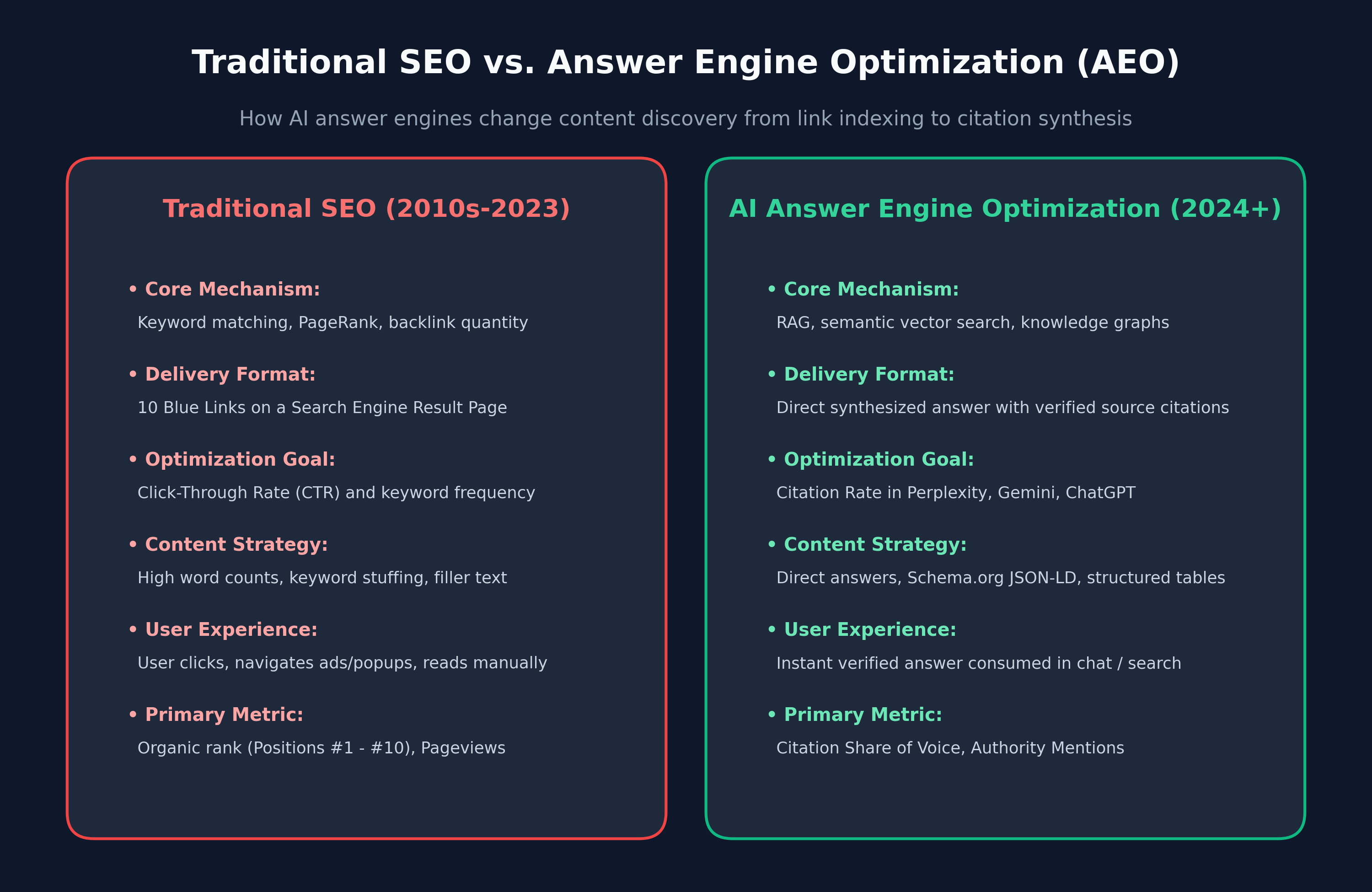
With the rise of AI-native search engines—such as Perplexity, ChatGPT Search, Google AI Overviews, and Claude Artifacts—users no longer click through five different blog posts to manually stitch together an answer. Instead, an AI model reads the web in real-time, extracts pertinent facts, synthesizes a direct response, and appends superscript citations pointing to its primary sources.
This transformation introduces critical challenges for traditional content strategies:
- The Zero-Click Reality: When an AI engine provides a complete answer directly in the chat or search interface, traditional impressions plummet. Websites that depend on ad banners, affiliate pop-ups, or bloated 3,000-word articles with buried answers lose traffic rapidly.
- Punishment for “SEO Fluff”: Traditional SEO incentivized keyword stuffing, repetitive headings, and introductory fluff designed to keep users scrolling. AI retrieval systems (RAG pipelines), however, evaluate text based on semantic density and information gain. Content filled with filler phrases gets down-ranked or ignored during retrieval chunking.
- The Citation Winner-Take-All Dynamic: Unlike a SERP where users might browse positions #1 through #5, an AI answer engine typically cites only 2 to 4 authoritative sources per response. If your content is not structured for machine readability and entity extraction, your domain becomes invisible in the AI discovery loop.
The Solution: The Architecture of AI-Native Answer Engine Optimization
To thrive in the age of conversational search, engineers and content creators must transition from classic SEO to Answer Engine Optimization (AEO).
AEO is the discipline of designing content, metadata, and technical web architecture so that Retrieval-Augmented Generation (RAG) pipelines and LLM web-crawlers recognize your website as the definitive, unambiguous source of truth on a given topic.
How AI Answer Engines Ingest and Cite Content
To optimize for AI engines, it helps to understand their underlying retrieval workflow:
- Query Decomposition: The user enters a question (e.g., “How to handle rate limits in automated data fetching pipelines?”). The AI engine breaks this query into targeted search sub-queries.
- Web Crawling & Extraction: The engine’s bot (e.g., PerplexityBot, GPTBot, Google-Extended) fetches relevant web pages.
- Semantic Chunking & Embedding: The raw HTML is parsed into clean text chunks, stripped of navigation boilerplate, and mapped into vector space.
- Reranking & Information Gain Scoring: The system compares retrieved chunks across multiple websites. It prioritizes chunks that offer high semantic density, direct answers, and verifiable primary facts.
- Synthesis with Source Attribution: The frontier LLM generates the answer, placing inline markdown citations pointing directly to the URLs that provided the supporting data.
The Four Pillars of AEO
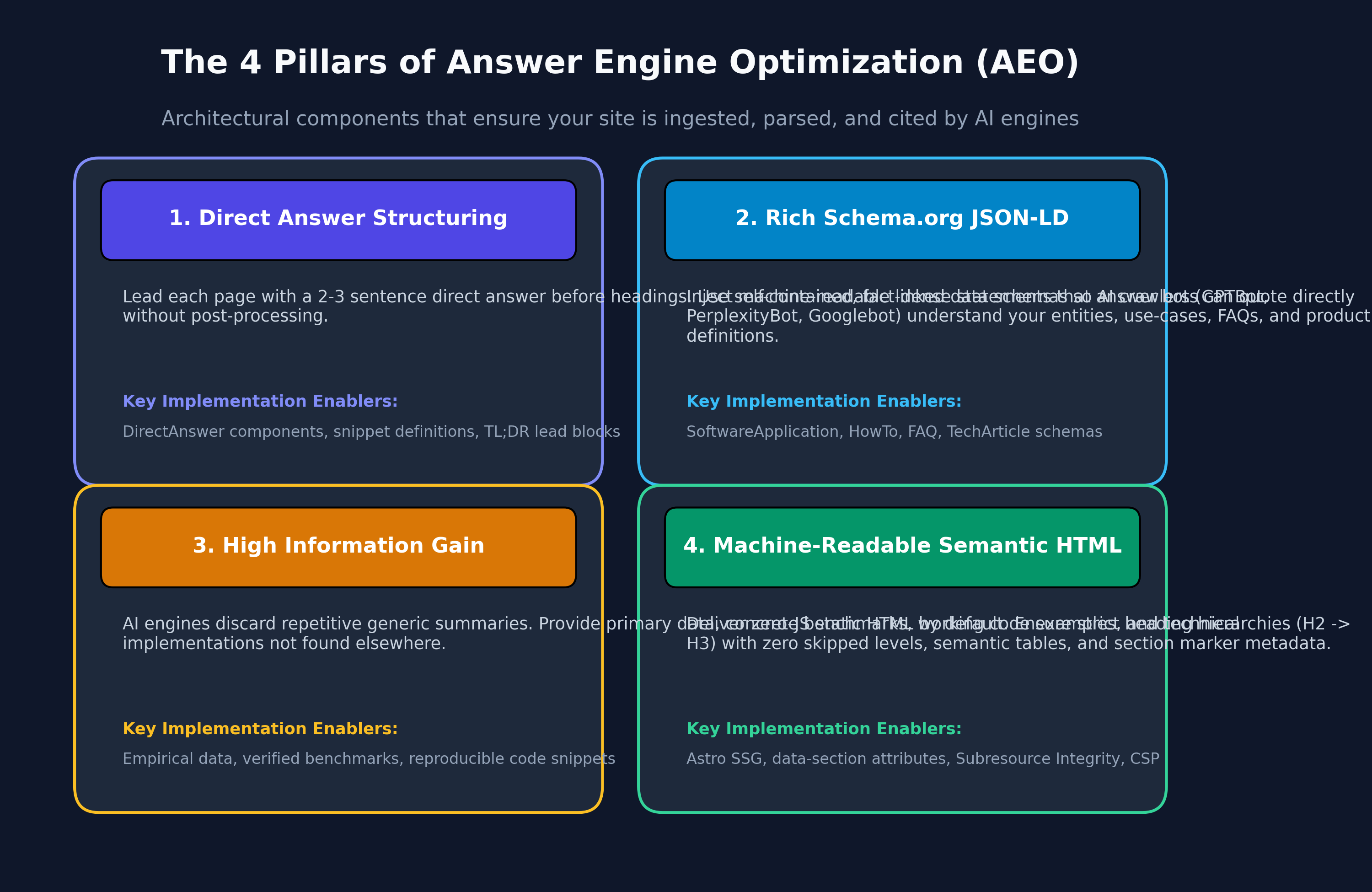
A successful AEO architecture rests on four core pillars:
- Direct Answer Structuring: Placing a concise, fact-dense direct answer (2–3 sentences) at the top of the post before secondary headings. This allows the extractor to lift the definition without parsing through background context.
- Structured Entity Markup (Schema.org JSON-LD): Providing explicit semantic definitions (
SoftwareApplication,HowTo,FAQ,TechArticle) so machines understand the exact nature of your software, parameters, and solutions without ambiguity. - High Information Gain: Providing original technical documentation, verified benchmarks, code examples, and unique workflows rather than generic AI-generated summaries.
- Machine-Readable Semantic HTML: Delivering fast, static, zero-JS HTML by default. AI scrapers often do not run client-side JavaScript or wait for heavy single-page apps (SPAs) to hydrate.
Implementation: Actionable Strategies to Optimize for AI Citations
Transforming a technical blog into an AI authority engine requires deliberate implementation across content design, markup, and deployment configuration.
1. Structure Pages for LLM Chunking
Organize each technical article so that individual sections can stand alone as complete semantic chunks when ingested by a RAG pipeline:
- Lead with the Direct Answer: Use a dedicated component (such as a
<DirectAnswer />block) immediately below the title. This gives AI extractors a drop-in snippet for summarization queries. - Enforce Strict Heading Hierarchy: Start with
##(H2) and descend sequentially to###(H3). Avoid skipping heading levels (e.g., jumping from H2 directly to H4) because heading trees define chunk boundaries in embedding models. - Use Section Markers: Embed machine-readable data attributes (e.g.,
<div class="section-marker" data-section="Problem"></div>) to demarcate problem, solution, and implementation boundaries.
2. Implement Dynamic Schema.org JSON-LD
Search crawlers parse structured data to disambiguate software entities. Inject valid Schema.org JSON-LD into the <head> of each article matching the content type:
{
  "@context": "https://schema.org",
  "@type": "HowTo",
  "name": "How to Optimize for Answer Engines (AEO)",
  "description": "Step-by-step implementation for getting cited by Perplexity, ChatGPT Search, and Gemini.",
  "step": [
    {
      "@type": "HowToStep",
      "name": "Implement Direct Answer Blocks",
      "text": "Place a 2-3 sentence summary at the top of each article for snippet extraction."
    },
    {
      "@type": "HowToStep",
      "name": "Deploy Clean Static HTML",
      "text": "Use an SSG like Astro to deliver server-rendered HTML with zero client-side JavaScript."
    }
  ]
} 3. Ensure Crawler Access in robots.txt
Ensure your web server or edge CDN does not inadvertently block AI search crawlers. Configure your public/robots.txt file to explicitly welcome AI indexing bots:
User-agent: GPTBot
Allow: /

User-agent: PerplexityBot
Allow: /

User-agent: Googlebot
Allow: /

User-agent: Bytespider
Allow: /

User-agent: *
Allow: /

Sitemap: https://blog.aifetchly.com/sitemap-index.xml 4. Optimize for Information Gain Over Word Count
LLM rerankers evaluate Information Gain—how much new, non-redundant information your document contributes relative to already retrieved sources. To maximize your citation probability:
- Include Working Code Snippets: Provide concrete code with syntax highlighting, clear parameter names, and error-handling routines.
- Publish Comparison Matrices: Structured Markdown tables comparing tools, protocols, or benchmarks are easily ingested by AI engines and frequently quoted verbatim.
- Cite Primary Data: Reference specific performance metrics, response times, or architectural trade-offs.
5. Technical Delivery: Static-First, Zero-JS Architecture
AI crawlers operate under aggressive timeout budgets. Heavy React or Vue client-side applications that require JavaScript hydration to render article text often result in blank or truncated crawler fetches.
- Deliver pure static HTML from the edge (using frameworks like Astro 6 deployed to Cloudflare Pages).
- Enforce strict Subresource Integrity (SRI) and Content Security Policy (CSP) headers to ensure high credibility and fast edge delivery.
- Maintain a 100/100 Lighthouse performance and SEO score to guarantee instant crawler responses.
Conclusion
The shift toward AI-native search does not mean the death of web publishing—it represents an evolution toward higher quality and greater technical clarity. By adopting Answer Engine Optimization, you align your content with how modern intelligence systems read, verify, and cite the open web.
Instead of writing for algorithms that count keywords, AEO empowers you to write for reasoning engines that reward authority, precision, and verified solutions.