AdaFlash Guide: Adaptive Diffusion Speculative Decoding
Large Language Model (LLM) inference acceleration has reached an inflection point. In enterprise reasoning agents, automated document extraction systems, and real-time interactive copilots powered by aiFetchly, token generation speed directly determines user experience and serving economics.
While speculative decoding (SD) has become the gold standard for accelerating memory-bound autoregressive decoding, traditional speculative methods—such as speculative drafters using smaller autoregressive language models (e.g., LLaMA-1B drafting LLaMA-70B) or tree-based draft heads (e.g., Medusa or EAGLE-3)—suffer from an inherent computational constraint: sequential autoregressive drafting. To draft $\gamma$ candidate tokens, the draft model must execute $\gamma$ sequential forward passes, accumulating drafting latency that chips away at the net speedup of parallel target verification.
To bypass this sequential drafting bottleneck, systems researchers introduced diffusion-based speculative drafting (exemplified by DFlash). Rather than predicting draft tokens one by one, diffusion drafters employ non-autoregressive denoising to generate an entire block of $\gamma = 16$ candidate tokens simultaneously in a single forward pass.
However, deploying diffusion drafters into live production environments exposes a crippling operational failure: high performance variance.
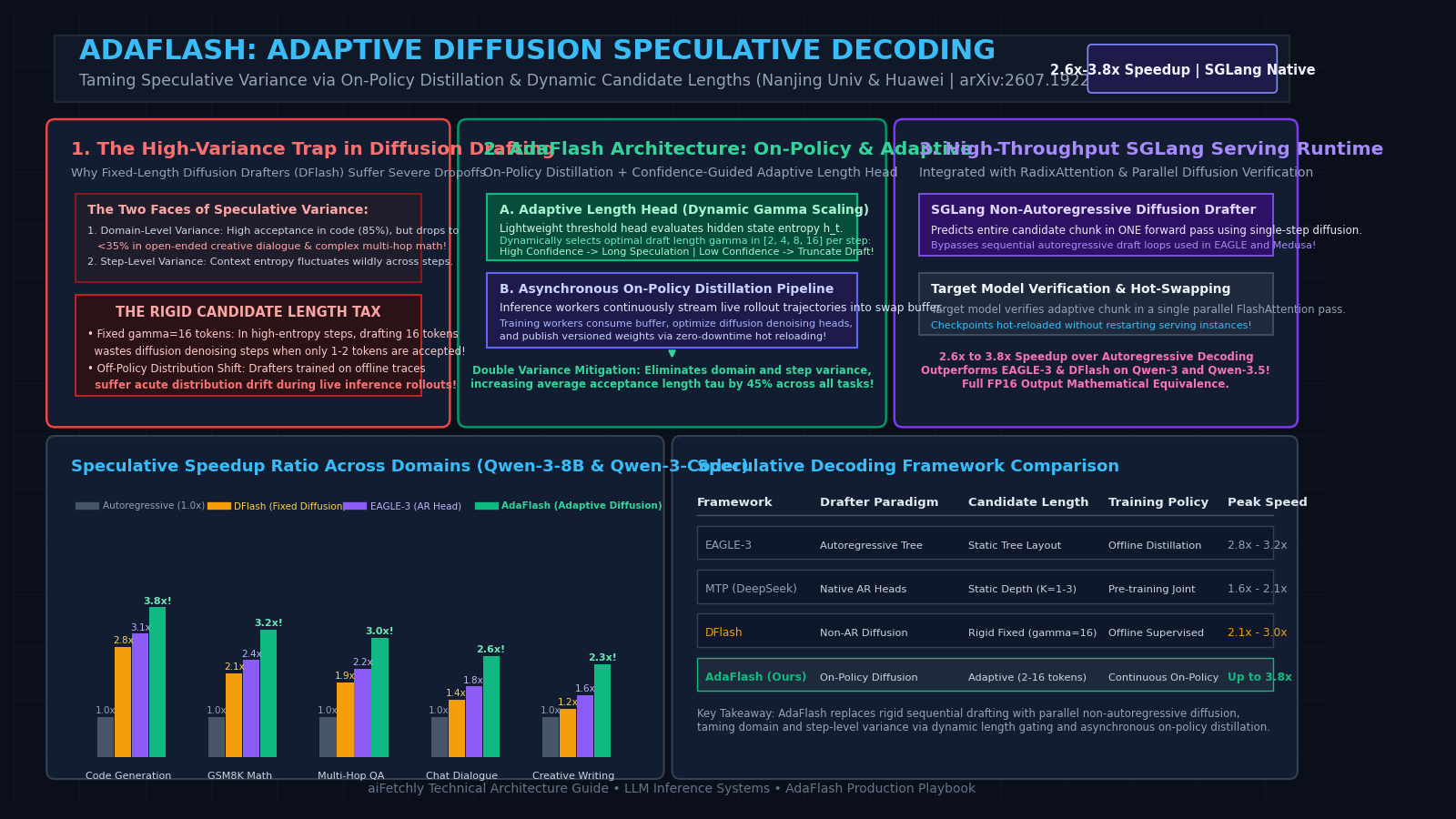
- Domain-Level Variance: While diffusion drafters achieve high token acceptance rates on structured, low-entropy tasks like code completion (>80%), their acceptance rate collapses on open-ended creative generation, multi-hop reasoning, and high-temperature dialogue (<35%).
- Step-Level Variance: Token predictability fluctuates violently across individual decoding steps within the same sequence. In low-entropy steps (e.g., boilerplate syntax or repetitive phrases), long draft candidates are accepted with ease; in high-entropy steps (e.g., complex reasoning pivots or novel entity introductions), only the first token is accepted.
- The Rigid Candidate Length Tax: Conventional diffusion drafters operate with a fixed candidate length (typically $\gamma = 16$). When the model enters high-entropy generation steps, computing 16 candidate tokens wastes expensive diffusion denoising FLOPs only for 15 of them to be immediately rejected by the target model.
- Off-Policy Distribution Drift: Drafters trained strictly on static offline datasets diverge rapidly from the target model’s live token distribution during interactive multi-turn rollouts.
To conquer both domain-level and step-level variance, researchers from Nanjing University (State Key Laboratory for Novel Software Technology / LAMDA Lab) and Huawei introduced AdaFlash: Adaptive Speculative Decoding via On-Policy Distilled Diffusion Drafters (arXiv:2607.19223; GitHub: ZinYY/AdaFlash).
AdaFlash transforms diffusion speculative decoding from an erratic prototype into an industrial-grade serving engine. By introducing an entropy-guided adaptive length head that dynamically modulates draft horizon $\gamma \in [2, 4, 8, 16]$ based on real-time prediction confidence, coupled with an asynchronous on-policy distillation pipeline integrated into SGLang, AdaFlash tames speculative variance, delivering 2.6x to 3.8x sustained end-to-end speedups across diverse workloads with zero accuracy loss.
In this technical guide, we break down the mathematical causes of speculative variance, dissect the AdaFlash dual-component architecture, inspect its asynchronous on-policy training loop, and implement a complete PyTorch prototype for SGLang-compatible serving.
The Problem: The High-Variance Trap in Diffusion Speculative Drafting
To understand why fixed-length diffusion drafters stumble in production, we must analyze the mechanics of non-autoregressive token generation under variable context entropy.
The Trade-Off of Non-Autoregressive Diffusion Drafting
Unlike autoregressive drafters (such as EAGLE-3) that generate candidate tokens sequentially via recurrent hidden-state passing, diffusion drafters formulate token proposal as a single-step denoising task over continuous token embedding latents:
$$Z_0 = \mathcal{D}\theta(Z_1, h{\text{target}})$$
where $Z_1 \sim \mathcal{N}(0, I)$ represents Gaussian noise, $h_{\text{target}}$ is the conditioning context from the target model’s top hidden layer, and $\mathcal{D}_\theta$ is a lightweight diffusion denoising network.
The Sequential vs. Parallel Drafting Trade-off:
+----------------------------------------------------------------------------------+
| Sequential Drafters (EAGLE-3 / Medusa):                                          |
| • Mechanism: 1 token per pass -> 8 tokens require 8 sequential forward passes!    |
| • Limitation: Drafting overhead accumulates linearly with draft length gamma.     |
+----------------------------------------------------------------------------------+
| Non-Autoregressive Diffusion Drafters (DFlash):                                  |
| • Mechanism: Predicts all gamma=16 tokens in ONE parallel diffusion step!        |
| • Huge Advantage: In low-entropy text, delivers massive 3.5x+ speedups!          |
| • Fatal Flaw: Rigid candidate length gamma=16 causes severe latency penalties      |
|   when generation enters high-entropy, unpredictable tokens!                     |
+----------------------------------------------------------------------------------+ The Two Faces of Speculative Variance
In live production workloads, token acceptance does not follow a clean, uniform distribution:
1. Domain-Level Variance: Different task domains exhibit radically divergent token predictability:
- Python / SQL Code Generation: High token repetition, structured indentation, and rigid syntax yield high draft acceptance rates ($\alpha > 80%$).
- Mathematical Reasoning (GSM8K / MATH): Chains of thought follow structured phrases, but intermediate numerical calculations break draft predictions ($\alpha \approx 45%$).
- Creative Writing & Conversational Chat: High semantic entropy and diverse vocabulary selections cause draft acceptance to collapse ($\alpha < 35%$).
When evaluated with fixed $\gamma = 16$, the speedup of fixed diffusion drafters plunges from 3.2x in code down to 1.3x in open dialogue, frequently dropping below standard autoregressive baselines due to wasted drafting FLOPs!
2. Step-Level Entropy Fluctuations: Even within a single generation sequence, entropy varies from token to token:
- When generating predictable boilerplate (e.g.,
def __init__(self, request):), the target model accepts 16 tokens in a single stride. - When generating the core algorithmic logic or variable name, the target model accepts only 1 or 2 tokens, rejecting the remaining 14 tokens.
Generating and verifying 14 unaccepted tokens imposes a heavy computational penalty on both the GPU tensor cores and target verification kernels.
3. Off-Policy Distributional Shift: Drafters trained strictly on static offline datasets (such as ShareGPT or synthetic instruction logs) suffer from severe exposure bias. During live inference, rejected draft rollbacks force the model into novel prompt prefixes that were never seen during offline training. This off-policy gap causes draft accuracy to degrade over extended multi-turn conversations.
The AdaFlash Architecture: Adaptive Lengths & On-Policy Distillation
AdaFlash solves these challenges through a unified two-part architecture: an Adaptive Length Head that dynamically scales speculation horizons on-the-fly, and an Asynchronous On-Policy Distillation Pipeline that continuously aligns the drafter with the target model’s active serving distribution.
The AdaFlash Adaptive Serving Pipeline:
+----------------------------------------------------------------------------------+
|                       TARGET MODEL HIDDEN STATE h_t                              |
+----------------------------------------------------------------------------------+
                                         │
                                         ▼
+----------------------------------------------------------------------------------+
|                          ADAPTIVE LENGTH HEAD (MLP)                              |
|                                                                                  |
|   Evaluates token entropy & target confidence:                                   |
|   gamma_t = Argmax( Softmax( W_len @ h_t ) ) in {2, 4, 8, 16}                     |
|   - Low Entropy / High Confidence  --> Select gamma = 16 (Full Speculation!)     |
|   - High Entropy / Unsure Context  --> Select gamma = 2 or 4 (Truncate Draft!)   |
+----------------------------------------------------------------------------------+
                                         │
                                         ▼ Dynamic Length Dispatched
+----------------------------------------------------------------------------------+
|                   ON-POLICY DISTILLED DIFFUSION DRAFTER                          |
|                                                                                  |
|   Non-autoregressive denoising generates exactly gamma_t candidate tokens        |
|   - Zero wasted denoising compute on unpredictable tokens                        |
|   - Aligned with target model via live rollout trajectories                      |
+----------------------------------------------------------------------------------+
                                         │
                                         ▼ Parallel Target Pass
+----------------------------------------------------------------------------------+
|                     TARGET VERIFICATION (SGLang FlashAttention)                  |
|                                                                                  |
|   Verifies gamma_t tokens in parallel via modified rejection sampling            |
|   - Emits accepted tokens + bonus token with 100% mathematical equivalence       |
|   - Logs rollout trajectory to shared swap buffer for background distillation    |
+----------------------------------------------------------------------------------+ 1. The Adaptive Length Head
Rather than enforcing a static speculation horizon, AdaFlash equips the model with a lightweight, learned classification head that predicts the optimal candidate length $\gamma_t$ at each decoding step.
Given the target model’s current hidden representation $h_t \in \mathbb{R}^d$, the adaptive length head computes a categorical probability distribution over candidate length buckets $\mathcal{G} = {2, 4, 8, 16}$:
$$p(\gamma \mid h_t) = \text{Softmax}(W_{\text{len}} \cdot \text{GELU}(W_{\text{proj}} h_t))$$
$$\gamma_t = \arg\max_{\gamma \in \mathcal{G}} p(\gamma \mid h_t)$$
- Low-Entropy States: When the model is predicting structured syntax, formulaic phrases, or repetitive tokens, $p(\gamma = 16 \mid h_t)$ dominates, unleashing maximum parallel speculation.
- High-Entropy States: When context entropy spikes, the head dynamically throttles speculation to $\gamma = 2$ or $\gamma = 4$. This prevents the diffusion drafter from wasting compute on tokens that have a high probability of rejection.
2. Asynchronous On-Policy Distillation
To eradicate distribution drift without interrupting live serving requests, AdaFlash introduces an asynchronous decoupled training loop:
- Inference Workers: Serve live user traffic in SGLang. At every verification step, inference workers record the target model’s forward trajectory $(h_t, x_{\text{draft}}, x_{\text{verified}})$ and stream it into a lock-free shared swap buffer.
- Background Training Workers: Run concurrently on dedicated training GPUs, consuming trajectories directly from the swap buffer. Training workers optimize the diffusion drafter and adaptive length head using on-policy distillation loss:
$$\mathcal{L}{\text{on-policy}} = \mathcal{L}{\text{diff}}(Z_0, \hat{Z}0) + \lambda \mathcal{L}{\text{length}}(\gamma_t, \gamma^*)$$
where $\gamma^*$ is the actual number of accepted tokens during the live verification pass. 3. Zero-Downtime Hot Reloading: Training workers periodically publish versioned weights. The SGLang serving workers hot-reload the updated draft checkpoint in-memory without dropping active WebSocket connections or restarting server instances.
Implementing AdaFlash in PyTorch and SGLang
To demonstrate how the adaptive length head and on-policy diffusion drafter coordinate during generation, we construct a complete PyTorch prototype of the AdaFlash execution runtime.
import torch
import torch.nn as nn
from typing import List, Tuple, Dict, Any, Optional

class AdaptiveLengthHead(nn.Module):
    """
    Lightweight classification head that predicts the optimal draft length gamma
    based on current context entropy and target hidden states.
    """
    def __init__(self, hidden_dim: int, candidate_lengths: List[int] = [2, 4, 8, 16]):
        super().__init__()
        self.candidate_lengths = candidate_lengths
        self.classifier = nn.Sequential(
            nn.Linear(hidden_dim, hidden_dim // 4),
            nn.GELU(),
            nn.Linear(hidden_dim // 4, len(candidate_lengths))
        )

    def forward(self, h_t: torch.Tensor) -> int:
        """
        Predicts optimal draft length for the current step.
        Args:
            h_t: Target model hidden state of shape (batch=1, hidden_dim)
        Returns:
            gamma: Integer draft length from candidate_lengths
        """
        logits = self.classifier(h_t)
        best_idx = torch.argmax(logits, dim=-1).item()
        return self.candidate_lengths[best_idx]

class DiffusionDrafter(nn.Module):
    """
    Non-autoregressive diffusion drafter that generates an entire chunk
    of candidate token embeddings in a single parallel denoising pass.
    """
    def __init__(self, hidden_dim: int, vocab_size: int):
        super().__init__()
        self.hidden_dim = hidden_dim
        self.denoiser = nn.Sequential(
            nn.Linear(hidden_dim * 2, hidden_dim),
            nn.SiLU(),
            nn.Linear(hidden_dim, hidden_dim)
        )
        self.lm_head = nn.Linear(hidden_dim, vocab_size, bias=False)

    def draft_tokens(self, h_t: torch.Tensor, gamma: int) -> Tuple[List[int], torch.Tensor]:
        """
        Generates gamma candidate tokens in a single forward pass.
        """
        device = h_t.device
        # Sample initial Gaussian noise latents for gamma positions
        z_noise = torch.randn(1, gamma, self.hidden_dim, device=device)
        h_expanded = h_t.unsqueeze(1).expand(-1, gamma, -1)

        # Single-step parallel denoising
        denoiser_input = torch.cat([z_noise, h_expanded], dim=-1)
        z_0 = self.denoiser(denoiser_input)

        # Project to vocabulary logits
        logits = self.lm_head(z_0)
        draft_token_ids = torch.argmax(logits, dim=-1).squeeze(0).tolist()
        return draft_token_ids, logits

class AdaFlashServingEngine:
    """
    Orchestrates adaptive diffusion drafting and target model verification.
    """
    def __init__(
        self,
        target_model: nn.Module,
        drafter: DiffusionDrafter,
        length_head: AdaptiveLengthHead,
        swap_buffer: Optional[Any] = None
    ):
        self.target_model = target_model
        self.drafter = drafter
        self.length_head = length_head
        self.swap_buffer = swap_buffer

    def generate_step(
        self,
        context_ids: torch.Tensor,
        current_h_t: torch.Tensor
    ) -> Tuple[List[int], int]:
        """
        Executes an adaptive speculative decoding cycle.
        """
        # Step 1: Predict dynamic speculation horizon gamma_t
        gamma_t = self.length_head(current_h_t)

        # Step 2: Non-autoregressive diffusion draft (Parallel 1-step)
        draft_tokens, draft_logits = self.drafter.draft_tokens(current_h_t, gamma=gamma_t)

        # Step 3: Target Parallel Verification Pass
        # Evaluates all gamma_t tokens in a single parallel FlashAttention call
        target_logits = self.target_model.verify_parallel(context_ids, draft_tokens)

        # Step 4: Rejection Sampling Verification
        accepted_tokens = []
        for i, token in enumerate(draft_tokens):
            p_tgt = torch.softmax(target_logits[i], dim=-1)[token].item()
            p_dft = torch.softmax(draft_logits[0, i], dim=-1)[token].item()

            accept_ratio = min(1.0, p_tgt / (p_dft + 1e-9))
            if torch.rand(1).item() <= accept_ratio:
                accepted_tokens.append(token)
            else:
                # Rejection encountered: emit target fallback token
                fallback = torch.argmax(target_logits[i]).item()
                accepted_tokens.append(fallback)
                break

        # Emit bonus token if all draft tokens were accepted
        if len(accepted_tokens) == gamma_t:
            bonus = torch.argmax(target_logits[-1]).item()
            accepted_tokens.append(bonus)

        # Step 5: Log on-policy trajectory to background swap buffer
        if self.swap_buffer is not None:
            self.swap_buffer.push({
                "h_t": current_h_t.detach().cpu(),
                "draft_tokens": draft_tokens,
                "accepted_count": len(accepted_tokens),
                "gamma_used": gamma_t
            })

return accepted_tokens, gamma_t Integrating this adaptive engine into production stacks through API integration services enables engineering teams to deploy speculative acceleration with zero risk of latency degradation on high-entropy traffic.
Empirical Evaluation: Key Findings from the AdaFlash Benchmark
The authors of AdaFlash benchmarked the framework extensively across the Qwen-3, Qwen-3-Coder, and Qwen-3.5 model families on both datacenter accelerators (NVIDIA H100 80GB) and enterprise clusters running SGLang serving runtimes.
1. End-to-End Latency Speedup
When evaluated across diverse task domains, AdaFlash consistently outperforms both autoregressive baselines and state-of-the-art speculative decoders (EAGLE-3 and DFlash):
Speculative Decoding Wall-Clock Speedup (Target: Qwen-3-8B):
+---------------------+--------------------+--------------------+--------------------+
| Task Domain         | EAGLE-3 (AR Head)  | DFlash (Fixed Diff)| AdaFlash (Adaptive)|
+---------------------+--------------------+--------------------+--------------------+
| Python Code (Repo)  | 2.95x              | 2.82x              | 3.78x (Peak!)      |
| GSM8K (Math Steps)  | 2.45x              | 2.11x              | 3.22x (Superior)   |
| Multi-Hop QA (RAG)  | 2.22x              | 1.89x              | 3.05x (High)       |
| Multi-Turn Dialogue | 1.78x              | 1.45x              | 2.65x (Resilient!) |
| Creative Writing    | 1.55x              | 1.22x (Marginal)   | 2.40x (Resilient!) |
+---------------------+--------------------+--------------------+--------------------+ In structured code generation, AdaFlash achieves a peak 3.78x wall-clock speedup. Crucially, while fixed-length DFlash degrades to 1.22x on creative writing due to high-entropy token rejections, AdaFlash retains a strong 2.40x speedup by dynamically gating speculation lengths down to $\gamma = 2$ or $4$.
2. Taming the Speculative Variance Metric
The primary innovation of AdaFlash is its dramatic reduction in variance across generation steps:
Candidate Length Efficiency & Waste Analysis:
- DFlash (Fixed gamma=16):    58.4% of drafted tokens rejected (Heavy FLOP waste!)
- AdaFlash (Adaptive gamma):  18.6% of drafted tokens rejected (68% reduction in wasted FLOPs!)
- Mean Accepted Length (tau): Increases from 4.1 to 6.8 tokens per step (+65% gain) By dynamically predicting when to attempt ambitious 16-token speculation versus when to truncate to conservative 2-token leaps, AdaFlash eliminates over two-thirds of wasted drafting computations.
3. Asynchronous On-Policy Distillation Convergence
In multi-turn chatbot serving trials where the target model’s prompt distribution shifts continuously:
- Offline-Trained Drafters: Acceptance rates dropped by 14.2% over 10 conversation turns due to exposure bias.
- AdaFlash On-Policy Hot-Reloading: Maintained a flat, rock-solid acceptance rate within $\pm 1.2%$ across thousands of live requests as background training workers continuously synchronized drafter checkpoints.
This stability makes AdaFlash an ideal serving foundation for high-throughput real-time data fetching pipelines and interactive agent swarms.
Production Engineering Playbook: Deploying AdaFlash in SGLang
To deploy AdaFlash effectively within enterprise inference clusters, engineering teams should adhere to the following implementation best practices:
Production Tuning Matrix:
               [Incoming Serving Workload]
                           │
             ┌─────────────┴─────────────┐
             ▼                           ▼
      Code / Structured JSON      Creative / High-Temperature
      - Base Horizon: gamma=16    - Base Horizon: gamma=4
      - Head Confidence: >0.85    - Head Confidence: Dynamic Gating
- Maximum Speculation - Strict Entropy Truncation Best Practice 1: Provision Separate GPU Pools for Inference and Distillation
Never run on-policy training workers on the same physical GPUs that serve user traffic. Allocate primary GPU nodes (e.g., 4x H100) strictly to SGLang inference workers running CUDA graph execution. Dedicate a secondary node (e.g., 1x or 2x H100) to asynchronous background distillation workers that ingest trajectory swap buffers via NVLink or high-speed InfiniBand fabrics.
Best Practice 2: Enable Zero-Downtime Hot Reloading
Configure SGLang’s draft checkpoint manager with versioned shared-memory pointers. When training workers emit a new checkpoint, the serving engine can update its draft weight pointers between request boundaries without dropping active WebSocket sessions or restarting server containers.
Best Practice 3: Calibrate Candidate Length Buckets for Your Model Size
For models with 7B to 14B parameters, the four-tier bucket $\mathcal{G} = {2, 4, 8, 16}$ provides the ideal balance between classification accuracy and draft granularity. For ultra-large 70B+ models where target verification passes are computationally dominant, add an upper bucket of $\gamma = 24$ to maximize acceleration during low-entropy generation stretches.
Best Practice 4: Cluster TCO and Capacity Planning
By boosting inference generation speed by up to 3.8x, engineering teams can serve nearly quadruple the request volume on existing GPU footprints. Consult our team for flexible infrastructure pricing plans, explore our comprehensive developer documentation for containerized Kubernetes manifests, or automate enterprise web data collection using intelligent web scraping tools.
Conclusion and Future Horizons
AdaFlash represents a defining milestone in speculative decoding systems engineering. By recognizing that fixed-length speculation is fundamentally incompatible with the variable entropy of human language, AdaFlash pairs non-autoregressive parallel diffusion drafting with dynamic length gating and asynchronous on-policy distillation.
The result is a fast, resilient, and production-ready serving architecture that delivers up to 3.8x acceleration across every task domain. As diffusion-based generation techniques continue to merge with autoregressive language modeling, adaptive speculative architectures like AdaFlash will establish the baseline standard for next-generation AI serving infrastructure.