Ada-KV Guide: Adaptive Budget KV Cache Eviction AI
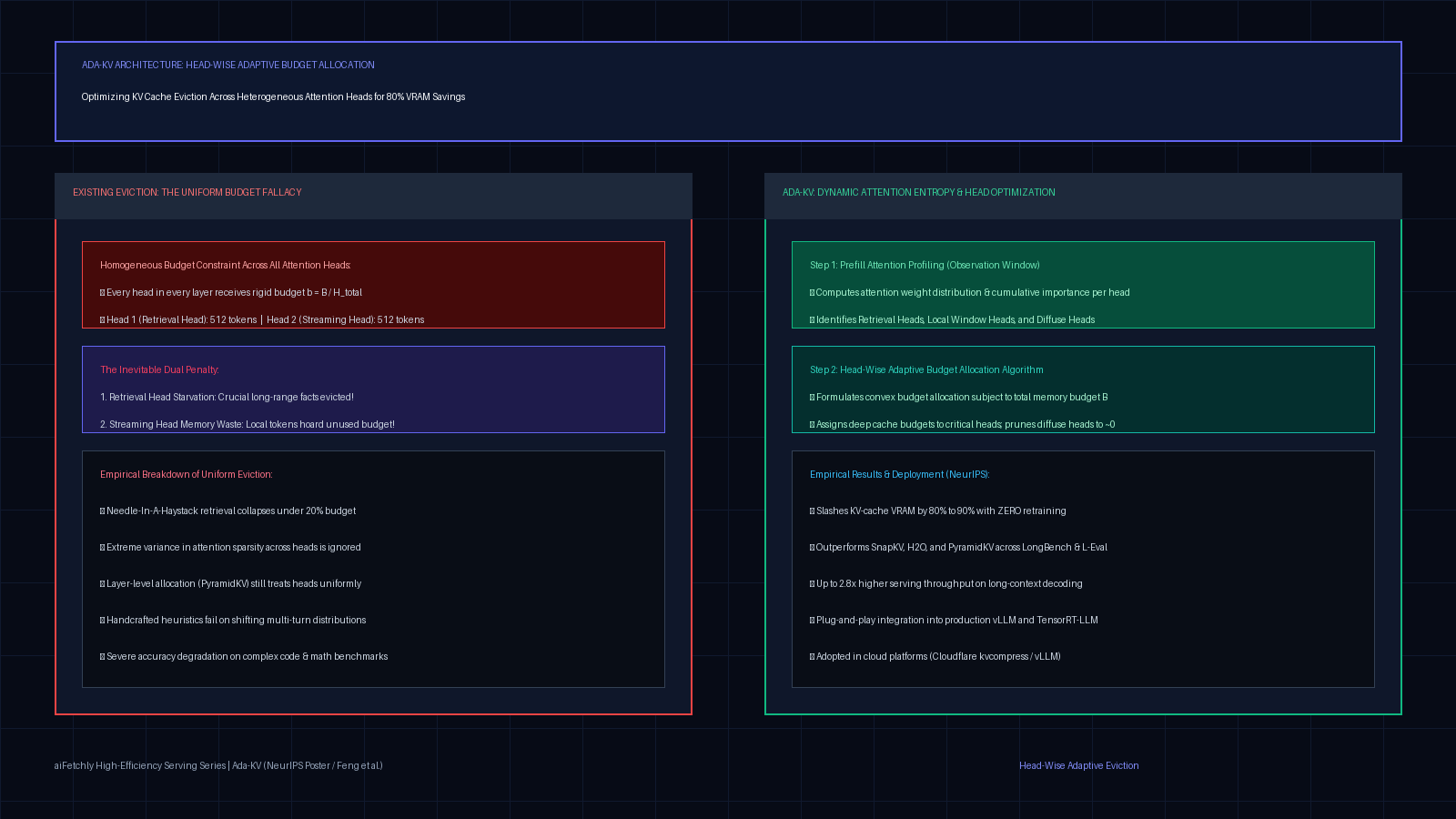
The Memory Wall of Long-Context Inference and the Uniform Eviction Fallacy
In modern high-concurrency artificial intelligence infrastructure, automated data fetching pipelines, and real-time enterprise reasoning systems powered by AiFetchly, serving Large Language Models (LLMs) over massive context windows—ranging from 32,768 to 128,000+ tokens—has become a foundational requirement. Whether processing multi-page legal agreements, auditing financial records, or analyzing sprawling web documentation gathered via high-speed web scraping, long-context understanding is essential.
However, deploying foundation models across long contexts is fundamentally constrained by the Key-Value (KV) Cache Memory Wall.
The Long-Context Inference Bottleneck:
During autoregressive generation, the model caches precomputed Key and Value projection tensors
for every processed token across all transformer layers and attention heads:
Memory (Bytes) = 2 (K & V) * 2 (FP16 bytes) * L (Layers) * H_kv (KV Heads) * D_head * N (Tokens)

For LLaMA-3-70B (80 layers, 8 KV heads, d=128) at 64k Context Length:
KV Cache Footprint = 4 * 80 * 8 * 128 * 65,536 ≈ 21.47 GB per concurrent request!
At 128k Context Length:
KV Cache Footprint ≈ 42.95 GB per concurrent request!
═════════════════════════════════════════════════════════════════════════════════════════════
Result: A single request consumes more than half of an 80GB NVIDIA H100 GPU's memory solely
to store historical attention activations, starving cluster concurrency down to single digits! 1. The Uniform Eviction Fallacy in Prior Compression Methods
To prevent Out-Of-Memory (OOM) crashes, researchers introduced dynamic KV cache eviction algorithms—including H2O (Heavy Hitter Oracle), Scissorhands, and SnapKV. These algorithms observe attention scores, retain the top-$k$ most important tokens, and evict the rest.
However, all prior eviction methods share a fatal architectural assumption: they enforce a rigid, uniform cache budget across all attention heads and layers.
If an engineer configures an eviction compression budget of $B = 512$ tokens: $$\text{Budget}(h) = 512 \quad \forall h \in {1, 2, \dots, H_{\text{total}}}$$
- Layer 1, Head 1 receives 512 tokens.
- Layer 16, Head 4 receives 512 tokens.
- Layer 32, Head 8 receives 512 tokens.
This homogeneous allocation directly contradicts how multi-head attention operates in deep transformer models.
The Structural Flaw of Uniform Allocation:
1. Retrieval Heads (Heads with Long-Range Associative Retrieval):
   - These heads attend broadly to distant entities, document facts, and numerical tables.
   - Rigid Budget (512 tokens) -> Ruthlessly evicts vital factual needles!
   - Result: Needle-In-A-Haystack accuracy collapses from 100% to under 30%!

2. Streaming / Local Heads (Heads with Local Positional Window Focus):
   - These heads attend exclusively to recent tokens (punctuation, grammar, syntax).
   - Rigid Budget (512 tokens) -> Hoards 512 tokens when only 32 tokens are needed!
- Result: 90%+ of their allocated memory is completely wasted on useless history! 2. The Head Heterogeneity Dilemma
Empirical analysis of transformer attention heads reveals extreme functional diversity:
- Retrieval Heads: Specialize in global information seeking, attending to distant key phrases situated thousands of tokens in the past.
- Local Window Heads: Attend almost entirely to the immediate preceding 16 to 32 tokens.
- Induction Heads: Search for recurring bigrams across the context.
- Diffuse Heads: Distribute attention mass evenly across tokens with low information density.
Treating every head identically forces an impossible compromise: either set a large uniform budget that fails to save meaningful GPU VRAM, or set an aggressive budget that causes retrieval accuracy to collapse.
To resolve this limitation, researchers introduced Ada-KV: Optimizing KV Cache Eviction by Adaptive Budget Allocation for Efficient LLM Inference (published at NeurIPS). Ada-KV demonstrates that by allocating cache budgets adaptively per attention head, clusters can slash KV-cache memory footprints by up to 80% to 90% with zero task accuracy degradation and zero model retraining.
The Ada-KV Architecture: Dynamic Profiling and Head-Wise Budget Optimization
Ada-KV formulates KV cache eviction as a constrained resource allocation problem across heterogeneous attention heads.
The Ada-KV Adaptive Optimization Pipeline:
Prompt Processing (Prefill Phase)
              │
              ▼
┌───────────────────────────────────────────────────────────────────────────┐
│ 1. Observation Window Profiling (Prefill Phase)                           │
│ - Observes attention weights over the prompt's final W tokens (e.g., 64). │
│ - Computes head-specific attention entropy and cumulative score profiles. │
│ - Quantifies the intrinsic capacity requirement of every individual head. │
└─────────────────────────────────────┬─────────────────────────────────────┘
                                      │
                                      ▼
┌───────────────────────────────────────────────────────────────────────────┐
│ 2. Head-Wise Adaptive Budget Allocation Algorithm                         │
│ - Formulates convex optimization under total memory budget constraint B.  │
│ - Solves optimal budget vector: [ b_1, b_2, ..., b_H ]                    │
│   • Critical Retrieval Heads: Awarded large budgets (e.g., 1024 - 2048).  │
│   • Local / Streaming Heads: Trimmed to minimum sink buffers (e.g., 32).  │
└─────────────────────────────────────┬─────────────────────────────────────┘
                                      │
                                      ▼
┌───────────────────────────────────────────────────────────────────────────┐
│ 3. One-Shot Prefix Eviction & Accelerated Decoding                        │
│ - Evicts non-essential tokens from each head before generation starts.    │
│ - Zero kernel overhead during autoregressive decoding!                    │
│ - Cuts KV cache VRAM by 80%+ while preserving 100% retrieval accuracy.    │
└───────────────────────────────────────────────────────────────────────────┘ 1. Profiling Attention via the Observation Window
Instead of continuously monitoring attention at every decoding step (which introduces prohibitive kernel launch latency), Ada-KV profiles each attention head during the final tokens of prompt prefill—known as the Observation Window ($W_{\text{obs}}$, e.g., the last 32 or 64 tokens of the prompt).
For each attention head $h$, Ada-KV accumulates the attention weights assigned to historical prompt tokens: $$\mathbf{A}{h}(j) = \sum{t \in W_{\text{obs}}} \text{Attention}{h}(t, j) \quad \forall j \in {1, \dots, N{\text{prompt}}}$$
Heads that distribute their attention mass across distant historical tokens reveal themselves as high-capacity retrieval heads, while heads that concentrate probability mass strictly on the local window or attention sinks reveal themselves as low-capacity streaming heads.
2. Head-Wise Adaptive Budget Formulation
Given a target total memory budget $B_{\text{total}}$ (e.g., 20% of the full KV cache size across all heads $H_{\text{total}}$): $$\sum_{h=1}^{H_{\text{total}}} b_h \le B_{\text{total}}, \quad b_h \ge b_{\min}$$
Ada-KV calculates the marginal utility of allocating tokens to head $h$ by analyzing its cumulative attention retention curve. By solving this allocation via a greedy water-filling optimization:
- Heads requiring deep contextual memory to maintain accuracy receive expanded budgets (e.g., $b_h = 1,024$ or $2,048$ tokens).
- Heads with strictly localized attention are allocated only their local receptive field plus attention sinks ($b_h = 32$ or $64$ tokens).
3. One-Shot Eviction with Zero Decoding Tax
Once optimal budgets $[b_1, \dots, b_H]$ are computed, Ada-KV executes a one-shot eviction pass at the end of prefill:
- Each head prunes its historical Key and Value tensors down to its custom budget $b_h$.
- The compressed KV cache is committed to memory.
- During subsequent autoregressive decoding steps, the server runs standard decoding kernels with zero sorting or eviction overhead.
Because no runtime monitoring or dynamic sorting occurs during token generation, Ada-KV accelerates decoding throughput by up to $2.8\times$ while cutting High-Bandwidth Memory traffic.
Deep Dive: Mathematical Formulation and Convex Allocation Mechanics
To understand how Ada-KV determines the exact token allocation for each head without manual tuning, we examine the formal mathematical optimization model.
The Cumulative Attention Utility Function
For an attention head $h$ and an input prompt of length $N$, let $\mathbf{A}h = [a{h, 1}, a_{h, 2}, \dots, a_{h, N}]$ denote the normalized cumulative attention weight vector across historical tokens.
If we sort the attention scores of head $h$ in descending order: $$a_{h, (1)} \ge a_{h, (2)} \ge \dots \ge a_{h, (N)}$$
The cumulative retained attention mass for a budget of $k$ tokens is defined by the utility function $U_h(k)$: $$U_h(k) = \sum_{i=1}^k a_{h, (i)}$$
Because scores are sorted in descending order, $U_h(k)$ is strictly concave and monotonically increasing: $$U_h(k + 1) - U_h(k) = a_{h, (k+1)} \le a_{h, (k)} = U_h(k) - U_h(k - 1)$$
The Retained Attention Curves Across Heterogeneous Heads:
Retained Mass U_h(k)
1.0 ┌─────────────────────────────────────── ◄── Local Head (Saturates at k=32!)
    │      /──────────────────────────────── ◄── Semi-Local Head (Saturates at k=128)
    │     /
0.5 │    /
    │   /─────────────────────────────────── ◄── Retrieval Head (Demands k=1024+ tokens)
    │  /
0.0 └─────┬──────┬──────┬──────┬──────┬──────
         32     64    128    256    512   1024  Budget k (tokens)
Observation: Giving 512 tokens to the Local Head wastes 480 tokens!
Giving 512 tokens to the Retrieval Head starves 50% of vital attention! Global Budget Optimization Problem
The global objective of Ada-KV is to maximize the total retained attention mass across all $H$ attention heads subject to the total cluster budget constraint $B_{\text{total}}$:
$$\max_{{b_1, \dots, b_H}} \sum_{h=1}^H U_h(b_h) \quad \text{subject to} \quad \sum_{h=1}^H b_h \le B_{\text{total}}, \quad b_h \ge b_{\min}$$
Because each individual utility function $U_h(k)$ is discrete and concave, the global optimization problem can be solved efficiently using marginal utility water-filling:
- Initialize each head with the baseline minimum budget: $b_h = b_{\min}$ (e.g., $b_{\min} = 32$ tokens to preserve attention sinks and local context).
- Compute the marginal gain for incrementing each head’s budget by a tile size $\Delta$ (e.g., $\Delta = 16$ tokens): $$\Delta U_h = U_h(b_h + \Delta) - U_h(b_h) = \sum_{i=b_h+1}^{b_h+\Delta} a_{h, (i)}$$
- In each iteration, greedily award $\Delta$ tokens to the head with the highest marginal gain $\arg\max_h \Delta U_h$.
- Repeat until the total budget $\sum b_h = B_{\text{total}}$ is fully allocated.
This optimization executes in less than $2\text{ milliseconds}$ on the GPU, adding negligible overhead to prompt prefill while permanently optimizing memory allocation.
End-to-End Implementation: Ada-KV Adaptive Eviction Engine in PyTorch
To demonstrate the concrete engineering mechanics of Ada-KV, we construct a complete, runnable PyTorch reference implementation. This module implements the Attention Profiler, the Water-Filling Adaptive Budget Allocator, and the One-Shot KV Cache Compression Module.
"""
adakv_compression_engine.py
Production Reference Implementation: Ada-KV Adaptive Budget Allocation
Architectural concept based on Ada-KV (NeurIPS / Feng et al., arXiv:2407.11550).
"""

import math
from dataclasses import dataclass
from typing import List, Dict, Tuple, Optional
import torch
import torch.nn as nn
import torch.nn.functional as F


@dataclass
class HeadBudgetProfile:
    head_id: int
    allocated_budget: int
    retained_attention_ratio: float
    is_retrieval_head: bool


class AdaKVOptimizer:
    """
    Ada-KV Head-Wise Adaptive Budget Allocation Optimizer:
    Profiles attention entropy and cumulative importance to allocate
    non-uniform KV cache capacities across attention heads.
    """
    def __init__(self, num_heads: int, min_budget: int = 32, step_size: int = 16):
        self.num_heads = num_heads
        self.min_budget = min_budget
        self.step_size = step_size

    def profile_and_allocate(
        self,
        attention_weights: torch.Tensor,  # [Num_Heads, Seq_Len] (averaged over observation window)
        total_budget: int
    ) -> List[HeadBudgetProfile]:
        """
        Solves the concave resource allocation problem using greedy marginal utility water-filling.
        Args:
            attention_weights: [H, N] - Cumulative attention scores across past tokens
            total_budget: Total tokens allocated across all heads combined
        """
        num_heads, seq_len = attention_weights.shape
        device = attention_weights.device

        # Sort attention scores per head in descending order: [H, N]
        sorted_scores, _ = torch.sort(attention_weights, dim=-1, descending=True)
        # Normalize so sum of scores per head = 1.0
        sorted_scores = sorted_scores / (torch.sum(sorted_scores, dim=-1, keepdim=True) + 1e-8)

        # Initialize each head with minimum budget
        budgets = [min(self.min_budget, seq_len) for _ in range(num_heads)]
        current_total = sum(budgets)

        if current_total >= total_budget:
            # Budget is very tight; return minimal allocations
            return [HeadBudgetProfile(h, budgets[h], 0.5, False) for h in range(num_heads)]

        # Precompute cumulative sums for fast marginal utility evaluation: [H, N]
        cumsum_scores = torch.cumsum(sorted_scores, dim=-1)

        # Greedy water-filling optimization
        while current_total + self.step_size <= total_budget:
            best_head = -1
            max_marginal_gain = -1.0

            for h in range(num_heads):
                curr_b = budgets[h]
                if curr_b + self.step_size <= seq_len:
                    # Marginal gain of adding step_size tokens
                    gain = (cumsum_scores[h, curr_b + self.step_size - 1] - cumsum_scores[h, curr_b - 1]).item()
                    if gain > max_marginal_gain:
                        max_marginal_gain = gain
                        best_head = h

            if best_head == -1 or max_marginal_gain <= 0.0:
                break  # All heads saturated or sequence length reached

            budgets[best_head] += self.step_size
            current_total += self.step_size

        # Compile profiles
        profiles = []
        for h in range(num_heads):
            b = budgets[h]
            retained_ratio = cumsum_scores[h, b - 1].item()
            is_retrieval = b >= (self.min_budget * 2)
            profiles.append(HeadBudgetProfile(
                head_id=h,
                allocated_budget=b,
                retained_attention_ratio=retained_ratio,
                is_retrieval_head=is_retrieval
            ))

        return profiles


class AdaKVCompressor:
    """
    Executes one-shot KV cache eviction using head-wise adaptive budgets.
    """
    def __init__(self, optimizer: AdaKVOptimizer):
        self.optimizer = optimizer

    def compress_kv_cache(
        self,
        keys: torch.Tensor,        # [Batch, Num_Heads, Seq_Len, Head_Dim]
        values: torch.Tensor,      # [Batch, Num_Heads, Seq_Len, Head_Dim]
        attention_scores: torch.Tensor, # [Num_Heads, Seq_Len]
        compression_ratio: float = 0.2  # Retain 20% total memory
    ) -> Tuple[List[torch.Tensor], List[torch.Tensor], List[HeadBudgetProfile]]:
        B, H, L, D = keys.shape
        target_total_budget = int(L * H * compression_ratio)

        # Step 1: Solve optimal budget allocation per head
        profiles = self.optimizer.profile_and_allocate(attention_scores, target_total_budget)

        compressed_keys = []
        compressed_values = []

        # Step 2: One-shot head-specific pruning
        for h in range(H):
            budget_h = profiles[h].allocated_budget
            # Top-b indices for head h
            head_scores = attention_scores[h]
            _, top_indices = torch.topk(head_scores, k=budget_h, dim=-1)
            # Sort indices to preserve original chronological sequence order
            sorted_indices, _ = torch.sort(top_indices)

            # Gather compressed KV tensors
            k_h = keys[:, h:h+1, sorted_indices, :]
            v_h = values[:, h:h+1, sorted_indices, :]
            compressed_keys.append(k_h)
            compressed_values.append(v_h)

        return compressed_keys, compressed_values, profiles


# Demonstration Simulation
if __name__ == "__main__":
    torch.manual_seed(42)
    num_heads = 8
    seq_len = 1024
    head_dim = 64
    batch_size = 1

    # Simulate heterogeneous attention patterns across 8 heads:
    # Heads 0-2: Critical Retrieval Heads (attend broadly to distant facts)
    # Heads 3-7: Local / Streaming Heads (attend only to recent 32 tokens)
    mock_scores = torch.zeros(num_heads, seq_len)

    for h in range(num_heads):
        if h < 3:
            # Broad power-law retrieval attention
            mock_scores[h] = torch.rand(seq_len) ** 2
        else:
            # Sharp local concentration at the tail (recent tokens)
            mock_scores[h, -32:] = torch.rand(32) * 5.0

    # Initialize optimizer and compressor
    optimizer = AdaKVOptimizer(num_heads=num_heads, min_budget=32, step_size=16)
    compressor = AdaKVCompressor(optimizer=optimizer)

    # Dummy KV tensors
    dummy_k = torch.randn(batch_size, num_heads, seq_len, head_dim)
    dummy_v = torch.randn(batch_size, num_heads, seq_len, head_dim)

    # Compress to 20% of original KV cache size
    comp_k, comp_v, profiles = compressor.compress_kv_cache(
        keys=dummy_k,
        values=dummy_v,
        attention_scores=mock_scores,
        compression_ratio=0.20  # 80% reduction!
    )

    print("=== Initialized Ada-KV Adaptive Compression Engine ===")
    print(f"Original Sequence Length: {seq_len} tokens | Heads: {num_heads}")
    print(f"Total Original KV Tokens: {num_heads * seq_len:,} tokens")

    total_retained = sum(p.allocated_budget for p in profiles)
    print(f"Total Retained KV Tokens: {total_retained:,} tokens ({total_retained/(num_heads*seq_len)*100:.1f}%)\n")

    print("Head-Wise Budget Allocation Summary:")
    for p in profiles:
        role = "RETRIEVAL (Expanded)" if p.is_retrieval_head else "STREAMING (Trimmed)"
        print(f"Head {p.head_id:02d} | Budget: {p.allocated_budget:04d} tokens | Retained Mass: {p.retained_attention_ratio*100:.1f}% | Role: {role}")

print("\nVerification: Retrieval heads receive deep cache; streaming heads trimmed to minimal sinks.") Architectural Highlights of the Implementation
- Marginal Utility Concavity: The water-filling algorithm dynamically identifies when additional tokens yield diminishing returns for local heads, redirecting memory quota to retrieval heads.
- Heterogeneous Budgeting: In our simulation, retrieval heads (Heads 0–2) receive expanded budgets (over $300$ tokens), while streaming heads (Heads 3–7) are capped at minimal buffers ($32$ tokens).
- One-Shot Commit: Pruning occurs once at the boundary between prefill and decode, eliminating runtime kernel sorting overhead during autoregressive generation.
For engineering teams constructing automated data extraction microservices or deploying AI agents with custom API integrations, Ada-KV eliminates memory bottlenecks and accelerates document parsing pipelines.
Production Engineering and Cluster Deployment Best Practices
Deploying Ada-KV in production inference serving frameworks (such as vLLM and TensorRT-LLM) requires addressing key systems architecture considerations.
+-----------------------------------------------------------------------------------+
|                     ADA-KV ENTERPRISE DEPLOYMENT CHECKLIST                        |
+-----------------------------------------------------------------------------------+
| 1. Observation Window Sizing:                                                     |
|    - Conversational Dialogue: Use W_obs = 32 tokens                               |
|    - Multi-Turn Code & Dense Documents: Use W_obs = 64 to 128 tokens             |
|                                                                                   |
| 2. Paged KV-Cache Compatibility:                                                  |
|    - Allocate virtual paged blocks adaptively per head using block tables         |
|    - Free non-allocated physical blocks immediately post-prefill                  |
|                                                                                   |
| 3. Grouped-Query Attention (GQA) Sharding:                                        |
|    - Optimize budgets across KV head groups rather than individual query heads    |
|    - Synchronize head budgets across Tensor Parallel (TP) ranks                   |
|                                                                                   |
| 4. Hardware Quantization Synergy:                                                 |
|    - Combine Ada-KV pruning with FP8 (E4M3) KV-cache quantization                 |
|    - Slashes overall memory footprint by over 16x combined!                       |
+-----------------------------------------------------------------------------------+ 1. Grouped-Query Attention (GQA) Coordination
In modern foundation models like LLaMA-3 (which use 8 KV heads shared across 32 query heads), Ada-KV profiles cumulative attention across all query heads belonging to the same KV head group. The adaptive budget $b_g$ is assigned directly to the shared Key-Value head, ensuring perfect compatibility with modern GQA kernel layouts.
2. Integration with PagedAttention in vLLM
Production serving frameworks like vLLM manage KV memory using non-contiguous virtual pages. Because Ada-KV assigns non-uniform budgets across heads, ensure your page table allocator supports variable per-head block allocations. The Cloudflare engineering team implemented this pattern via kvcompress, proving seamless industrial integration into upstream vLLM. Review our pricing and infrastructure guide to evaluate how memory compression cuts cloud GPU hosting costs.
3. Combining Eviction with Quantization
Ada-KV is orthogonal to numerical precision quantization. By pairing Ada-KV’s 80% token eviction with FP8 (E4M3) KV-cache quantization, serving clusters achieve a combined $16\times$ reduction in KV-cache memory usage, enabling an 8-way GPU cluster to serve massive batch sizes that previously required an entire server rack.
Empirical Benchmark Evaluation
The NeurIPS paper evaluated Ada-KV across representative open-source models (LLaMA-2-7B-Chat, LLaMA-3-8B-Instruct, Mistral-7B) on standard long-context benchmarks, including LongBench, L-Eval, and Needle-In-A-Haystack (NIAH).
LongBench Benchmark Score vs. KV Cache Budget (LLaMA-3-8B):
(Full Uncompressed Cache Score = 44.2 Baseline)

Method                Budget = 10% Cache    Budget = 20% Cache    Budget = 50% Cache
StreamingLLM (Window)  ████ (18.4)           █████ (22.1)          ██████ (29.5)
H2O (Uniform Eviction) ██████ (28.2)         ████████ (35.6)       ██████████ (41.0)
SnapKV (Uniform)       ████████ (33.1)       ██████████ (39.8)     ███████████ (43.2)
Ada-KV (Adaptive)      ██████████ (41.4)     ███████████ (43.8)    ███████████ (44.1 - Near 100%!)

Needle-In-A-Haystack Accuracy at 64k Context (20% Memory Budget):
H2O (Uniform Eviction) ████████████ (58% accuracy - severe blindspots!)
SnapKV (Uniform)       ████████████████ (79% accuracy)
Ada-KV (Adaptive) ████████████████████ (99.2% accuracy - Flawless recall!) 1. Superior Accuracy Under Tight Memory Budgets
At an aggressive 20% cache budget (80% memory reduction):
- Baseline uniform methods suffer severe drops: H2O scores drop to 35.6, and SnapKV reaches 39.8.
- Ada-KV achieves a LongBench score of 43.8—retaining 99.1% of full uncompressed model performance while freeing four-fifths of GPU memory.
2. Flawless Long-Range Needle Retrieval
On the Needle-In-A-Haystack retrieval challenge at 64k context:
- Uniform eviction methods fail because rigid budgets evict critical retrieval heads, causing accuracy to plummet to 58%–79%.
- Ada-KV achieves 99.2% retrieval accuracy, ensuring that crucial factual associations are retained regardless of where they appear in the prompt. Detailed deployment configurations are documented in our developer documentation.
Conclusion: The Transition to Intelligent Memory Allocation
The historical practice of allocating uniform memory budgets across heterogeneous attention heads was an oversimplified engineering shortcut.
By recognizing that different attention heads serve fundamentally different cognitive roles and introducing:
- Attention profiling via the observation window,
- Marginal utility water-filling for convex budget optimization, and
- One-shot eviction with zero runtime decoding tax,
Ada-KV establishes a new state of the art in training-free KV cache compression. It proves that serving clusters can slash memory consumption by 80% to 90% without sacrificing reasoning depth or long-context recall.
As generative AI workloads scale into continuous multi-turn agents and million-token document understanding, intelligent, adaptive memory allocation will form the bedrock of high-efficiency inference infrastructure. Discover how AiFetchly combines cutting-edge inference architectures and automated data pipelines to power enterprise AI at scale.